

Trust, habit are surfacing as worldwide media issues
Content Strategies Blog | 25 August 2026

Earl Wilkinson’s recent account summarising a summer of global publishing activity — from New Delhi newsrooms to California courtrooms via Latin America, virtual masterclasses, and countless industry conversations — is a thorough synthesis of where a turbulent industry is right now.
It looked at things as varied as collapsing ad supply, search and referral issues, legal cases, and the end of the Google “bargain” with media owners. I recommend reading it in full if you haven’t.
What stood out was how closely the themes matched what we heard at a live event we ran in London in July, Glide Live: London 2026, around the time Wilkinson was on his epic tour. The conversations were smaller and more personal as it ran under Chatham House Rules, with industry peers across media and sports talking candidly rather than presenting. But the conclusions were the same, so I think the lessons and advice are relevant to reshare.
This isn’t a plug for the event, which is now in the past and wasn’t charged anyway, but rather a chance to raise the shared realisations and thinking industry professionals similar to you are experiencing.
A look at the numbers
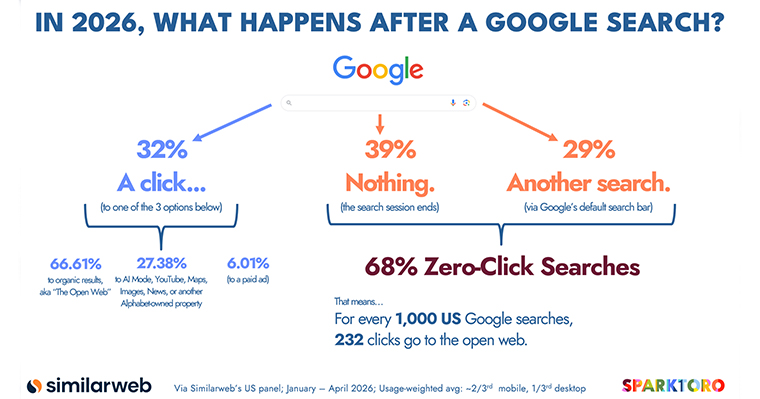
The keynote opened with a look at the state of search traffic. Google referral traffic to publishers is down 34% year-on-year overall, 68% of searches now end without a click to any publisher site, and bot traffic overtook human traffic for the first time with 57.5% of all Web traffic now automated. Small publishers have been worst hit by the drop in referrals, which have seen a frankly silly 60% drop over the last two years.
What does this mean in practical terms? Wilkinson’s piece brings numbers from other parts of the publishing business to turn those search stats into harder-nosed business metrics. It reveals that publisher ad supply — basically, the amount of advertising a publisher has been able to show — fell as much as 40% in the second quarter.
Meanwhile, in three months of 2026, Google’s own search advertising grew 17% to US$63.3 billion.
It’s a bleak story. However, it is echoed by a prediction from the U.K.’s Association of Online Publishers, which projects U.K. publisher referrals will halve by the third quarter of 2027. To put it in the nicest terms, SEO-ing your way to business growth through ad revenue alone isn’t advisable.
As it is, though, I don’t think anyone in publishing thinks that model is ever coming back anyway. Instead, companies are pursuing other more reliable business models. They are turning to the very things media firms have that search and AI firms do not: trust and expertise.
Both of those are under attack, however.
Trust is priceless, not free
At the event, a scientific publisher described receiving 5.7 billion bot requests in a 16-day window — roughly 300 times the normal traffic — as AI scrapers grabbed content at industrial scale without any of the expertise of the people it had taken it from. This led to an AI site recommending an adult pharmaceutical dosage for a child, and a significant legal effort to have the content taken down.
The trust discussion at Glide Live wasn’t purely a philosophical one; it was absolutely about business survival too. As one speaker echoing Wilkinson’s article put it: “Code is no longer a moat — the moat is unique data, clean data, understood data, and trust and brand.”
Wilkinson heard the same thing from Matiur Rahman of Dhaka-based national newspaper Prothom Alo, a proper in-the-thick-of-it journalist who has endured 79 court cases, advertising blockades, and an arson attack. His line from the INMA South Asia festival in New Delhi nailed it: “There is one thing algorithms cannot replicate and no one can destroy, and that is credibility.”
Habits beat volume
A publisher at Glide Live shared what they called the rule of three, which outlined that bringing a new reader back to the site three times in a single week led, in 78% of cases, to long-term retention — a huge success. A little against expectations, the count of pageviews was irrelevant, and it was the number of days per week which indicated growing appeal.
This tracks with Wilkinson’s report of Nalin Mehta, managing editor of Mumbai site Moneycontrol, who revealed newsletter stories, which generated little traffic, would generate a flood of complaints if one was missed. Habit is a big deal!
On Wilkinson’s comments about leveraging archives, I loved reading about La Nación building an in-house semantic archive search that outperforms Google, and NDTV building an answer engine from its own reporting.
These examples mirror what was being said in London. In one London example, a publisher is now licensing its knowledge base to a major tech company precisely because it is AI-free. Your own archive, properly indexed, is the prime asset AI can’t steal from you.
Well, as long as you know how to block errant bots, but that’s a separate discussion.
In London, a special SEO session brought together search specialists Barry Adams, Steven Wilson-Beales, and Harry Clarkson-Bennett. For me, it yielded one of the strongest parallels with Wilkinson’s view: “If you’ve been chasing traffic without investing in retention, loyalty, or subscriptions, you’re exposed. If you have [been investing] you’re probably going to be fine.”
Broadly, the publishers building direct relationships while traffic was still flowing in have more options than those that did not. That’s not to say they can’t, but they are starting late with less time in a market that is worse off.
A familiar model, renewed
Wilkinson’s analysis covered events which took place across a whole week, around the world, while Glide Live was a single day. However, both inescapably arrived at the same conclusions: Relationship is now valued over volume, trust and expertise are primary assets, your archive and your understanding of that archive is a defensible moat, and future revenue cannot depend on Google.
It’s not gloom and doom, and there is always a lot in these sessions giving rise to optimism. Upliftingly, none of what is proving to be a success is conceptually new or revelatory to publishers: Creating good content that is useful to readers isn’t some quantum leap.
Any publishers still deciding whether to act probably should do so, as quickly as they can.
Banner image: Adobe stock by Dilok.
Related Articles
-

Marketers should outsource tasks, not thinking
25 October 2026 -

AI’s effect on super user math
15 September 2026 -

At Mediacorp’s CNA, loyalty means giving audiences a reason to ...
20 August 2026 -

Tribun Network turns print “dots” into AI-powered insight
20 August 2026 -

As AI shifts from crawling to citing, the page stops being the ...
11 August 2026 -

Nation Media Group focuses editorial strategy on stories that m...
4 August 2026 -

Briefly News empowers journalists with AI tool suite Nova
4 August 2026 -

Inside Denník N’s successful subscription strategy
15 July 2026
Upcoming Events
-

Subscriber Acquisition Master Class
10-17 November 2026
-

Media Advertising Summit
New York, United States
07-10 December 2026
-

AI-Native News Product Master Class
18-25 February 2027
-

Media Subscriptions Summit
Oslo, Norway
08-12 March 2027
-

World Congress of News Media
New York, United States
25-30 April 2027
-

Branded Content & Partnerships Master Class
20-27 May 2027
-

Subscriber Retention Master Class
17-24 June 2027
-

Conferencia Latinoamericana
15-16 July 2027
-

South Asia News Media Festival
New Delhi, India
19-22 July 2027
-

Asia/Pacific News Media Summit
19-20 August 2027
-

CEO Roundtable at Kilkenny
Kilkenny, Ireland
24-26 August 2027
-

Media Innovation Week
Amsterdam, The Netherlands
27 September - 01 October 2027








