

UK publishers form SPUR as global AI standards movement accelerates
Digital Platform Initiative Blog | 26 February 2026

Five of the United Kingdom’s most influential news organisations have called for a coordinated response to the unauthorised use of journalism by AI systems, ahead of two pending UK government reports that could have broader global impact.
In an open letter to the media industry, the Financial Times, The Daily Telegraph, the BBC, Comcast’s Sky News, and The Guardian warn the viability of journalism was under threat: “Content is being scraped, copied, and reused with no common standards to enable permission or payment, weakening the economic model that supports journalism.” Without a sustainable business model for journalism, it’s the democratic society that suffers. There need to be independent means for verified information and to hold power to account.
Their new coalition, SPUR, joins a growing global push that has centred on Brussels and Washington, D.C., where publishers and industry bodies have been lobbying for recognition and remuneration of journalism in the AI ecosystem.
Last year, INMA’s Board of Directors published the Basic Principles for News Media for its 26,000 members, drawing on the work of groups including the European Publishers’ Council (EPC) and the U.S. News Media Alliance. The framework calls for consent-based access, fair value exchange, and transparent attribution.
The timing of the formation of SPUR may prove pivotal.
The UK government is due to publish its AI copyright policy and economic impact assessment by March 18. An earlier proposal that would have allowed broad use of copyrighted material for AI triggered strong opposition from IP owners.
In parallel, the UK Competition and Markets Authority is wrapping up what might prove to be a groundbreaking AI inquiry. The results of both reports are expected to influence EU regulators, as they have slowed finalisation of their own plans to amend their AI and copyright acts to include text-and-data mining rules. The CMA has already found news publishers should get more say over how their content is used by Google in AI overviews.
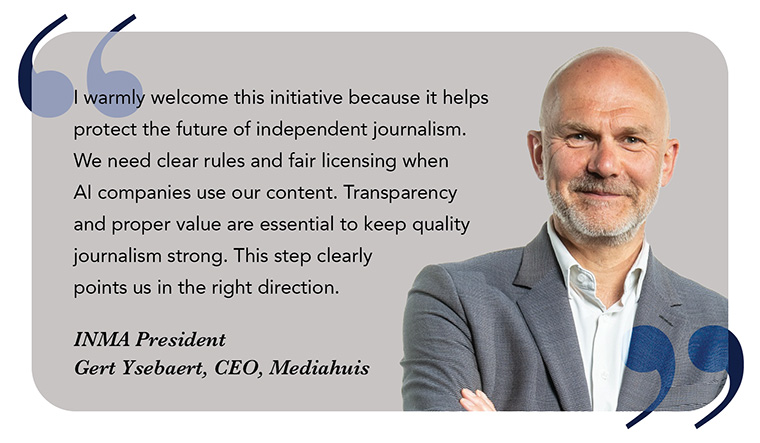
INMA President Gert Yserbart, CEO of Mediahuis, welcomed the SPUR campaign as helping “protect the future of independent journalism.” He said “clear rules and fair licensing” were needed when AI companies use publisher content, with transparency and proper value “essential to keep quality journalism strong.”
With the BBC’s involvement being particularly noteworthy, the SPUR announcement was signed by the CEOs of the five organisations: Tim Davie, BBC director-general; Jon Slade,CEO, Financial Times; Anna Bateson, CEO, The Guardian;David Rhodes, executive chairman, Sky News; and Anna Jones, CEO, Telegraph Media Group.
At the centre of SPUR’s project is a push for shared technical and commercial frameworks that authorise AI access to journalism.
Aside from Google, few major AI model companies have struck commercial deals with publishers. This realisation has accelerated the pivot instead towards scalable, interoperable standards for licensing, tracking, and payment.
That standards’ layer is beginning to emerge.
Frameworks such as Really Simple Licensing (RSL), a global non-profit, and x402, a crypto-based protocol, are being built for machine-to-machine licensing, usage tracking, and automated payments at scale, with in-built permissions, pricing, and auditing.
RSL co-founder Doug Leeds welcomed the initiative taken by the UK media houses, especially noting the involvement of The Guardian, which was part of RSL’s first 1,500 partners. “Fragmentation will not solve this challenge; shared standards paired with collective licensing will,” he said.
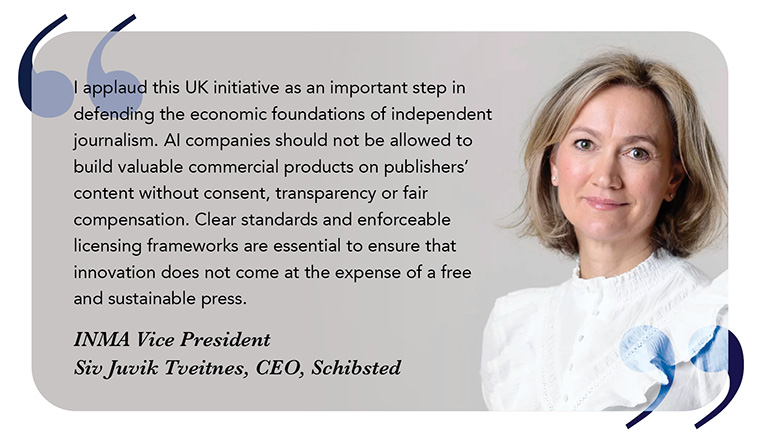
The chair of INMA’s Digital Platform Initiative committee, Schibsted CEO Siv Juvik Tveitnes, said the latest UK move marked an important step in defending journalism’s economic foundations. AI companies “should not be allowed to build valuable commercial products on publishers’ content without consent, transparency, or fair compensation.” Enforceable standards, she said, were essential to ensure innovation does not come at the expense of a free and sustainable press.
INMA will host an invitation-only forum on AI deals, copyright, and open standards on May 8 at its World Congress of News Media in Berlin under Chatham House rules.Contact Ioana Straeter for more information.
Related Articles
-

Marketers should outsource tasks, not thinking
25 October 2026 -

WSJ executive councils show how publishers build communities th...
19 October 2026 -

Bundling is a pricing decision, rebundling is an organisational...
18 October 2026 -

AI’s effect on super user math
15 September 2026 -

At Mediacorp’s CNA, loyalty means giving audiences a reason to ...
20 August 2026 -

Tribun Network turns print “dots” into AI-powered insight
20 August 2026 -

Nation Media Group focuses editorial strategy on stories that m...
4 August 2026 -

Briefly News empowers journalists with AI tool suite Nova
4 August 2026
Upcoming Events
-

Subscriber Acquisition Master Class
10-17 November 2026
-

Media Advertising Summit
New York, United States
07-10 December 2026
-

AI-Native News Product Master Class
18-25 February 2027
-

Media Subscriptions Summit
Oslo, Norway
08-12 March 2027
-

World Congress of News Media
New York, United States
25-30 April 2027
-

Branded Content & Partnerships Master Class
20-27 May 2027
-

Subscriber Retention Master Class
17-24 June 2027
-

Conferencia Latinoamericana
15-16 July 2027
-

South Asia News Media Festival
New Delhi, India
19-22 July 2027
-

Asia/Pacific News Media Summit
19-20 August 2027
-

CEO Roundtable at Kilkenny
Kilkenny, Ireland
24-26 August 2027
-

Media Innovation Week
Amsterdam, The Netherlands
27 September - 01 October 2027








