

Q4 earnings indicate the post-traffic playbook is working
Advertising Initiative Blog | 25 February 2026

Over the past few weeks, a wave of Q4 and full-year 2025 earnings reports have rolled in from a wide set of publishers in the U.S., UK, and beyond. And while no one would call this period easy for news media, the picture that’s emerging is far more nuanced and encouraging than the prevailing narrative of decline.
The burst of publisher financial reporting came with some sharp contrasts. The Washington Post announced devastating cuts on the same day The New York Times reported its strongest advertising quarter in years.
I don’t say this with any joy, and a whole host of others have said it much better than I can, but the juxtaposition shows how important strategy, execution, and diversification are to ensuring survival in our business.
The New York Times: digital advertising accelerates
The New York Times reported Q4 2025 revenue of US$802 million, up 10.4% year-over-year. Adjusted operating profit rose nearly 13% to US$192 million. The company added approximately 450,000 net digital-only subscribers in the quarter, ending the year with 12.78 million total subscribers.
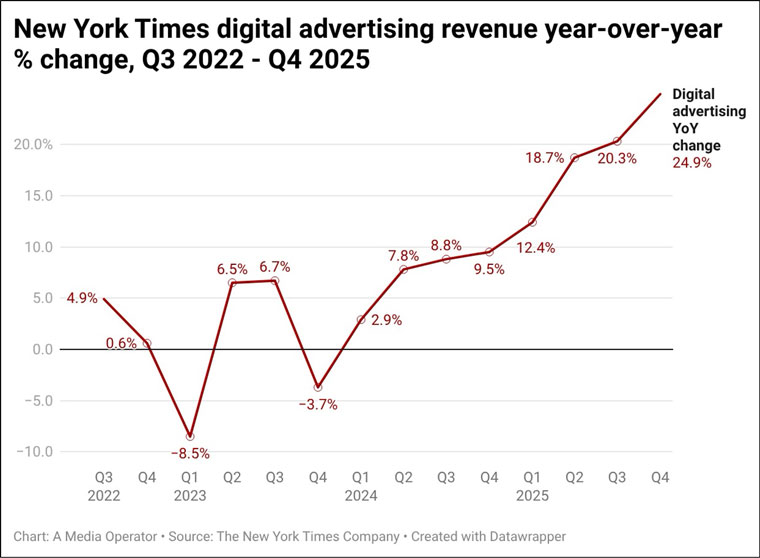
The advertising story is particularly notable. Digital advertising revenue rose 24.9% in Q4 to US$147.2 million, continuing an acceleration that has seen higher year-over-year growth every quarter since Q4 2023. For the full year, digital ad revenue was up 20% to US$410.6 million, helping The Times cross US$2 billion in total digital revenue for the first time.
CEO Meredith Kopit Levien attributed the growth to strong marketer demand and new advertising supply, noting The Times now operates at scale across games, sports, cooking, and shopping.
CFO Will Bardeen pointed to the company’s investments in video as a key driver of new ad inventory and format expansion. Total advertising revenue (including print) was up 16% in the quarter, and the company guided toward low double-digit advertising growth in Q1 2026.
The Times is showing that with the right strategy — including premium inventory, first-party data, format innovation, and scaled product surfaces — digital advertising can be a genuine growth engine alongside subscriptions.
People Inc. (formerly Dotdash Meredith): the post-traffic playbook
People Inc. reported its strongest digital revenue growth in five quarters in Q4, with digital revenue up 14% to US$355 million. For the full year, digital revenue reached US$1.1 billion.
What makes People Inc.’s results especially instructive is they were achieved despite a 13% decline in core Web site sessions, driven primarily by Google AI Overviews reducing search referrals. The company has seen a 50% decline in Google search referrals over the past two years. Google AI Overviews now appear on 70% of top People Inc. queries.
The growth came instead from what People Inc. calls “non-session-based revenue,” which grew 37% year-over-year in Q4 and now accounts for 38% of total digital revenue. This includes events, creator and social revenue, Apple News partnerships, AI content licensing deals (with OpenAI, Microsoft, and Meta), and the company’s proprietary contextual targeting platform D/Cipher.
CEO Neil Vogel was direct about the strategy: The model is built on strong growth from non-session-based revenue streams, off-platform audiences, and D/Cipher, while absorbing continued declines in search referral traffic.
The advertising breakdown: Digital advertising was up 9%, performance marketing (largely affiliate) up 17%, and licensing and other categories up 46%. Premium advertising categories including health, pharma, finance, and entertainment were particularly strong. Off-platform views nearly doubled over the past two years, growing 43% year-over-year in Q4.
People Inc. is also making events a core growth pillar, with more than 60 events planned for 2026, including People Magazine’s first major consumer event. IAC’s full-year 2026 guidance projects People Inc. adjusted EBITDA of US$310-US$340 million, with both digital revenue and digital EBITDA expected to grow mid-to-high single-digits.
Dow Jones/News Corp: record digital ad revenue
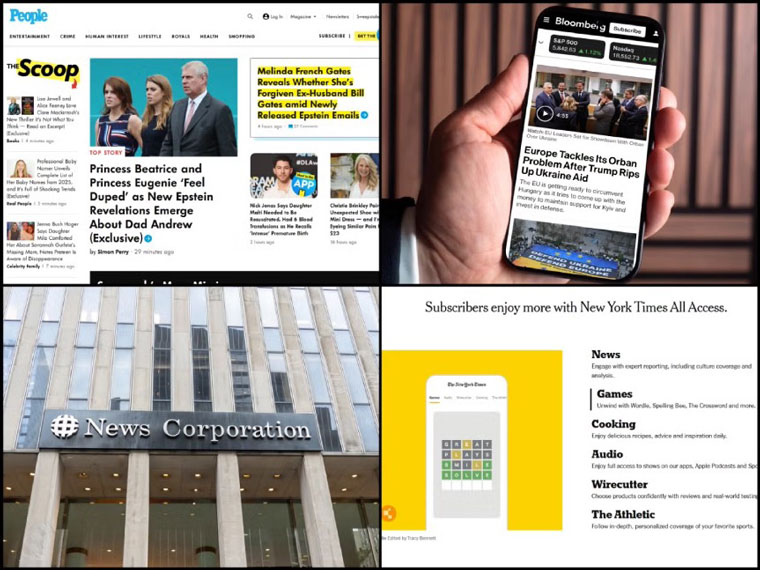
Dow Jones, publisher of The Wall Street Journal, reported 7% revenue growth in the six months to December 2025, reaching US$1.2 billion. Adjusted EBITDA for the segment was up 10% to $335 million, with an EBITDA margin approaching a record 30%.
The advertising detail stands out: Dow Jones reported record digital advertising revenue, up 12%, alongside a 7% increase in print advertising in Q2. Digital advertising now makes up 65% of total ad revenue, up from 64% a year earlier.
The Wall Street Journal now has 4.29 million digital-only subscriptions. News Corp’s book publishing business (HarperCollins) also had a record quarter, powered by the BookTok phenomenon.
Bloomberg Media: events and subscriptions drive growth
Bloomberg Media, which doesn’t publish exact financials, disclosed that total revenue grew 6% in 2025. Subscriptions revenue increased 10%, while total advertising and sponsorship revenue grew 5%.
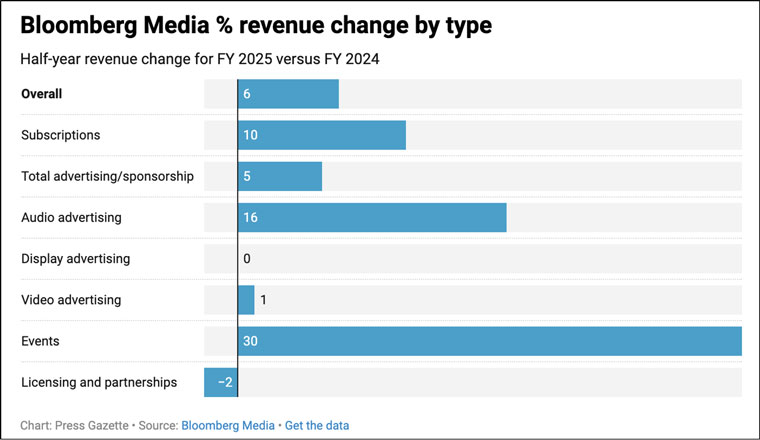
Within advertising, the breakdown is telling. Live event sponsorships grew 30%. Audio advertising was up 16% (driven by 36% growth in podcasts). Video advertising across linear, digital, and streaming was up 1%. Digital display advertising was close to flat.
The advertising business posted an 82% client retention rate, and every international market finished up in total ad revenue (Europe +11%, Asia-Pacific +8%, Middle East & Africa +6%, North America +3%).
Bloomberg’s paying subscriber base now exceeds 707,000, up from 660,000 six months earlier. CEO Karen Saltser emphasised the value of a diversified revenue model where each business line reinforces the others.
Hearst: record performance, powered by B2B
Hearst, the 138-year-old media conglomerate, posted record revenues and profits for the second consecutive year. Revenue grew 3% to US$13.5 billion.
The B2B story is the headline here. Hearst’s business media division now accounts for approximately 60% of the company's profits, up from less than 10% just 15 years ago. Fitch Group, the bond-rating agency Hearst acquired fully in 2018, is the single biggest contributor. Health-care software, aviation data, and automotive services companies round out the B2B portfolio.
CEO Steve Swartz noted Hearst’s newspapers and television stations also beat budgeted numbers, and the company’s diversified portfolio provided resilience. Hearst has no net debt and is positioned for further acquisitions.
For advertising teams, the Hearst story is a reminder that B2B media — with its proprietary data, specialised audiences, and essential information services — represents a viable growth path even as consumer advertising faces structural pressure.
Thomson Reuters: organic revenue up 7%
Thomson Reuters reported full-year revenues of US$7.5 billion, with organic revenue growth of 7%. The “big three” segments (legal, corporates, tax and accounting) reported 9% organic revenue growth and comprised 82% of total revenues. The company’s 2026 outlook projects organic revenue growth of 7.5% to 8.0%, with continued EBITDA margin expansion. Reuters News revenue was up 3% in Q4.
The Economist Group: record year and growing subscriptions
The Economist Group posted record revenue of £368.5 million for its most recent full year, with first-half 2026 revenue up 4% (7% at constant currency) to £170.3 million and profit before tax up 28%. Subscriptions reached 1.255 million, up 6% year-over-year.
The results came as the Rothschild family put its 9.99% stake up for sale at a valuation implying roughly £1 billion for the group.
Others: a broad trend
The positive signals extend further:
Semafor celebrated its first profitable year and is expanding, with events a key revenue driver. Its flagship World Economy Summit will expand to five days and double in size in 2026.
Atlas Obscura posted its first annual profit in 16 years, with revenue of US$18.3 million and a US$2.6 million return.
Outside Interactive posted its first profit ever on US$125 million in revenue (up 23%), with digital subscription and recurring services now comprising 60% of revenue, compared to 70% from advertising in 2021.
Haymarket Group reported £11.5 million in annual profits on £175 million in turnover, noting strong performance in Asia and continued digital diversification.
The Hill grew Q4 traffic 14% year-over-year to 33.4 million unique visitors, making it the largest dedicated U.S. political news Web site, in a market where most of the top 50 U.S. news sites are losing traffic.
Even publishers facing headwinds showed resilience:
DMGT (publisher of the Daily Mail) saw digital advertising revenue fall 15% due to traffic lost to AI Overviews, but adjusted operating profit was still up 11% group-wide thanks to cost management, subscription growth (up 10%), and a growing property information business.
LADbible Group grew total revenue 7% to £92.2 million by shifting toward direct brand deals (up 29% in the U.S.) and away from volatile programmatic and platform revenue.
If you’d like to subscribe to my bi-weekly newsletter, INMA members can do so here.
Banner photo: Adobe Stock By RIFKI DWI.
Related Articles
-

How four publishers are winning advertisers with quality over v...
26 October 2026 -

What’s really defensible in the age of AI?
30 August 2026 -

Newsday’s Together Long Island initiative unites companies and ...
13 August 2026 -

Latin American publishers must rewrite ad strategies around out...
20 July 2026 -

ABP’s Anandabazar.com makes Durga Pujo more accessible to audie...
22 April 2026 -

News companies translate measurement into commercial results
2 April 2026 -

How publishers are capturing the value of quality engagement fo...
1 April 2026 -

3 Swedish publishers support decision to expel Meta from IAB Sw...
18 March 2026
Upcoming Events
-

Subscriber Acquisition Master Class
10-17 November 2026
-

Media Advertising Summit
New York, United States
07-10 December 2026
-

AI-Native News Product Master Class
18-25 February 2027
-

Media Subscriptions Summit
Oslo, Norway
08-12 March 2027
-

World Congress of News Media
New York, United States
25-30 April 2027
-

Branded Content & Partnerships Master Class
20-27 May 2027
-

Subscriber Retention Master Class
17-24 June 2027
-

Conferencia Latinoamericana
15-16 July 2027
-

South Asia News Media Festival
New Delhi, India
19-22 July 2027
-

Asia/Pacific News Media Summit
19-20 August 2027
-

CEO Roundtable at Kilkenny
Kilkenny, Ireland
24-26 August 2027
-

Media Innovation Week
Amsterdam, The Netherlands
27 September - 01 October 2027








