

Washington Post’s new model reimagines publisher-content creator partnerships
Digital Strategies Blog | 02 August 2026

For years, publishers have watched creators through the lens of competition. They worried about audiences migrating to YouTube, TikTok, podcasts, and newsletters while journalists increasingly leave established newsrooms to build businesses of their own.
That perspective captures only half of what’s happening.
As creators grow into media businesses, they begin encountering challenges publishers have spent decades learning to solve. Speaking at Connect London 2026, hosted by Arc XP, Sara Goo, president of Washington Post Creators, argued this shift presents publishers with a different opportunity.
Rather than trying to compete with creators for attention, publishers can become partners by providing the commercial, editorial, and operational support independent creators increasingly need as they grow.
Creators have solved one problem; the next one looks familiar
One reason creators have become so influential is they have mastered audience building. Across topics ranging from personal finance and health to politics and travel, individuals have built loyal communities around expertise rather than institutional brands.
Research Goo shared from the Reuters Institute and Associated Press suggests those relationships are becoming increasingly important, particularly among younger audiences who now consume news through social platforms and creators as readily as they do traditional news organisations.
Those audience relationships have become the creator economy’s greatest strength. They have also changed the kinds of businesses many creators are running. What often begins as a single person sharing expertise can quickly evolve into a media business with sponsorships, commercial partnerships, and growing expectations around consistency and credibility. The work extends well beyond producing engaging content.
That evolution is where Goo believes publishers should reconsider where they create value. “Rather than getting depressed about this data, I actually think the good news is that there’s opportunity here,” Goo said.
Her optimism stems from a practical observation: While creators have become experts at building communities, publishers have spent decades developing the systems supporting sustainable media businesses.
Relationships with advertisers, sponsorship sales, legal review, editorial oversight, and established commercial operations may not attract audiences on their own, but they become increasingly valuable as creator businesses mature.
Washington Post Creators tests a different partnership model
That thinking shaped the launch of Washington Post Creators, a business unit operating separately from both the newsroom and opinion section.
Rather than asking journalists to become creators or hiring creators to produce traditional Washington Post journalism, the initiative focuses on partnerships with independent experts who have already built engaged audiences around their subject matter.
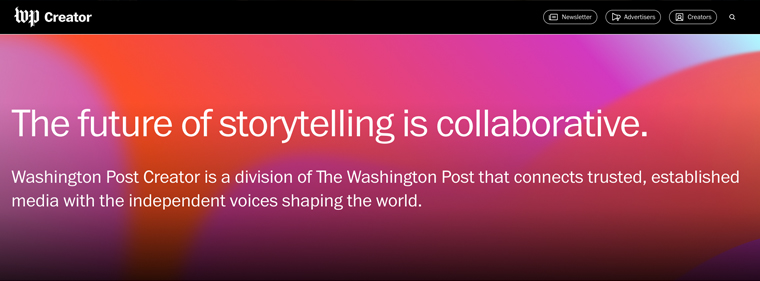
The model is intentionally collaborative. Creators produce content in their own voice while The Washington Post contributes fact-checking, legal review, distribution across its own platforms, and sponsorship sales.
Revenue from those sponsorships is shared, giving creators access to capabilities that would be difficult to build independently while allowing the publisher to introduce its brand to entirely new audiences.
For Goo, the model demonstrates publishers do not have to choose between protecting their editorial identity and participating in the creator economy. Their contribution is different. Rather than trying to replicate what successful creators already do well, publishers can strengthen the businesses creators are already building.
That distinction also changes how publishers think about their own assets. Sales organisations, legal teams, editorial standards, and long-standing advertiser relationships are often viewed as internal functions supporting journalism. In a creator economy, they can also become services creating value for partners.
Trust becomes part of the business model
The implications extend beyond creators themselves.
Many advertisers recognise creator-led media has become an important way to reach younger audiences. Working directly with creators, however, can be difficult to scale. Brands must identify partners, negotiate contracts, evaluate reputational risk, monitor disclosures, and manage numerous individual relationships.
For many marketers, that process is resource-intensive and difficult to standardise. Publishers already understand how to solve those problems.
Goo explained Washington Post Creators developed its own ethics framework, reviews potential conflicts of interest, applies editorial and legal oversight, and emphasises transparency throughout the partnership process.
Those safeguards are designed to protect the publisher’s reputation, but they also provide advertisers with greater confidence in the environment surrounding sponsored content.
For creators, those same systems remove many of the operational burdens that accompany growth. This allows them to remain focused on developing content while relying on an experienced partner to support the business behind it.
The relationship only works, Goo argued, if publishers recognise creators as businesses rather than simply another distribution channel.
“They should be your partners. They’re each their own small business,” she said.
She noted many creators have walked away from previous media partnerships feeling they were valued primarily for the audiences they could deliver. Sustainable partnerships require both sides to benefit, with creators viewed as long-term collaborators rather than short-term marketing opportunities.
Where publishers fit next
Creator advertising is expected to generate US$44 billion this year, according to figures Goo shared during the session. As investment continues to flow into the market, technology companies, talent agencies, marketing firms, and media organisations are all competing to define their role within the creator economy.
For publishers, that competition may be less about producing creator-style content than about recognising where their competitive advantage already exists. Audience behaviour has changed dramatically, but the need for trusted commercial relationships, editorial credibility, operational expertise, and sustainable business models has not.
The creator economy has transformed how people discover information. It is now reshaping how independent media businesses are built.
Publishers recognising that shift early may find their greatest opportunity lies not in becoming creators themselves, but in helping the next generation of creator businesses grow with the support of institutions that understand how enduring media companies are built.
Related Articles
-

Bundling is a pricing decision, rebundling is an organisational...
18 October 2026 -

Agents, liquid content, vibe coding raise questions for news me...
9 September 2026 -

What news CEOs are investing in — and what they are killing
8 September 2026 -

Nation Media Group focuses editorial strategy on stories that m...
4 August 2026 -

Grupo RBS builds social-first video operation to expand audienc...
20 July 2026 -

AI adoption in newsrooms should move from experiment to strateg...
12 July 2026 -

Why are audiences going to AI answer engines for news?
30 June 2026 -

Bonnier News Local, Gota Media strike gold with their Core Mode...
21 June 2026
Upcoming Events
-

Subscriber Acquisition Master Class
10-17 November 2026
-

Media Advertising Summit
New York, United States
07-10 December 2026
-

AI-Native News Product Master Class
18-25 February 2027
-

Media Subscriptions Summit
Oslo, Norway
08-12 March 2027
-

World Congress of News Media
New York, United States
25-30 April 2027
-

Branded Content & Partnerships Master Class
20-27 May 2027
-

Subscriber Retention Master Class
17-24 June 2027
-

Conferencia Latinoamericana
15-16 July 2027
-

South Asia News Media Festival
New Delhi, India
19-22 July 2027
-

Asia/Pacific News Media Summit
19-20 August 2027
-

CEO Roundtable at Kilkenny
Kilkenny, Ireland
24-26 August 2027
-

Media Innovation Week
Amsterdam, The Netherlands
27 September - 01 October 2027








