

AI search should complement SEO strategy, not replace it
Digital Subscriptions Blog | 05 October 2026

Generative AI has grown rapidly, with recent reports showing ChatGPT surpassing 900 million weekly active users worldwide. Along with that growth has come a new alphabet soup for marketers: GEO (generative engine optimisation), AEO (answer engine optimisation), LLMO (large language model optimisation), take your pick.
For those of us who have spent years in SEO (search engine optimisation), it has also fueled a familiar narrative: “SEO is dead.”
The data tells a different story. AI search is changing how people discover and consume information, but it is not replacing traditional search. The two increasingly coexist and, in many cases, rely on the same foundations.
Here are four reasons AI search should work alongside your SEO strategy, not replace it.
1. Organic search remains a meaningful traffic driver
The first — and perhaps most obvious — is that organic search remains a significant driver of traffic. Yes, we have witnessed a considerable decline over the past several years with the rise of “zero-click” searches and Google expanding its own GenAI features like AI Mode and AI Overviews. However, even with the headwinds, organic search remains one of the most significant contributors of external traffic to organisations.
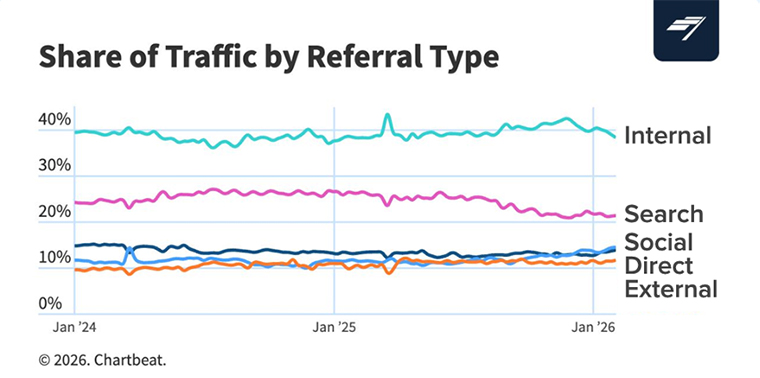
A recent Chartbeat study found that search remains the second-largest source of traffic to publishers, behind only internal traffic.
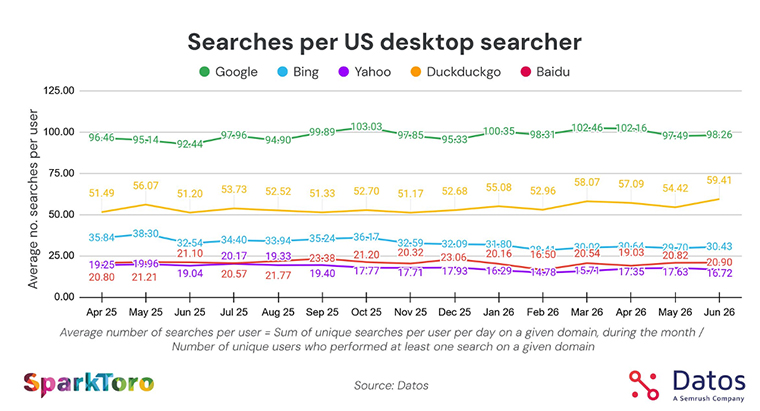
Furthermore, Datos’ State of Search report for the second quarter of 2026 found traditional search volume has remained stable over the past several years, with Google continuing to comprise the lion’s share. While traditional search traffic may be declining, search usage is not.
At the same time, AI platforms still account for less than 1% of publisher pageviews in Chartbeat’s analysis. That does not diminish the importance of AI discovery, but it does mean traffic alone is the wrong reason to abandon SEO.
2. There is massive overlap between GenAI and traditional search usage
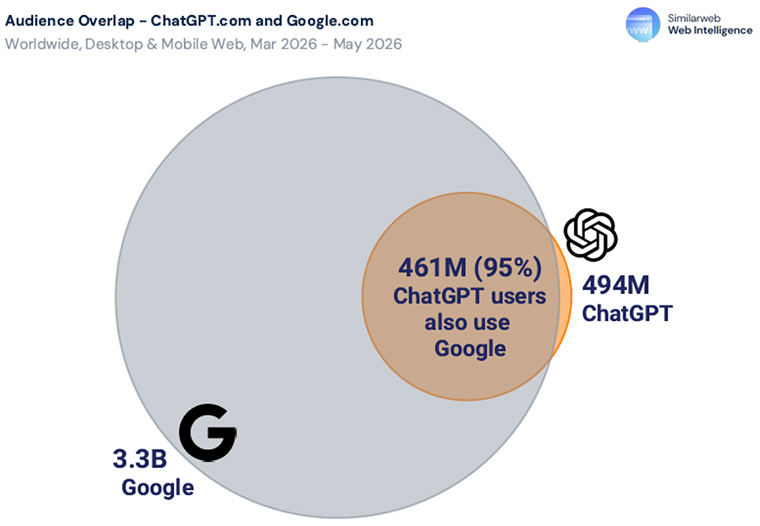
Investing in generative AI versus traditional SEO is not an either/or proposition. According to a recent SimilarWeb report, 95% of ChatGPT users are also using Google, a strong indication that generative AI is expanding how users find information, but not at the expense of traditional search.
3. Search behaviour differs across GenAI and traditional search
Traditional search typically begins with a query and leads users to external sources for information. And while search results have evolved to provide more answers directly on the page, clicking through to a Web site remains a core part of the experience.
GenAI platforms like ChatGPT support a different behaviour. Users engage in a conversation, refining their questions and receiving synthesised answers directly within the platform rather than navigating a list of results.
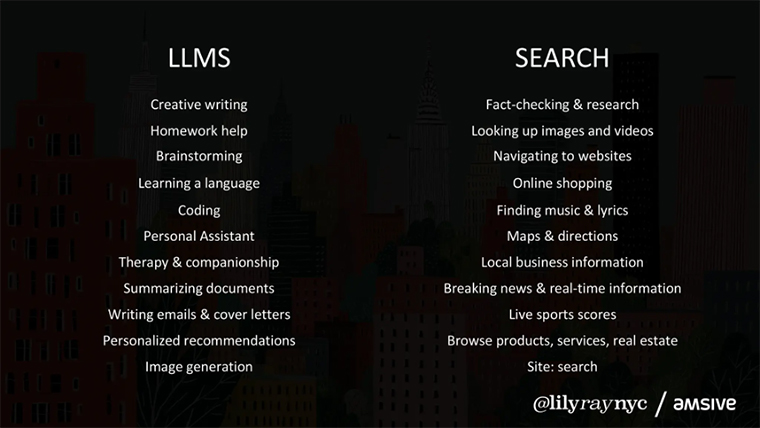
The use cases for large language models (LLMs) and traditional search can vary greatly. A comparison from SEO and AI search consultant Lily Ray frames this well.
4. The tactics for SEO and GEO are fundamentally the same
The tactics for maximising visibility in AI and traditional search are largely the same — and Google’s own guidance reinforces this point. Look no further than its AI optimisation guide, which offers the following recommendations:
- “Apply foundational SEO best practices to generative AI search.”
- “Continue prioritising foundational SEO best practices, such as building a clear technical structure and creating unique, valuable content; these are the foundation for visibility in generative AI search experiences (and Google Search overall).”
A successful AI search strategy cannot exist without a strong SEO foundation. Although the indicators of success may differ — rankings and click-through rates in traditional search versus citations, visibility and brand sentiment on AI platforms — the underlying approach remains largely the same.
At The Washington Post, we are protecting the SEO fundamentals that continue to drive meaningful audience growth while adapting our measurement and optimisation strategy for generative AI.
In practice, that means maintaining a strong technical foundation, producing authoritative and distinctive journalism, and structuring content so it is easy for both people and platforms to discover, understand, and trust. Rather than treating SEO and AI search as competing priorities, we see them as complementary parts of a broader discovery strategy.
Banner image: Adobe stock image by Animonday.
Related Articles
-

Marketers should outsource tasks, not thinking
25 October 2026 -

Bundling is a pricing decision, rebundling is an organisational...
18 October 2026 -

AI’s effect on super user math
15 September 2026 -

The front door is gone — and Asia-Pacific publishers are rebuil...
26 August 2026 -

At Mediacorp’s CNA, loyalty means giving audiences a reason to ...
20 August 2026 -

Tribun Network turns print “dots” into AI-powered insight
20 August 2026 -

Nation Media Group focuses editorial strategy on stories that m...
4 August 2026 -

Briefly News empowers journalists with AI tool suite Nova
4 August 2026
Upcoming Events
-

Subscriber Acquisition Master Class
10-17 November 2026
-

Media Advertising Summit
New York, United States
07-10 December 2026
-

AI-Native News Product Master Class
18-25 February 2027
-

Media Subscriptions Summit
Oslo, Norway
08-12 March 2027
-

World Congress of News Media
New York, United States
25-30 April 2027
-

Branded Content & Partnerships Master Class
20-27 May 2027
-

Subscriber Retention Master Class
17-24 June 2027
-

Conferencia Latinoamericana
15-16 July 2027
-

South Asia News Media Festival
New Delhi, India
19-22 July 2027
-

Asia/Pacific News Media Summit
19-20 August 2027
-

CEO Roundtable at Kilkenny
Kilkenny, Ireland
24-26 August 2027
-

Media Innovation Week
Amsterdam, The Netherlands
27 September - 01 October 2027








