

Stavanger Aftenblad built a powerful subscription driver by covering all runners
Ideas Blog | 19 July 2026

Some people buy a newspaper to read the news. Others buy it to find their own name in it.
For years, I’ve been struck by the role The New York Times plays in the New York Marathon. People buy the print edition to find the page where their name appears. Some of them frame the page and hang it on the wall — before filming it and posting it on TikTok and Instagram. Not because they won, but because they completed something that mattered to them — and a major newspaper made them part of the story.
At Stavanger Aftenblad, this sparked a simple question: Could we create something similar for runners in our own region, only in a visual, digital form? Not just a results page but a service that makes people feel recognised and gives them something they want to keep, share, and pay for.
That was the start of RUN.
We launched it at exactly the right moment. Running is in the middle of a global boom, and in our region, the trend is even stronger. Our region has a strong running culture and is home to some of the fastest runners in the world, including the Ingebrigtsen brothers.
This combination gave us a clear opportunity: build a service for a growing audience that already cares deeply about running.
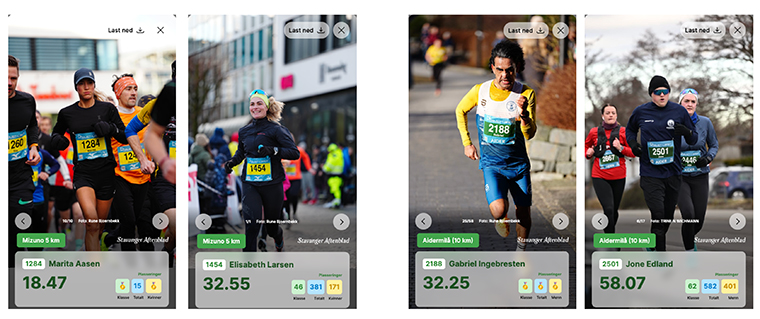
Results for regular runners, not just winners
In practical terms, we built a real-time results service for the growing number of recreational races across Rogaland: 5Ks, 10Ks, half marathons, and marathons. We connect race results with photos we take along the course and create shareable “cards” that combine the runner’s image, result, and the Aftenbladet logo. They are made for Strava and other social platforms.
This changed our perspective as a newsroom. Traditionally, race coverage focuses on the winners. We wanted to include everyone. That made our coverage more accessible and more in tune with what running really is for most people: a personal best, a finish line or a shared experience. RUN reflects all of these goals and makes race coverage more inclusive and more engaging.
Race stories and result services were already strong sellers for Stavanger Aftenblad. But this experience used to be fragmented, hard to search, and unpredictable from one race to another. With RUN, we built a better product with a team of Web developers, AI specialist, UX designer, and a photographer — all from Schibsted and Stavanger Aftenblad.
Rethinking the process
We built a workflow where our photographers deliver images in real time while races are still ongoing. We built technology that connects photos and results faster and more precisely. And we made it possible to cover many more races across the region than before. We can send one photographer to a valley, a small town, or a rural community – and let the technology do the rest.
RUN has changed our local news coverage in an important way. People experience that their newspaper is present where they live and run. And because we publish as the race unfolds, people can follow the event live through updates and images as if the runners were professional athletes.
Technology plays a key role in the success of RUN. Still, one key lesson is that technology does not drive itself. You cannot launch a new product and assume it will succeed on its own.
To take it further, we assigned a skilled journalist with knowledge and close contact with the audience. Inga, an experienced runner herself, became that person.
She oversees RUN day to day, engages directly with the running community, follows up with partners, sees what needs adjusting, and brings energy and credibility to the project. The technology connects a bib number to a result, but Inga connects the product to people. That makes a huge difference.
RUN has become a commercial success. Every time there is a race, RUN rises to the top of Stavanger Aftenblad’s subscription charts. This project has turned into one of our biggest subscription drivers.
Related Articles
-

Hearst Newspapers use generative AI to expand civic coverage
3 September 2026 -

With Düsseldorf geht aus, Rheinische Post brings local gastrono...
14 July 2026 -

Dow Jones turns complex B2B data into “prosumer” content with c...
13 July 2026 -

Australian Community Media reinvents its travel brand, unlocks ...
30 June 2026 -

La Nación explores historic corruption case with unprecedented ...
16 June 2026 -

In an AI‑driven future, just 2 viable media models exist
27 May 2026 -

Beobachter’s healthcare costs tracker combines journalism, enga...
30 April 2026 -

The Economic Times Digital reinvented itself from news destinat...
16 April 2026
Upcoming Events
-

Subscriber Acquisition Master Class
10-17 November 2026
-

Media Advertising Summit
New York, United States
07-10 December 2026
-

AI-Native News Product Master Class
18-25 February 2027
-

Media Subscriptions Summit
Oslo, Norway
08-12 March 2027
-

World Congress of News Media
New York, United States
25-30 April 2027
-

Branded Content & Partnerships Master Class
20-27 May 2027
-

Subscriber Retention Master Class
17-24 June 2027
-

Conferencia Latinoamericana
15-16 July 2027
-

South Asia News Media Festival
New Delhi, India
19-22 July 2027
-

Asia/Pacific News Media Summit
19-20 August 2027
-

CEO Roundtable at Kilkenny
Kilkenny, Ireland
24-26 August 2027
-

Media Innovation Week
Amsterdam, The Netherlands
27 September - 01 October 2027








