

Hearst Newspapers use generative AI to expand civic coverage
Ideas Blog | 03 September 2026

At Hearst Newspapers (HNP), generative AI is being used to tackle one of local journalism’s biggest challenges: keeping up with public meetings, where important decisions are made in communities across the country.
The DevHub, HNP’s editorial innovation team, created a set of AI-powered tools designed to help journalists and readers follow public agencies more closely without requiring a reporter in every room. The tools, called Assembly and Meeting Monitor, turn lengthy meeting recordings into transcripts, summaries, and alerts that make public information more accessible — both for our newsrooms and for the communities we cover.
Covering key moments in public meetings
Assembly is an internal newsroom tool to help reporters identify newsworthy moments that might otherwise go uncovered. Public meetings often stretch for hours, making it difficult for local newsrooms to monitor every school board, city council, or county commission session. By automating transcription and summarisation, Assembly gives journalists a faster way to find key discussions, track topics, and surface potential story leads, while freeing up time for human verification, interviews, and deeper reporting.
“We work closely with our local newsrooms and heard again and again from reporters and editors about the burden of keeping up with meetings across large coverage areas,” said Tim O’Rourke, founder of the DevHub and HNP’s vice president for editorial innovation and AI strategy. “Assembly quickly became our most-used internal AI tool, with requests for training and new meetings pouring in.”
Since its launch, Assembly has seen rapid adoption across HNP newsrooms. The tool now tracks 460 public agencies across the country, a number that grows each week. It has processed more than 10,000 meetings, saving reporters countless hours.
One of the biggest recent advances came behind the scenes earlier this year, when the DevHub rolled out an agentic AI system to handle newsroom requests to add new agencies to the tool. Requests that once took days or even weeks to fulfil can now be completed in minutes with this new system.
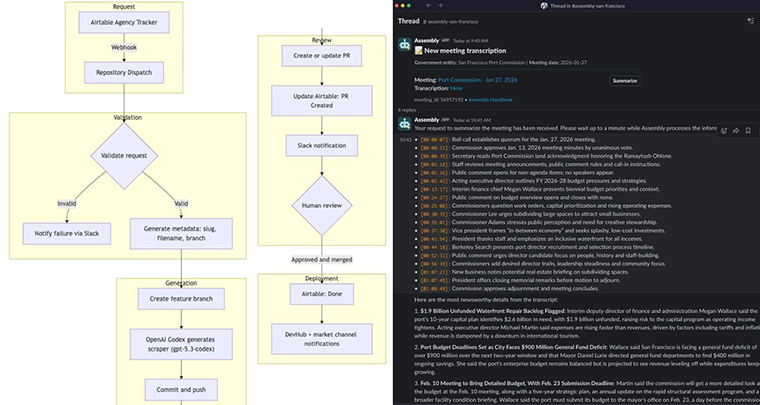
The agentic workflow analyses agency Web sites, generates production-ready code, and submits it for human review before anything goes live to readers. This has removed a major engineering bottleneck while maintaining human oversight, allowing the tool to expand more quickly in response to newsroom needs.
“This tool could have literally saved years of my life,” said Robert Eckhart, senior editor of investigations for HNP’s Houston Chronicle.
Education reporter Kathleen Moore of the Times Union in Albany, N.Y., said the school boards she covers often meet at the same time, making it impossible for her to attend every meeting. Assembly allows her to quickly summarise what happened at the various meetings on her beat.
The broader aim is not to replace journalists, but to support them. Assembly helps reporters find leads and identify moments worth investigating, while the journalism itself still depends on human judgment, verification, and context. The DevHub is continuing to refine the tool with newsroom feedback, including user-experience improvements and new features.
Meeting access for audiences
HNP is also extending the same generative AI technology to readers through Meeting Monitor, a public-facing tool that gives audiences access to meeting transcripts and summaries in a searchable, filterable database. The product was first piloted in Houston in 2025. In March, HNP published a beta version in Connecticut covering eight school districts, marking a second launch for the reader tool. Meeting Monitor is designed to help local communities understand what is happening in public meetings without having to watch hours of video or attend meetings in person.
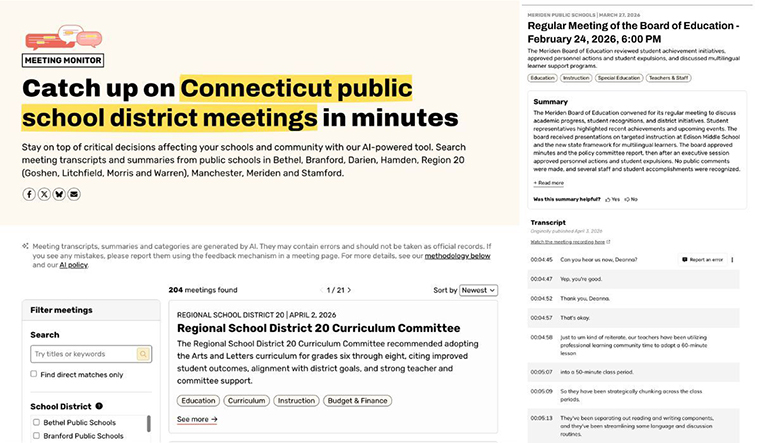
Together, Assembly and Meeting Monitor show how AI can be used responsibly in local journalism to improve both efficiency and transparency when it comes to public meeting coverage.
For reporters, the technology reduces repetitive work and helps expand coverage to a broader set of meetings. For readers, it offers a better view into what is going on in their local agencies and the decisions being made that affect the communities they call home.
Related Articles
-

Marketers should outsource tasks, not thinking
25 October 2026 -

AI’s effect on super user math
15 September 2026 -

At Mediacorp’s CNA, loyalty means giving audiences a reason to ...
20 August 2026 -

Tribun Network turns print “dots” into AI-powered insight
20 August 2026 -

DRIVE, Local_Vocal reinvent local newspapers for the AI age
9 August 2026 -

Nation Media Group focuses editorial strategy on stories that m...
4 August 2026 -

Briefly News empowers journalists with AI tool suite Nova
4 August 2026 -

Toronto Star goes from AI sceptic to true believer after pilot ...
30 July 2026
Upcoming Events
-

Subscriber Acquisition Master Class
10-17 November 2026
-

Media Advertising Summit
New York, United States
07-10 December 2026
-

AI-Native News Product Master Class
18-25 February 2027
-

Media Subscriptions Summit
Oslo, Norway
08-12 March 2027
-

World Congress of News Media
New York, United States
25-30 April 2027
-

Branded Content & Partnerships Master Class
20-27 May 2027
-

Subscriber Retention Master Class
17-24 June 2027
-

Conferencia Latinoamericana
15-16 July 2027
-

South Asia News Media Festival
New Delhi, India
19-22 July 2027
-

Asia/Pacific News Media Summit
19-20 August 2027
-

CEO Roundtable at Kilkenny
Kilkenny, Ireland
24-26 August 2027
-

Media Innovation Week
Amsterdam, The Netherlands
27 September - 01 October 2027








