

Toronto Star goes from AI sceptic to true believer after pilot programme
Newsroom Innovation Initiative Blog | 30 July 2026

Christine Loureiro is the first to acknowledge her scepticism over resuming the comments section for stories at the Toronto Star. But, as the senior editor of audience engagement and live journalism told INMA members during this week’s Webinar, with some help from AI, this has become a powerful tool for growth and engagement.
When the Star first considered reopening comments in 2018, Loureiro said her reaction was visceral: “It was a feeling in the pit of my stomach that said, why would we want to bring people back into our house? We just cleaned it,” she said, recalling her fear that the newsroom would once again be overrun by the digital equivalent of muddy shoes.
Having spent years watching online comments devolve into hostile spaces filled with misinformation and personal attacks, she found the idea of inviting such chaos back onto the Star’s Web site counterintuitive.
But over the next several years, Loureiro’s scepticism transformed into something else entirely: advocacy. Her presentation traced that journey — not just her own, but the newsroom’s — which she likened to a religious experience that took her from doubt to confidence and belief.
The power of partnerships
The turning point, she explained, came through a combination of collaboration, automation, and setting clear boundaries.
The Star partnered with Viafoura, a platform that handles both the technology and moderation of comments using a blend of AI and human review. The system is anchored in a strict code of conduct, and the moderation team is available around the clock.
“Their algorithms and their teams keep an eye on our content,” Loureiro said, adding that “we work in collaboration to give them feedback on their algorithms and things we think it misses.” This allows for continuous improvement and also was key in making a believer out of her.
“The doubt I had at the beginning about people walking all over my clean carpet with dirty shoes on really dissipated when I began to see that moderation in action,” she said.
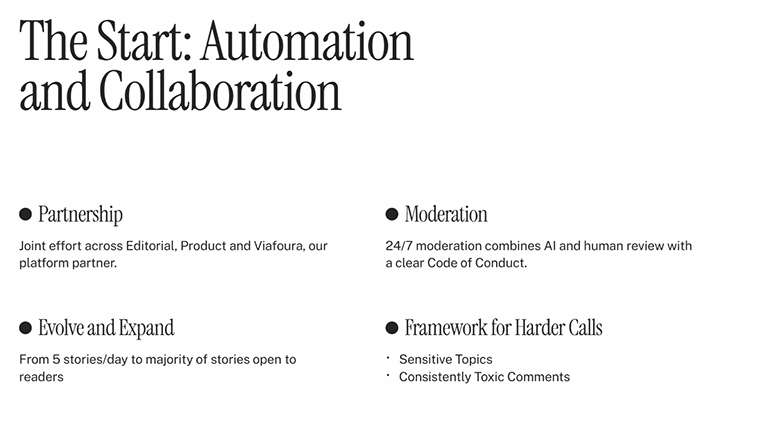
Trust didn’t happen overnight. The Star reopened comments slowly — first on five to 10 stories a day, then on one section, then on news, then on politics. It took two to three years to expand commenting across most of the site.
During that time, internal perception remained wary. Many journalists still saw comments as “a yucky place,” Loureiro said, something the business side might tolerate but reporters avoided unless absolutely necessary.
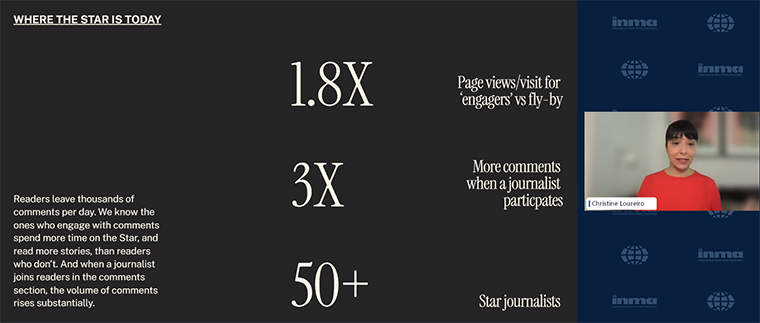
But the data began to tell a different story: Readers who commented spent significantly more time with Star journalism than those who didn’t. Even light engagement — observing, upvoting, or reacting — increased time on site by 1.8%. Active commenters were far more likely to subscribe, and subscribers who commented were less likely to churn. And, importantly, data showed journalist participation dramatically amplified engagement.
“We have three times more comments on a story when a journalist participates than when they don’t,” Loureiro said.
That insight became the foundation for a newsroom-wide shift.
Getting journalist support
To build internal buy‑in, Loureiro and her team launched a pilot programme and invited 10 journalists to participate. They simply had to add comments twice over four weeks; each was given a playbook, a short training session, and the reassurance that moderation would keep the space safe.
The programme was a success and showed how effective journalist participation was. Those 10 journalists quickly became internal advocates, providing a crucial shift in perspective amongst the newsroom.
The playbook played a critical role in the programme’s success; it offered real examples of how to engage when answering questions, clarifying context, hosting Ask Me Anything sessions, or simply greeting familiar readers.
For those who felt unsure — like a personal finance reporter who worried he wasn’t an expert — the team created tailored approaches. For example, he hosted a conversation featuring one of his subject matter experts, allowing him to participate without feeling pressured to have all the answers.
Loureiro emphasised that journalist participation isn’t about debating readers or defending stories; it’s about providing a human element: “Only at the Star could you speak to the investigative reporter that’s been covering a salacious murder for eight years,” she said, describing how one reporter regularly joins the comments after each podcast episode to answer questions. “AI can’t do it. It’s just with us.”
The Star also developed frameworks for difficult situations. Sensitive topics remain open but are moderated both by AI and humans. If a topic becomes consistently toxic, comments are temporarily shut off — and readers are told why:
“We’re making this decision because we can’t guarantee you a space for safe and healthy conversation,” Loureiro said they explain to readers. “You don’t have to agree, but you do have to be constructive. Name‑calling is not allowed.”
AI for story ideation
The Star uses AI not just to moderate comments but to surface journalism opportunities hidden within them, Loureiro shared.
One example is Ontario’s automated speed enforcement cameras — a topic that generated hundreds of comments each time the Star published a story. Comments often included claims that people were being ticketed for driving one or two kilometres over the speed limit. Reporters couldn’t confirm the claims, but the comments were full of anecdotes.
The team exported thousands of comments into a spreadsheet and fed them into Google Gemini, its in‑house chatbot LLM. The team asked it to isolate comments from people who said they’d been ticketed for less than 10 kilometres over the limit, identify themes, and pull unique anecdotes. It even collected e-mail addresses from commenters who claimed to have received such tickets and passed them to the reporter.
This resulted in “a couple of roundup stories,” opened up more conversations with readers, and gave the editorial team a clearer understanding of reader concerns.

AI also helps uncover “hidden gems” — powerful comments left on stories with low engagement. Viafoura sends a daily e-mail highlighting high‑quality anecdotes and persistent questions across the site.
One recent example came from a teacher who commented on an investigation into online gambling, describing how students were losing thousands of dollars through online betting. That comment became a lead for the investigative reporter — something that could easily have been missed without AI.
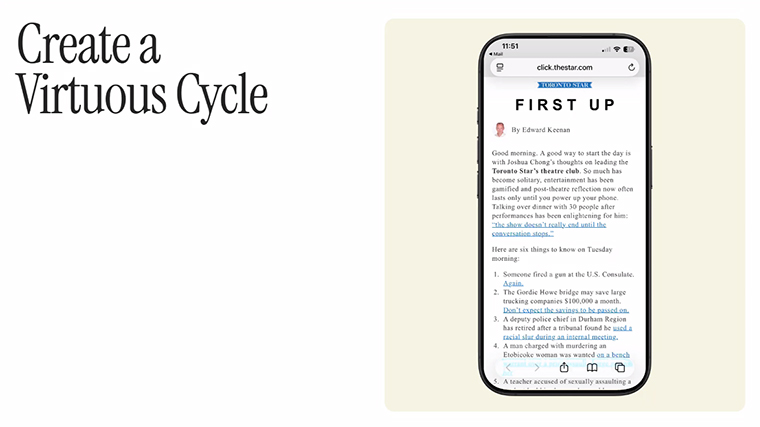
The Star then closes the loop by featuring standout comments in its flagship morning newsletter, creating what Loureiro calls a “virtuous cycle.” Newsletter readers are guided to active comment sections, commenters see their contributions valued, and engagement deepens across both audiences.
Looking ahead, the Star is exploring custom AI copilots to predict future engagement based on historical patterns. The goal is to help editors plan coverage and allocate journalist time more strategically.
“Based on previous performance, I bet that our readers will be deeply engaged with that story and it’s worth a reporter’s time to be in that comment section,” she said.
The team is also expanding its community approach to Reddit: “That’s a little different because it’s less about engagement and more about visibility,” she said.
Banner art: Adobe stock by oum.
Related Articles
-

Marketers should outsource tasks, not thinking
25 October 2026 -

AI’s effect on super user math
15 September 2026 -

At Mediacorp’s CNA, loyalty means giving audiences a reason to ...
20 August 2026 -

Tribun Network turns print “dots” into AI-powered insight
20 August 2026 -

Nation Media Group focuses editorial strategy on stories that m...
4 August 2026 -

Briefly News empowers journalists with AI tool suite Nova
4 August 2026 -

Indian Express builds a video-first future around trusted journ...
20 July 2026 -

Grupo RBS builds social-first video operation to expand audienc...
20 July 2026
Upcoming Events
-

Subscriber Acquisition Master Class
10-17 November 2026
-

Media Advertising Summit
New York, United States
07-10 December 2026
-

AI-Native News Product Master Class
18-25 February 2027
-

Media Subscriptions Summit
Oslo, Norway
08-12 March 2027
-

World Congress of News Media
New York, United States
25-30 April 2027
-

Branded Content & Partnerships Master Class
20-27 May 2027
-

Subscriber Retention Master Class
17-24 June 2027
-

Conferencia Latinoamericana
15-16 July 2027
-

South Asia News Media Festival
New Delhi, India
19-22 July 2027
-

Asia/Pacific News Media Summit
19-20 August 2027
-

CEO Roundtable at Kilkenny
Kilkenny, Ireland
24-26 August 2027
-

Media Innovation Week
Amsterdam, The Netherlands
27 September - 01 October 2027








