

Australian Community Media reinvents its travel brand, unlocks sustainable growth
Ideas Blog | 30 June 2026

For years, publishers have optimised for destinations: building Web sites, growing audiences, and trying to drive loyalty. But audiences don’t behave that way anymore.
At Australian Community Media (ACM), we stopped treating distribution as something that happens at the end and rebuilt Explore, our travel brand, as a network-native product. The result wasn’t just growth; it was a system that delivers it.
Explore wasn’t struggling. It had a clear editorial voice, a loyal audience and strong commercial relationships.
The print section, now published in 28 regional and community newspapers across Australia, was growing week on week. But by early 2025, digital growth on its standalone site, exploretravel.com.au, had settled into a familiar pattern: seasonal spikes, then a return to baseline.
It looked healthy, but it wasn’t scaling.
At the same time, ACM had more than 80 digital mastheads with scale and trust, but no consistent, premium travel product across them. Explore existed, but as a standalone site, it sat outside the network’s daily flow. Explore had the journalism. The network had the audience. They just weren’t set up to work together.
This wasn’t a content problem. It was a product problem.
Redefining the product
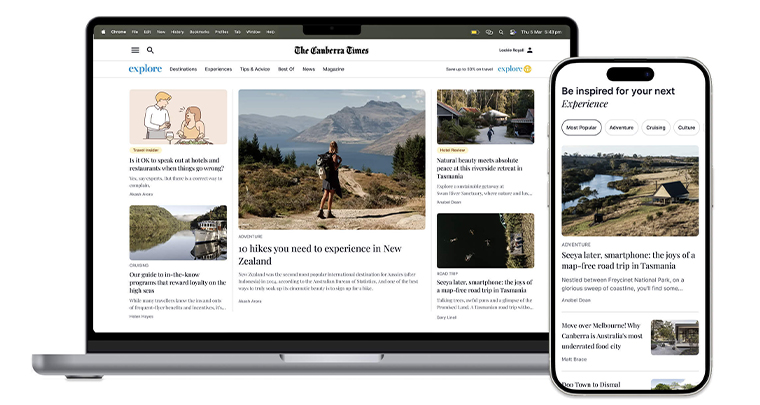
The change wasn’t about pushing Explore harder as a site. It was about redefining what the product needed to be.
Instead of a standalone destination, Explore became something that lives across the network, designed to surface wherever the reader happens to be.
That meant rethinking how stories are made. Not for a homepage, but for feeds, search, and context — whether someone landed from our news site in the coastal city of Newcastle or a late-night Google search. In that environment, readers don’t need to remember where something lives. They just need to recognise it when they see it.
The data had been pointing us in that direction for a while. The stories that consistently performed weren’t our big, glossy features. They were the ones that helped people make decisions: what’s changed, hacks to watch out for, and where the value is. So we developed clearer formats, more consistent packaging and a tone that prioritised what readers needed to know.
What made it work
The biggest shift wasn’t editorial but operational.
In a commission-once model, stories were created with a clear role and then deliberately deployed across the network. This meant better use of good journalism and more consistent output without increasing workload.
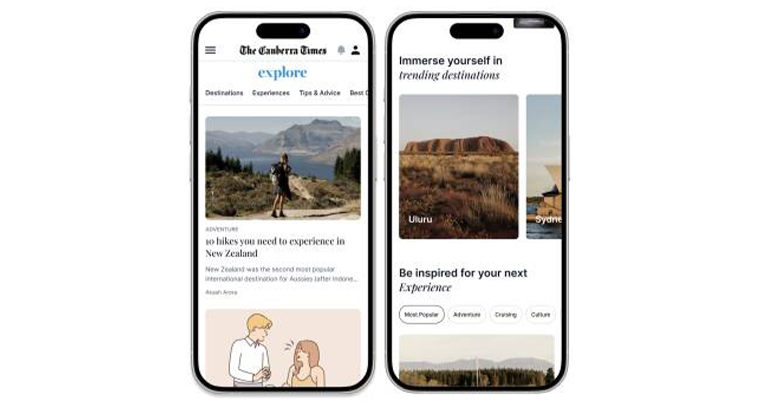
At the network scale, systems matter. Tagging matters. CMS usability matters. Explore backed the shift with a cleanup of taxonomy, workflows, and publishing tools, alongside a cleaner, more useful site, including text-to-audio and improved search.
This work on time-consuming technology, product, and UX quietly underpinned everything else.
Creating growth
Since the April 2025 migration, baseline pageviews grew 270%, and held; organic traffic increased 237%; newsletter traffic increased 291%.
In 2025, Explore reached 2.1 million users, with a monthly average of ~176,000 and a peak of more than 300,000.
The most important shift wasn’t the peak, but the baseline: the audience stopped dropping away between spikes. Growth became something the system delivered — more predictable, more repeatable, and less reliant on one-off wins.
A bigger picture
Some publishers are still trying to solve for growth within a single site — optimising pages, tweaking formats, publishing more. That still matters. But it’s not the whole picture anymore.
Audiences are moving through networks — across titles, platforms and formats — often without thinking too much about where they are, only whether what they’re reading is useful, trustworthy and worth their precious time.
The opportunity is not to push harder within a single site, but to design products that work wherever they land.
The network isn’t just a channel you flick on at the end. It’s the product.
Related Articles
-

At Mediacorp’s CNA, loyalty means giving audiences a reason to ...
20 August 2026 -

Tribun Network turns print “dots” into AI-powered insight
20 August 2026 -

Indian Express builds a video-first future around trusted journ...
20 July 2026 -

Grupo RBS builds social-first video operation to expand audienc...
20 July 2026 -

Inside Denník N’s successful subscription strategy
15 July 2026 -

10 years later, user needs must be twinned with content formats...
1 July 2026 -

Why are audiences going to AI answer engines for news?
30 June 2026 -

Rheinische Post programme turns print loyalty into digital conf...
11 June 2026
Upcoming Events
-

Subscriber Acquisition Master Class
10-17 November 2026
-

Media Advertising Summit
New York, United States
07-10 December 2026
-

AI-Native News Product Master Class
18-25 February 2027
-

Media Subscriptions Summit
Oslo, Norway
08-12 March 2027
-

World Congress of News Media
New York, United States
25-30 April 2027
-

Branded Content & Partnerships Master Class
20-27 May 2027
-

Subscriber Retention Master Class
17-24 June 2027
-

Conferencia Latinoamericana
15-16 July 2027
-

South Asia News Media Festival
New Delhi, India
19-22 July 2027
-

Asia/Pacific News Media Summit
19-20 August 2027
-

CEO Roundtable at Kilkenny
Kilkenny, Ireland
24-26 August 2027
-

Media Innovation Week
Amsterdam, The Netherlands
27 September - 01 October 2027








