

Sports marketing, AI — with a dose of FOMO — take centre stage at Cannes
Innovative Advertising Solutions Blog | 07 July 2026
“Wow, is it ever hot” was, by far, the most overused phrase at the 2026 Cannes Lions International Festival of Creativity. It was a verbal launching pad for most of the week’s sessions, timed precisely to match the heat dome that settled across Europe in late June.
Did it deter any of the thousands of attendees? It did not. There were plenty of electric mini-fans (a popular swag item) and fold-out paper fans among the crowds.
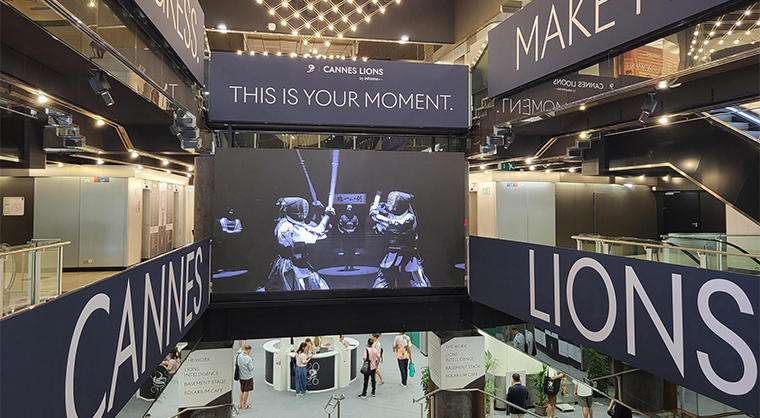
As a first-time attendee, my biggest challenge was suppressing FOMO (fear of missing out). There were so many speakers, across so many venues, hosted by so many brands, it was a huge challenge to achieve scheduling satisfaction. You had to pick your spots, and take comfort in your wins.
With that in mind, here are my top five takeaways from five days at Cannes, the biggest annual gathering of advertisers and marketers on the planet.
1. It’s game on for sports marketing
Cannes has the Palais grounds, the heart of the festival that can only be accessed with an official pass. But over the years, there’s been an expansion along the Croissette, a stretch of waterfront beyond the main staging area, where brands build huge activations.
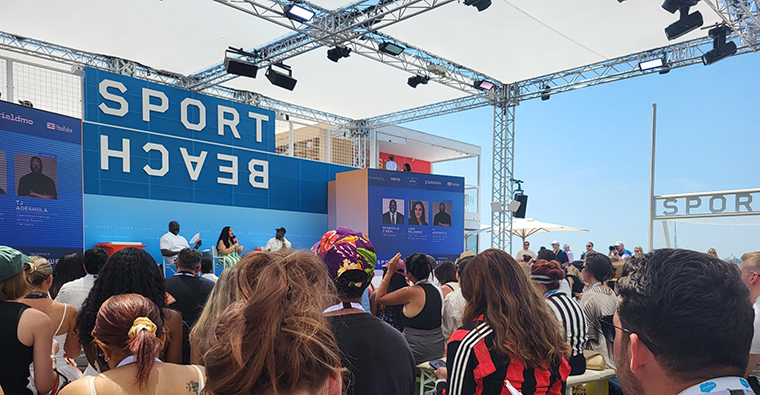
Sport Beach was a highlight, featuring a makeshift stage that hosted a number of active and retired professional athletes and their sponsorship partners. Yes, a creative marketing conference managed to draw a steady stream of NBA stars, tennis icons, F1 drivers, and baseball and hockey players.
It’s something I wasn’t expecting, but clearly their personal brands have become just as important to them as their athletic prowess. I caught former Laker Shaquille O’Neal musing about his collaboration with Eli Lilly, William Nylander of the Toronto Maple Leafs on the value of loyalty, and tennis legend Maria Sharapova on the double-standard female athletes face when it comes to expressing themselves.
2. Creators and influencers rule the roost
Globe Content Studio regularly uses the phrase “human-centered storytelling” with clients, and it’s no secret that younger audiences tend to prefer recommendations and information from individual creators over traditional brands. This means companies are increasingly tapping creators and influencers (the former focusing on content, the latter on curating communities) as the faces of their campaigns.
One of the rotating panels of the CMOs in the Spotlight series featured legacy brands Kraft Heinz, L’Oreal, and McDonald’s. All three representatives stressed the need for a consistent brand narrative — staying true to “timeless” elements — but making space to “mash up” assets and intellectual property (IP). That’s where the creators come in.
The speakers also emphasised that brands need to effectively communicate to those creators about “playing in-bounds” to maintain values and consistency.
3. The AI dance gets more delicate
The most visceral crowd reaction I witnessed came from a slide during a presentation by Alex Jenkins, editorial director of Contagious. It showed a picture of Cannes signage and the “festival of creativity” slogan, but the word “creativity” was crossed out and replaced with “cost-cutting” scrawled crudely above it.
“Cannes isn’t called the festival of cost-cutting,” was his accompanying quip.
It was a nice illustration of the trending tone in AI conversations, highlighted often in Cannes. Nobody was saying don’t use AI, but the vibe is shifting to using AI to find efficiencies in your work, but keeping the humans in charge of creativity.
On a related note, a Future Gazers panel with Shilpa Maniar, principal of full funnel AI experiences at Amazon Ads, said AI is giving humans more downtime, which provides space for improved creative judgment at scale.
4. Mel Robbins is everywhere (or so it seemed)
Do you know Mel Robbins? I didn’t, until she was scheduled to speak at The Wall Street Journal’s Journal House, and a few of my colleagues showed up and insisted I check her out.
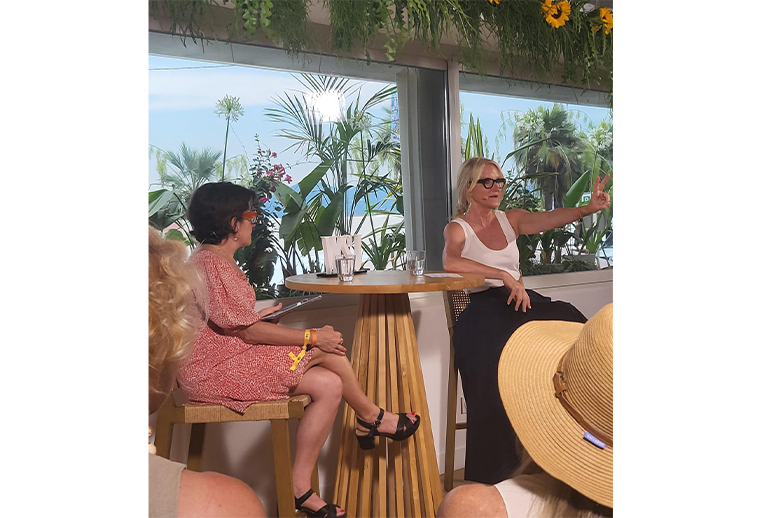
The author and host of The Mel Robbins Podcast has very clear ideas on production and distribution. She was full of great tips, perhaps none sager than her opening salvo: Virality culture starts with one person.
How can you, as a creator, be relevant to one other person? What problem are you trying to solve for that one person? If you do that effectively, they’ll recommend you to others, and that’s what leads to “the many.” A simple message beautifully framed — and food for thought for any podcaster.
In looking her up afterward, I noticed she was scheduled for at least two more appearances at other venues during the week.
5. It’s easy to forget the value of in-person activations
Humans still crave hanging out, and in an increasingly online world, it’s easy to insulate yourself. There were a few quiet spaces in the basement of the main festival building, where attendees could jump on their laptops to do some work, but they were lightly used. During most presentations, audience members would only fire up their phones to take photos. They stayed present in the moments.
In the evenings, after the sun went down, the Croissette was packed into the wee hours. Spotify Beach hosted the likes of Mumford & Sons, Raye, and John Summit. Yahoo’s stage featured Tiesto. Amazon Port brought in indie band The xx. There were yacht parties, hotel parties, and the wildly popular Gutter Bar, which didn’t get going until midnight. It was a week-long excuse to ditch the screens and, you know, actually talk to people.
Related Articles
-

Marketers should outsource tasks, not thinking
25 October 2026 -

Bundling is a pricing decision, rebundling is an organisational...
18 October 2026 -

AI’s effect on super user math
15 September 2026 -

Sydney Morning Herald, Age enhance student subscriptions with e...
31 August 2026 -

At Mediacorp’s CNA, loyalty means giving audiences a reason to ...
20 August 2026 -

Tribun Network turns print “dots” into AI-powered insight
20 August 2026 -

Nation Media Group focuses editorial strategy on stories that m...
4 August 2026 -

Briefly News empowers journalists with AI tool suite Nova
4 August 2026
Upcoming Events
-

Subscriber Acquisition Master Class
10-17 November 2026
-

Media Advertising Summit
New York, United States
07-10 December 2026
-

AI-Native News Product Master Class
18-25 February 2027
-

Media Subscriptions Summit
Oslo, Norway
08-12 March 2027
-

World Congress of News Media
New York, United States
25-30 April 2027
-

Branded Content & Partnerships Master Class
20-27 May 2027
-

Subscriber Retention Master Class
17-24 June 2027
-

Conferencia Latinoamericana
15-16 July 2027
-

South Asia News Media Festival
New Delhi, India
19-22 July 2027
-

Asia/Pacific News Media Summit
19-20 August 2027
-

CEO Roundtable at Kilkenny
Kilkenny, Ireland
24-26 August 2027
-

Media Innovation Week
Amsterdam, The Netherlands
27 September - 01 October 2027








