

AI pushes licensing to become a third revenue stream
Satisfying Audiences Blog | 12 October 2026



For two decades, publishers’ deal with search and online platforms was to provide access to their content in return for visitor traffic. The business model that grew around that bargain became familiar: monetise reader attention through advertising and subscriptions.
However, AI changes this exchange: A bot or agent can now consume a page, answer a user’s question, and keep the user inside another interface, negating the need for humans to visit the publisher page.
As this redirection takes place, publishers should consider content licensing as a material source of revenue alongside advertising and subscriptions.
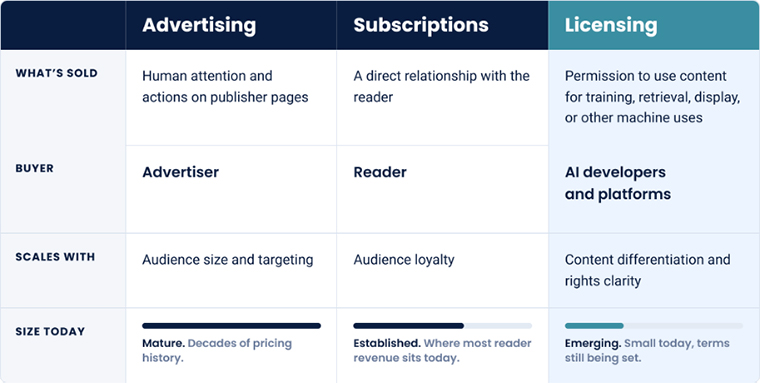
Although the content still creates value, the mechanism that historically returned part of that value to the publisher is weakening. Pew Research Center found users clicked a traditional search result 8% of the time when a Google AI summary appeared, compared with 15% when no summary appeared. Likewise, users clicked a source cited inside the AI summary only 1% of the time.
Cloudflare’s network data reaches the same conclusion from the crawler side: AI crawlers like Anthropic’s ClaudeBot and OpenAI’s GPTBot are consuming publisher pages while sending virtually no referral traffic back to them.
The market is beginning to put a price on machine use
Publishers have responded with every tool available. Some block crawlers. Some litigate. Others sign licenses, join marketplaces, or meter access. Increasingly, the same publisher does several of these things at once.
The New York Times has pursued copyright litigation while separately licensing content to Amazon for use in AI products. That agreement reportedly pays the Times more than US$20 million each year. People Inc. has combined crawler restrictions with commercial agreements, including a pay-per-use relationship with Microsoft.
Although the Microsoft terms have not been disclosed, People Inc.’s OpenAI agreement provides another public benchmark: Financial disclosures indicate a fixed payment of at least roughly US$16 million per year, before any additional variable payments.
As another example of the scale of this licensing opportunity, Wiley reported US$49 million of AI revenue in fiscal year 2026 and more than US$110 million of lifetime AI revenue. Their strategies differ, but each treats the machine visitor as something to be negotiated with rather than blocked outright.
The pattern extends beyond these three examples. Rob Kelly’s Media & the Machine tracker counted 94 publicly announced AI content licensing deals by July 2026. A growing share of the public agreements focus on fresh, trusted content for retrieval augmented generation (RAG), rather than training rights alone.
Training buys an archive once. Retrieval needs content a newsroom is still producing, and it needs quality content to produce accurate answers. The demand is there for publishers equipped to meet it.
Tech is moving; the commercial side is catching up
Publishers now have more ways to control and monetise machine access than they did even a year ago. Cloudflare can block or charge AI crawlers, TollBit enables paid access, and Microsoft’s Publisher Content Marketplace helps AI builders discover and license premium content.
These tools are solving many of the technical problems that once made AI licensing difficult.
But technology can only get a publisher so far. A publisher still needs a buyer, a price, workable terms, usage reporting, and enough bargaining power to make an agreement worthwhile. And, for publishers without sufficient scale, negotiating one agreement at a time can be impractical.
That leaves a commercial problem: Publishers may have valuable content without a practical way to negotiate. Collective licensing offers one way to close that gap.
Collective licensing lowers the barrier on both sides
Individual negotiations work for a small number of large deals, but they do not scale across thousands of publishers and AI buyers. To solve this transaction cost problem, collective licensing seeks to aggregate rights under a common framework, giving buyers and sellers one place to transact and enabling a flow of value that may have otherwise been too costly.
Given the potential benefits of collective licensing for this burgeoning market, Mather has modelled the economics of AI demand for licensed content, using RSL’s collective model as a working case.
Our research supports a practical conclusion: For publishers with differentiated, rights-cleared content, licensing revenue can be large enough to warrant the same strategic attention already given to advertising and subscriptions.
What publishers need to know first
Whichever route a publisher takes (collective licensing included), none of it works without knowing what is theirs to sell. The work starts with a sorting exercise. Publishers need to know what rights they can actually sell, which content attracts machine demand, and the human revenue that same content generates. Here’s what publishers need to do to navigate this space:
- Audit the rights. Identify which content can be licensed, for which machine uses, and with what restrictions.
- Measure both audiences. Connect human revenue and engagement with verified machine demand at the same article or content identifier.
- Set policy by use. Training, live retrieval, and search indexing do not carry the same economic effects and should not be treated equally. Publishers should “count the cost” of each potential strategy (e.g. evaluating the human traffic at risk of being cannibalised).
- Package content for machines when it pays. Structured feeds, application programming interfaces (APIs), or model context protocol (MCP) servers can make licensed content easier to discover, retrieve, meter, and audit, making the most of the new machine consumer.
Reuters offers a useful example of the last step. In July 2026, it launched an MCP server that lets subscribed customers’ AI agents search, retrieve, and download Reuters News Agency content inside AI workflows. In August, Reuters also made its licensed news archive available through Snowflake Marketplace for integration into AI applications.
These two actions and those of the firms mentioned previously suggest the importance of packaging machine access as a product rather than treating it as an accidental byproduct of the Web site.
Although the final structure of this market is still uncertain, the economic direction is becoming clearer. Publishers historically built businesses around attracting audiences and converting some of those readers into subscribers.
AI creates another possibility: selling authorised machine-access to the content itself. In this new state of the content marketplace, the publishers best positioned to capture that opportunity will be the ones that know what they own, understand where machines find value in it, protect the human revenue streams, and develop the ability to price the difference.
Banner image: Adobe stock image by Kannapat.
Related Articles
-

Marketers should outsource tasks, not thinking
25 October 2026 -

Bundling is a pricing decision, rebundling is an organisational...
18 October 2026 -

AI’s effect on super user math
15 September 2026 -

At Mediacorp’s CNA, loyalty means giving audiences a reason to ...
20 August 2026 -

Tribun Network turns print “dots” into AI-powered insight
20 August 2026 -

Nation Media Group focuses editorial strategy on stories that m...
4 August 2026 -

Briefly News empowers journalists with AI tool suite Nova
4 August 2026 -

AI adoption in newsrooms should move from experiment to strateg...
12 July 2026
Upcoming Events
-

Subscriber Acquisition Master Class
10-17 November 2026
-

Media Advertising Summit
New York, United States
07-10 December 2026
-

AI-Native News Product Master Class
18-25 February 2027
-

Media Subscriptions Summit
Oslo, Norway
08-12 March 2027
-

World Congress of News Media
New York, United States
25-30 April 2027
-

Branded Content & Partnerships Master Class
20-27 May 2027
-

Subscriber Retention Master Class
17-24 June 2027
-

Conferencia Latinoamericana
15-16 July 2027
-

South Asia News Media Festival
New Delhi, India
19-22 July 2027
-

Asia/Pacific News Media Summit
19-20 August 2027
-

CEO Roundtable at Kilkenny
Kilkenny, Ireland
24-26 August 2027
-

Media Innovation Week
Amsterdam, The Netherlands
27 September - 01 October 2027








