

Atlantic writer Anne Applebaum warns news executives that autocrats target journalism first
World Congress Blog | 07 May 2026

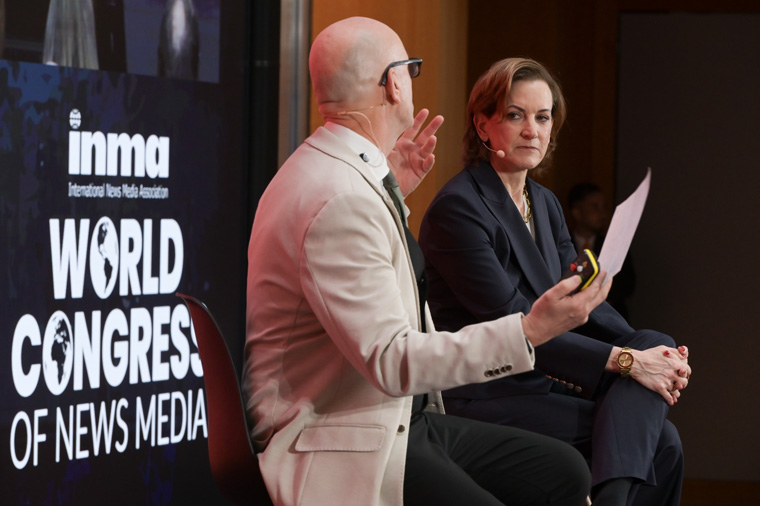
Pulitzer Prize-winning historian, author, and Atlantic staff writer Anne Applebaum warned news executives at the INMA World Congress of News Media in Berlin that the modern autocrat’s playbook increasingly begins with undermining independent media — not through overt censorship but through financial pressure, political intimidation, and algorithmic manipulation.
Drawing on her experience as a historian and journalist, Applebaum described how political polarisation has reshaped societies and fractured long-standing relationships. Referencing a New Year’s Eve gathering she hosted in Poland in 1999, she explained how many attendees — once united by anti-communist and centre-right politics — later split into opposing ideological camps.
“I came to the realization that I was living in a historical moment myself,” said Applebaum, author of Autocracy, Inc. and Twilight of Democracy. “I could see changes happening around me that were quite dramatic.”
She linked that growing polarisation to declining trust in political systems and to social media algorithms designed to reinforce existing beliefs.
“The algorithms look to give you information that will suit your prejudices and will sort you into categories because that makes it easier to sell you stuff,” she said.
How autocrats weaken independent media
For media leaders, the most consequential part of Applebaum’s presentation focused on how governments and political movements seek to control journalism. She said the traditional image of censorship — government officials literally crossing out newspaper text — has largely disappeared.
“What instead pioneered first in Russia and then in a more democratic context in Hungary, we see that censorship and control, and the attempt to control information, now happens at the level of corporate control, finance, and political relationships,” she said.
Using Hungary as a case study, Applebaum described how Prime Minister Viktor Orbán’s allies weakened independent media outlets financially before pro-government business figures acquired them.
“They would either shut it down or they would turn it into something that was very active in pro-government [messaging],” she said.
Applebaum stressed that these tactics often rely on advertising pressure and regulatory threats rather than direct censorship. Governments can discourage companies from advertising in critical media outlets or threaten broadcasters through regulators, she said, noting similarities she now sees emerging in the United States.
“We have seen the Trump administration put pressure on television stations, in particular, via the regulatory sort of broadcast regulator,” Applebaum said. “This is a familiar tactic from Russia.”
Poland’s warning for democratic countries
Applebaum also pointed to Poland, where state television under the previous government became “very vicious party propaganda.” She described how repeated, clipped broadcasts portraying former opposition leader Donald Tusk as “pro-German” were used to inflame public hostility.
The consequences can become dangerous, she warned, citing the murder of the mayor of Gdańsk after sustained attacks against him by state-aligned media.
“There was a campaign led by Polish state television, Polish public media, that was targeted on him,” Applebaum said. “This was one of the results.”
Despite those pressures, Applebaum argued journalism still matters deeply — especially trusted journalism. Even in countries where independent media is weakened, she said investigative reporting and whistleblower journalism can still shape public opinion and elections.
“It still can make an enormous difference that someone is producing material that’s trusted and that people believe,” she said.
The Atlantic’s approach to trust and community
Applebaum also offered insights into The Atlantic, which moderators described as a profitable publication with 1.5 million subscribers. She said the publication deliberately built a broad editorial community spanning “the center left to the center right” while focusing on democratic values rather than partisan identity.
“The idea is to make The Atlantic not just a newspaper or a magazine, but also a kind of community experience,” she said. “You are buying into a set of ideas when you buy it.”
For news executives confronting misinformation and declining trust, Applebaum argued the answer is not competing with disinformation using similar tactics.
“I don’t think there should be a liberal network of misinformation,” she said.
Instead, she called for greater transparency from social media platforms, stronger enforcement of democratic laws governing elections and speech, and more aggressive efforts by news organisations to reach audiences on emerging platforms.
“The idea that you could just have a famous newspaper with a famous title and wait for the readers to come because you were so prestigious is obviously over,” Applebaum said.
Scepticism about AI in journalism
On generative AI, Applebaum remained sceptical, describing experiments that produced fabricated quotes, nonexistent articles, and unusable speech drafts.
“The Atlantic is a magazine by human beings, for human beings, about human beings,” she said, explaining that AI-written articles are treated internally “the same as plagiarism.”
Related Articles
-

Arena Holdings learns reaching millions isn’t the same as servi...
8 October 2026 -

The 3 editorial pillars of Chile’s first streaming news channel
23 September 2026 -

Indian Express builds a video-first future around trusted journ...
20 July 2026 -

Inside Denník N’s successful subscription strategy
15 July 2026 -

Why are audiences going to AI answer engines for news?
30 June 2026 -

La Nación explores historic corruption case with unprecedented ...
16 June 2026 -

SCMP shows the power of print with supplement after deadly high...
1 June 2026 -

Audiences are reading less fact-based content yet newsrooms con...
25 May 2026
Upcoming Events
-

Subscriber Acquisition Master Class
10-17 November 2026
-

Media Advertising Summit
New York, United States
07-10 December 2026
-

AI-Native News Product Master Class
18-25 February 2027
-

Media Subscriptions Summit
Oslo, Norway
08-12 March 2027
-

World Congress of News Media
New York, United States
25-30 April 2027
-

Branded Content & Partnerships Master Class
20-27 May 2027
-

Subscriber Retention Master Class
17-24 June 2027
-

Conferencia Latinoamericana
15-16 July 2027
-

South Asia News Media Festival
New Delhi, India
19-22 July 2027
-

Asia/Pacific News Media Summit
19-20 August 2027
-

CEO Roundtable at Kilkenny
Kilkenny, Ireland
24-26 August 2027
-

Media Innovation Week
Amsterdam, The Netherlands
27 September - 01 October 2027








