

Brand is news media’s last defensible advantage in an AI-driven world
World Congress Blog | 06 May 2026

Brand has evolved from a marketing layer into the core operating system of news organisations — and may now be the news industry’s last durable competitive advantage, INMA Executive Director and CEO Earl J. Wilkinson told delegates at the INMA World Congress of News Media in Berlin.
In a keynote built around “five movements and one argument,” Wilkinson outlined how the forces reshaping media — platform dominance, AI acceleration, and the collapse of traditional business moats — have left brand as the defining differentiator.
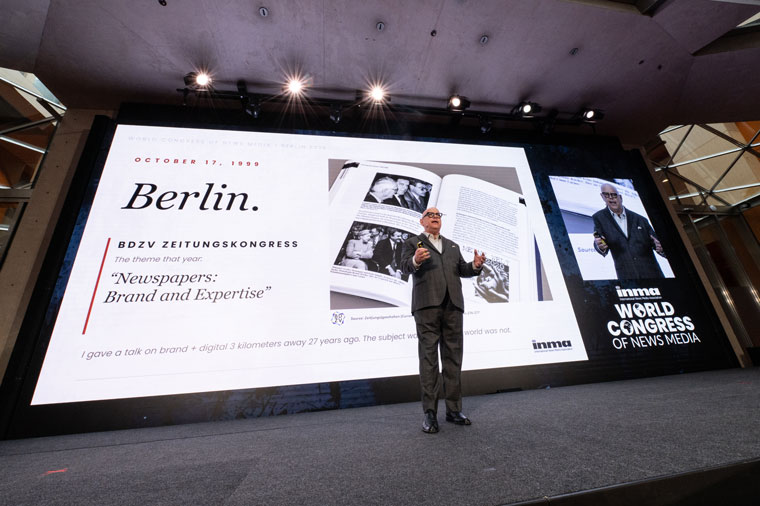
“We build businesses around things that are scarce,” Wilkinson told the record 750+ delegates from 38 countries attending this year’s World Congress in Berlin. “You’re not going to be investing in abundance where the margins are disappearing.”
From moats to “swamp of sameness”
Wilkinson traced the erosion of the industry’s historic advantages. Where once infrastructure, distribution, editorial capacity, and attention created defensible “moats,” each has been dismantled in the digital era:
“The Internet ate the trucks. Advertising got unbundled and became auction-based. Production was democratised. Attention was fragmented.”
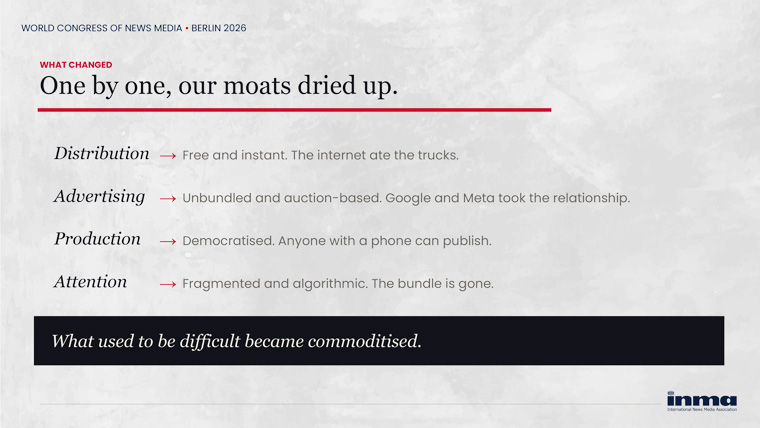
AI has accelerated that collapse, creating what he described as a “swamp of sameness,” where differentiation disappears and content becomes interchangeable.
“We’re losing our voice, our perspective. We’re being intermediated, homogenized, de-branded, becoming voiceless,” Wilkinson said.
The scale of disruption is stark: 90% of the world’s data has been generated in the past two years, while human-authored Web content has fallen sharply and is projected to drop below 1% within a decade.
Scarcity shifts to human journalism
As content becomes abundant and cheap, value shifts to what cannot be easily replicated: human journalism.
“We’re shifting from ‘is this true’ to ‘who made this and can I verify this?’” Wilkinson said.
He pointed to five emerging scarce assets: verified human authorship, first-hand reporting, source relationships, editorial judgment, and institutional accountability.
Wilkinson argued that “verified human journalism will become a premium category,” comparing it to organic food — a differentiated product that commands higher value.
Brand as operating system
At the centre of this shift is a redefinition of brand itself.
“Brand isn’t the wrapper anymore,” Wilkinson said. “Brand is the operating system.”
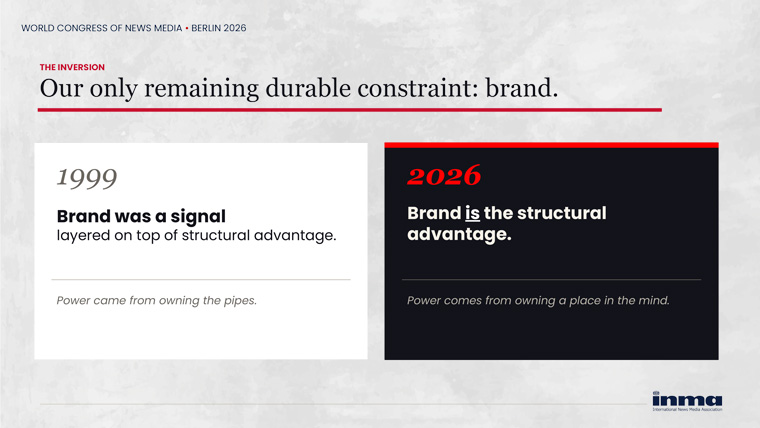
Rather than sitting on top of the business, brand now shapes core decisions across the organisation.
“The brand is determining which stories you run, which ones you don’t. Who you hire, who you don’t. What the product feels like, what the paywall looks like,” he said.
This represents a structural shift from brand as campaign to brand as strategy — owned not by marketing but by leadership across editorial, product, and executive teams.
6 attributes of winning brands
Wilkinson identified six attributes that define successful news brands today:
-
Clarity of mission.
-
Product consistency across platforms.
-
Editorial distinctiveness.
-
Emotional connection with audiences.
-
Trust within a defined community.
-
Courage to stand for something.
“These are not a marketing function,” he said. “They’re owned by the CEO. They’re owned by the editor. They’re owned by the product lead.”
Winning brands also make deliberate trade-offs.
“The winning brands choose to lose some readers in order to keep others more deeply,” Wilkinson said.
From product to relationship
Wilkinson placed this transformation within a broader evolution of how news organisations compete. Over three decades, the industry has shifted from scale and reach, to quality, and now to relationships.
“What’s scarce today is not news,” he said. “It is a reason to come back.”
This is reflected in messaging. Where news organisations once sought to prove they were digital, they now emphasise human qualities.
“What are we trying to prove today? The exact opposite: that we’re human, we’re authentic, we’re personal, we’re trustworthy,” Wilkinson said.
The only asset left
Looking ahead, Wilkinson warned that platforms, AI, and content economics will continue to erode traditional advantages.
“It’s not your distribution. It’s not your breaking news. It’s not your scale. It’s not your quality,” he said. “The only thing that is yours is who you are.”
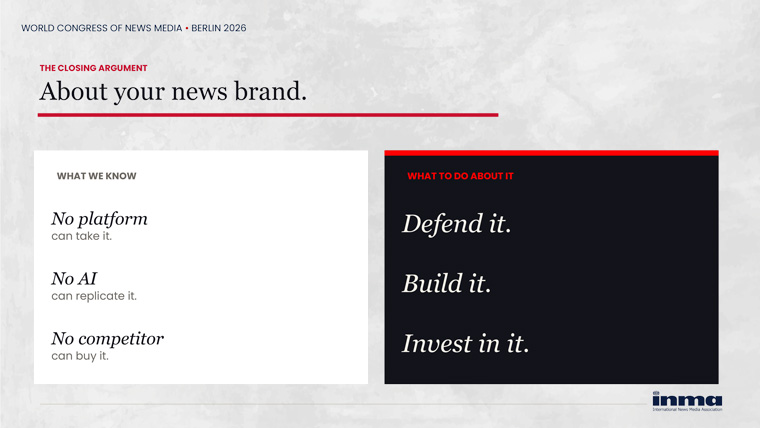
He closed with a challenge to treat brand as a core asset.
“We know that no platform can take it. We know that no AI can replicate it. We know no competitor can buy it,” Wilkinson said. “The decade ahead belongs to those who are unmistakably themselves.”
The key takeaway: In a media environment defined by AI-driven abundance and collapsing attention, brand — rooted in identity, trust, and human distinctiveness — is emerging as the news industry’s last sustainable advantage.
All photos by Robert Downs Photography.
Related Articles
-

Marketers should outsource tasks, not thinking
25 October 2026 -

Bundling is a pricing decision, rebundling is an organisational...
18 October 2026 -

AI’s effect on super user math
15 September 2026 -

At Mediacorp’s CNA, loyalty means giving audiences a reason to ...
20 August 2026 -

Tribun Network turns print “dots” into AI-powered insight
20 August 2026 -

Nation Media Group focuses editorial strategy on stories that m...
4 August 2026 -

Briefly News empowers journalists with AI tool suite Nova
4 August 2026 -

AI adoption in newsrooms should move from experiment to strateg...
12 July 2026
Upcoming Events
-

Subscriber Acquisition Master Class
10-17 November 2026
-

Media Advertising Summit
New York, United States
07-10 December 2026
-

AI-Native News Product Master Class
18-25 February 2027
-

Media Subscriptions Summit
Oslo, Norway
08-12 March 2027
-

World Congress of News Media
New York, United States
25-30 April 2027
-

Branded Content & Partnerships Master Class
20-27 May 2027
-

Subscriber Retention Master Class
17-24 June 2027
-

Conferencia Latinoamericana
15-16 July 2027
-

South Asia News Media Festival
New Delhi, India
19-22 July 2027
-

Asia/Pacific News Media Summit
19-20 August 2027
-

CEO Roundtable at Kilkenny
Kilkenny, Ireland
24-26 August 2027
-

Media Innovation Week
Amsterdam, The Netherlands
27 September - 01 October 2027








