

From AI workflows to younger audiences, INMA seminars focus on practical publisher change
World Congress Blog | 14 May 2026

At last week’s INMA World Congress of News Media in Berlin earlier, industry partners and sponsors shared research, operational lessons, and strategic advice on how publishers are adapting to rapid shifts in technology, audience behaviour, and monetisation.
Across five seminars covering advertising, subscriptions, AI-first newsrooms, agentic AI, and young audiences, presenters focused less on selling products and more on operational realities: how publishers can recover lost advertising value, prepare for AI-driven workflows and buying systems, improve newsroom operations, and adapt products for younger audiences.
Despite the range of topics, a common message emerged repeatedly throughout the day: Publishers can no longer rely on legacy workflows, passive distribution, or generic advertising models in a rapidly changing digital environment.
Whether the discussion centred on advertising systems, newsroom AI, subscription models, or younger audiences, speakers framed the future as a series of operational changes that publishers must begin implementing now.
Rebuilding publisher advertising around data, video, and AI
The Diversifying the Advertising Portfolio Seminar focused on how publishers can rebuild advertising value as browser privacy changes, AI search, and platform dependency continue reshaping the advertising market.
Kitty Brouwer, B2B strategy director at Mediahuis Group in the Netherlands, said publishers must prepare for a decentralised advertising environment where audiences increasingly consume journalism across AI systems, platforms, and distributed interfaces.
“Every time the model adapted, we adapted,” Brouwer said. “But this time it’s different.”
Shailley Singh, executive vice president/product and COO at IAB Tech Lab in the United States, described how browser privacy changes and AI-driven search disruption are forcing publishers to rethink monetisation infrastructure.
“We’re losing 30% to 50% of the addressable inventory,” Singh said, describing the impact of browser restrictions and data loss.
Singh outlined IAB Tech Lab’s work moving advertising monetisation systems from browsers to CDN edge infrastructure, which he said could improve publisher control, recover lost signals, and increase page-load performance.
News publishers are entering a period where AI systems, browser restrictions, and declining referral traffic are forcing news companies to rethink the technical foundations of digital advertising, Singh said. Much of his presentation focused on how publishers can regain visibility into their own data flows and maintain more control over third-party relationships.
“Our vision is creating the buyer and seller agents based on existing standards,” Singh said while discussing agentic advertising systems.
Maresa Wolkenstein of COPE and Styria Media Group in Austria described how publishers are collaborating around first-party data and consent frameworks to compete more effectively with global technology platforms.
“The enemy is really not the publisher from the next region,” Wolkenstein said. “Enemy is a common enemy. It’s the big platforms.”
Paul Brandenfeldt, sales director at Bonnier News in Sweden, discussed how publishers can diversify advertising relationships by connecting journalism brands with retail and commerce environments.
“The first time that we don’t have to call the clients,” he said. “The client calls us.”
Pippa Leary, managing director and publisher of free news and lifestyle at News Corp Australia, focused on how publishers can adapt storytelling and advertising strategies for mobile-first and younger audiences.
“First-party data is your moat. It’s your gold,” Leary said.
Publishers must adapt products and storytelling formats for younger, mobile-first audiences, she said. Her presentation focused heavily on the economics behind that shift. As display advertising weakens, she said publishers need editorial teams that can produce video-native journalism designed for mobile consumption, social environments, and swipe-based interfaces.
“You’ve got to do a video story where the hook comes in the first second or two,” she said.
Key takeaways:
- Publishers are increasingly trying to rebuild advertising leverage through first-party data, AI-assisted infrastructure, and premium commercial products rather than relying on scale display advertising alone.
- Agentic advertising systems and machine-readable infrastructure are quickly becoming central to future monetisation strategies.
Integrating AI directly into newsroom workflows
The AI-First Newsroom Seminar, sponsored by Stibo DX, concentrated on newsroom workflow integration, editorial adoption, and the organisational challenges of implementing AI inside editorial teams.
Rather than focusing on speculative AI use cases, the seminar examined how publishers are integrating AI into existing editorial systems while attempting to preserve newsroom trust, accuracy, and editorial standards.
Sonali Verma, INMA’s Newsroom Innovation Initiative lead, framed the challenge around operational adoption inside large news organisations.
“How do we drive meaningful AI adoption across a global newsroom?” Verma said.
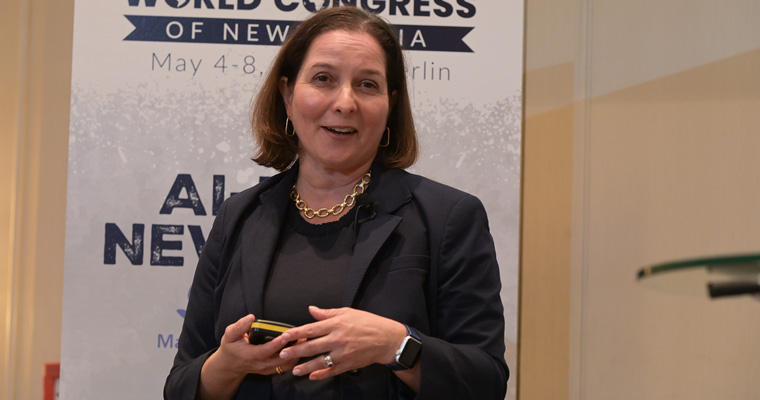
Anjali Kapoor of the BBC discussed how the organisation is approaching AI governance, workflow integration, and editorial collaboration across BBC News.
“We are very careful with our enterprise tools because of the fact that we think we have very valuable journalism IP,” Kapoor said.
Kapoor also described how the BBC is organising AI projects around four areas: boosting productivity, reformatting news content, augmenting journalism, and innovating user experience.
“Our joint research with EBU last year in twenty twenty five found that forty five percent of AI generated news outputs contain significant errors,” Kapoor said while discussing concerns around accuracy and sourcing.
The seminar also focused heavily on workflow integration, newsroom training, and peer-led adoption strategies.
“You have to build something that actually solves a problem for someone. Otherwise, your teams are not going to use the tools,” Verma said.
Speakers repeatedly returned to the idea that newsroom adoption often depends more on culture and workflow design than on the sophistication of the AI models themselves.
Key takeaways:
- AI adoption depends as much on workflow integration and newsroom trust as on the technology itself.
- Newsrooms are increasingly focusing on practical tools that solve operational problems rather than standalone AI experiments.
Adapting journalism for younger audiences
The Young Audiences Seminar, sponsored by FT Strategies, explored what publishers are learning about younger audience behaviour, creator culture, platform habits, and changing expectations around journalism.
Lisa MacLeod, director of FT Strategies, presented findings from the company’s Next Gen News 2 research project examining how younger consumers discover and engage with journalism.
“We wanted to try and understand a little bit more about the future of news consumption,” MacLeod said while describing the project’s research methodology.
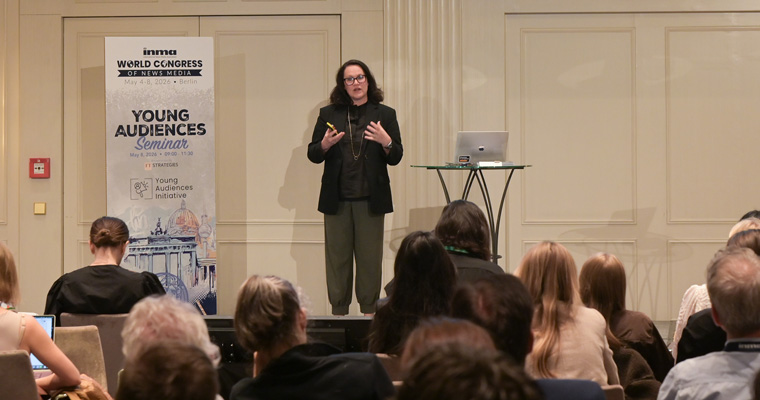
“Young people want to be mentioned in ways they can relate,” said Kerstin Hasse, INMA’s Young Audiences Initiative lead, who led the seminar.
Across the session, speakers discussed platform fluency, creator-style storytelling, community participation, and the need for publishers to rethink assumptions about how younger consumers discover journalism.
The discussion reflected a broader shift away from the idea that younger audiences will naturally develop habits around traditional news destinations. Instead, publishers increasingly need to meet audiences inside creator ecosystems, video platforms, and recommendation-driven feeds.
Key takeaways:
- Younger audiences increasingly expect journalism to behave more like creator content: visual, participatory, mobile-native, and personality-driven.
- Publishers can no longer assume younger consumers will come directly to news brands without strong off-platform distribution and community engagement strategies.
Preparing for the rise of agentic AI
The Agentic AI Seminar, sponsored by Darwin CX, focused on the strategic implications of agentic AI for publisher discovery, workflows, subscriptions, and advertising.
Several speakers argued that publishers may be underestimating both the speed and scale of the coming transition from search-based navigation to AI-assisted and agent-driven interaction models.
Jodie Hopperton, INMA’s Product & Tech Initiative lead, opened the seminar by positioning agentic AI as a major industry transition.
“Agentic AI is here,” Hopperton said. “It’s massive. It is going to change things very, very quickly.”
The session included discussions about AI operating systems, automation layers, and conversational interfaces. Presenters discussed how agents may eventually manage tasks ranging from discovery and recommendations to workflow automation and transaction handling, potentially reshaping how audiences interact with publisher products.

Claire Furino, director of AI Hub Programs at Holtzbrinck in the United States, said automation should help free employees to focus on higher-value work.
“I want to have the time to spend with the people that matter on the problems that matter,” Furino said while discussing workflow automation.
Key takeaways:
- Agentic AI is likely to reshape discovery, workflow automation, advertising, and subscription systems far faster than many publishers expect.
- Publishers are beginning to build AI operating systems and automation layers into day-to-day business operations.
Rethinking subscription growth and audience commitment
The Subscription Growth Seminar, sponsored by Piano, focused on how publishers are adapting subscription strategies and audience products as consumer habits and willingness to subscribe continue to evolve.
One of the seminar sessions examined how publishers are increasingly using behavioural data, segmentation, and audience signals to personalise user experiences on the Web site, and optimise revenue across editorial, advertising, and reader revenue operations.
Clemens Hammacher, general manager DACH at Piano in Germany, and Jürgen Risinger, head of subscription technology and UX at PD Digital in Germany, discussed how evolving business needs pushed the publisher toward a more comprehensive data and subscription infrastructure strategy.
Risinger described how audience segmentation increasingly shapes both user experience and monetisation decisions:
“And what is revenue driven design? Maybe a little story that might sound familiar to some of you: When a news Web site will be launched or relaunched, there's this one single moment the newsroom [when] ad sales and reader revenue are sitting on the table and the fight is on. Everyone is starting to fight over the best placements on the Web site.”
The session focused on how publishers can reduce internal tensions between newsroom, advertising, and reader revenue priorities by using behavioural data to dynamically personalise experiences for different audience segments.
Anjali Iyer, global head of subscriptions at The Washington Post, highlighted how news company challenged traditional assumptions about reader loyalty and consumer behaviour.
“I want to make it clear that subscriptions is the core business,” Iyer said. “That is not going away, but we are expanding beyond subscriptions now. There is a growing gap between willingness to pay and willingness to commit. These things meant the same, maybe five, six years ago. That does not mean the same thing today and younger audiences do have a preference for flexibility.
“They will pay for access, moment driven, impulsive. [They] might even pay more than a subscription, but they want it on their terms.”
Key takeaways:
- Publishers are increasingly using behavioural data and audience segmentation to personalise subscription experiences and reduce friction.
- Subscription growth depends not only on pricing, but also on adapting products and engagement strategies to changing consumer habits and expectations.
All photos by Robert Downs Photography.
Related Articles
-

Marketers should outsource tasks, not thinking
25 October 2026 -

Bundling is a pricing decision, rebundling is an organisational...
18 October 2026 -

AI’s effect on super user math
15 September 2026 -

What I told 40 CEOs (and won’t gatekeep from you)
30 August 2026 -

At Mediacorp’s CNA, loyalty means giving audiences a reason to ...
20 August 2026 -

Tribun Network turns print “dots” into AI-powered insight
20 August 2026 -

Nation Media Group focuses editorial strategy on stories that m...
4 August 2026 -

Briefly News empowers journalists with AI tool suite Nova
4 August 2026
Upcoming Events
-

Subscriber Acquisition Master Class
10-17 November 2026
-

Media Advertising Summit
New York, United States
07-10 December 2026
-

AI-Native News Product Master Class
18-25 February 2027
-

Media Subscriptions Summit
Oslo, Norway
08-12 March 2027
-

World Congress of News Media
New York, United States
25-30 April 2027
-

Branded Content & Partnerships Master Class
20-27 May 2027
-

Subscriber Retention Master Class
17-24 June 2027
-

Conferencia Latinoamericana
15-16 July 2027
-

South Asia News Media Festival
New Delhi, India
19-22 July 2027
-

Asia/Pacific News Media Summit
19-20 August 2027
-

CEO Roundtable at Kilkenny
Kilkenny, Ireland
24-26 August 2027
-

Media Innovation Week
Amsterdam, The Netherlands
27 September - 01 October 2027








