

Meta delays content-scraping terms under global pressure, but shows no retreat
Digital Platform Initiative Blog | 29 October 2026

Global action forced Meta to stall its grab for scraping rights to publishers’ content, but the company has given no indication in its meetings with regulators or public statements that it plans to retreat.
Here’s what INMA members need to know after a week of fast-moving events centering on Meta.
What started it: Meta announced a change to its commercial terms to allow it to scrape digital publications owned by anyone who uses Meta products for business purposes, including corporate brands that operate on Facebook, Instagram, WhatsApp, and Threads.
What inflamed it: The company quickly altered the wording to replace the explicit reference to AI “training” from its proposed terms, limiting the stated uses of scraped content to developing, improving and researching “advertising and business products.” It retained its broad Web site-crawling permissions.
Publisher revolt: Publishers and advertisers lobbied European Union and UK authorities and filed formal complaints to block the changes. Outside the EU, 10 publishers in Norway obtained a temporary court injunction to stop Meta from proceeding, in what is likely to be the first of several rulings.
The media industry finds its voice: The European Publishers Council, News Media Association in the UK, News/Media Alliance in the United States, and News Media Canada leapt into immediate attack. Press Gazette, the online trade journal, called for a media boycott of Meta, saying that “Meta has declared war on publishers and the open Web,” WAN-Ifra, as an umbrella association of national press associations, demanded action and negotiation.
Politics: The Meta moves and the publisher reactions prompted rare bipartisan support for the media in the U.S. Senate. Republican Marsha Blackburn, chair of the Judiciary Subcommittee on Privacy, Technology and the Law, and Democrat Adam Schiff demanded that Meta withdraw its new terms, warning of uncompensated scraping of intellectual property and abuse of market power.
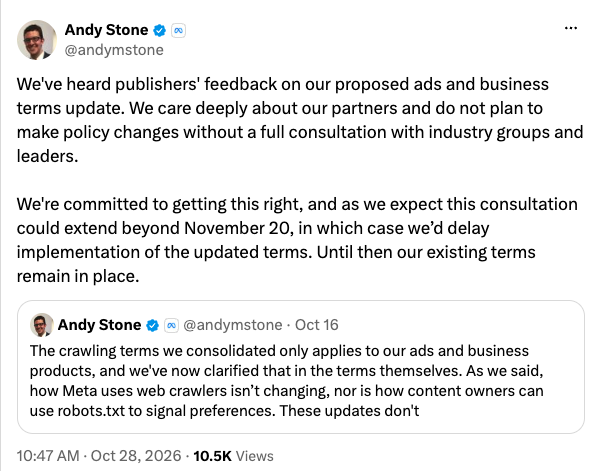
Meta’s update: Andy Stone, Meta’s vice president of communications, took to X to promise consultation to stave off regulatory intervention.
Read of the room: “I have zero confidence that Meta's proposed consultation with publishers or, more accurately, ‘industry groups and leaders,’ as they coined it – will produce a genuine resolution,” said Jason Kint, one of the media industry’s leading voices on Big Tech politics in his capacity as CEO of Digital Content Next, a U.S.-based group of premium publishers, told INMA.
The legal read: Damien Geradin, whose firm Geradin Partners brought many of the European legal interventions on behalf of media, was equally blunt. He told INMA the latest Meta statements were not a solution.
“Meta continues to believe it may impose its unjustifiable conditions on publishers. Publishers need to continue to remind Meta and competition authorities that this is not the case and insist on a fair compensation for Meta’s use of their content. Meta’s conduct constitutes a prima facie abuse of dominance, and we’re calling for interim measures to avoid irreparable harm.”
The advertising layer: The proposed revised commercial terms also cover advertising and business products as well as scraping of its clients digital assets. And the new terms to allow scraping for these remain unchanged. Publishers also advertise their brands on Meta’s platforms, and many act as resellers of advertising for Meta.
Was it a mistake? Unlikely. A mistake would have resulted in a swift backdown. Instead, Meta pushed back the date from October 30 to November 20 and later said that date was conditional on completing full consultation.
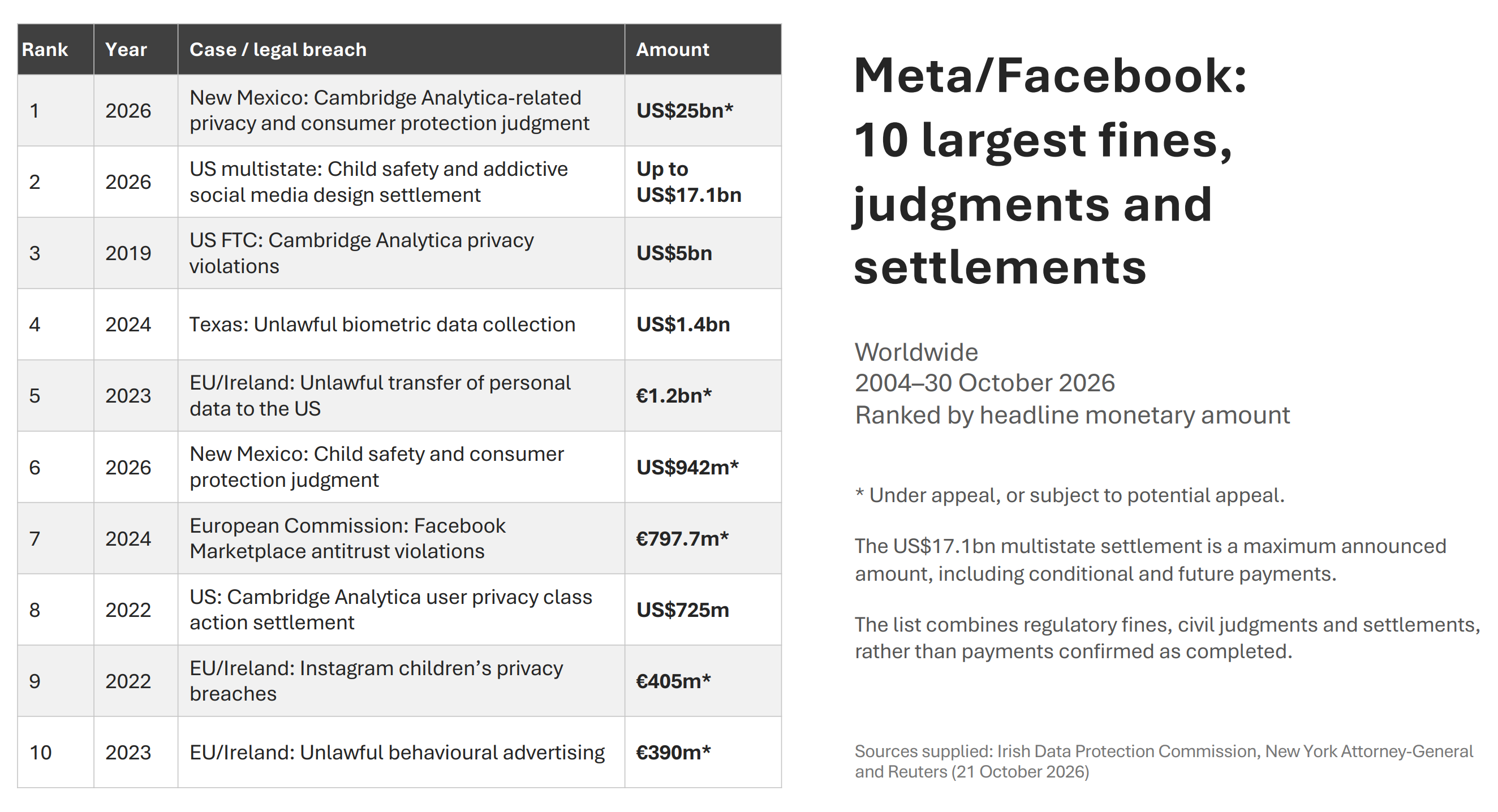
The defendant has history: Meta has form when it comes to pushing legal boundaries across many of its arenas. It has become the most-fined Big Tech company ever. In today’s dollars, the total is US$55 billion in fines imposed since the company’s founding.
Scraping context: Meta’s manoeuvre comes amid the media’s escalating battle to receive remuneration for its content. Publishers have dramatically tightened their defences against scraping bots in recent months to force licensing deals with AI companies for content. Publishers are moving from blacklisting specific bots to blocking all bots and instead approving a whitelist of only those crawlers essential for search and advertising.
In related but separate Meta matters: A French appeals court upheld orders on October 29 requiring Meta to negotiate in good faith with news publishers over neighbouring-rights payments under the EU copyright framework, adding to the legal pressure surrounding its new scraping terms.
As wider pressure mounts: In its biggest blow to date, a court in New Mexico ordered Meta to pay US$25 billion in civil penalties for misleading Facebook users about data privacy and the use of personal information, in a case arising from the Cambridge Analytica scandal. Meta plans to appeal the judgment, which was handed down on October 21. This ruling is separate from August’s multi-state settlement over social media addiction and child safety, under which Meta agreed to pay up to US$17.1 billion.
Related Articles
-

What makes an AI choose your news brand?
14 October 2026 -

Licensing won’t save media, but authentication might
13 October 2026 -

Every loyal reader was a stranger first
8 October 2026 -

A short guide for publishers on Google’s adtech remedies
24 September 2026 -

An update on OpenAI and the LLM ad platforms
14 September 2026 -

News companies are starting to build for agentic trading
13 September 2026 -

What I told 40 CEOs (and won’t gatekeep from you)
30 August 2026 -

News companies can ask their audience to choose them
27 May 2026
Upcoming Events
-

Subscriber Acquisition Master Class
10-17 November 2026
-

Media Advertising Summit
New York, United States
07-10 December 2026
-

AI-Native News Product Master Class
18-25 February 2027
-

Media Subscriptions Summit
Oslo, Norway
08-12 March 2027
-

World Congress of News Media
New York, United States
25-30 April 2027
-

Branded Content & Partnerships Master Class
20-27 May 2027
-

Subscriber Retention Master Class
17-24 June 2027
-

Conferencia Latinoamericana
15-16 July 2027
-

South Asia News Media Festival
New Delhi, India
19-22 July 2027
-

Asia/Pacific News Media Summit
19-20 August 2027
-

CEO Roundtable at Kilkenny
Kilkenny, Ireland
24-26 August 2027
-

Media Innovation Week
Amsterdam, The Netherlands
27 September - 01 October 2027








