

Licensing won’t save media, but authentication might
Product & Tech Initiative Blog | 13 October 2026

I’m somewhat sceptical about the strategic value of most AI licensing deals. Not because publishers shouldn’t be paid. If an AI company wants premium journalism, archives, or real-time information, there’s a perfectly reasonable commercial argument that publishers should receive compensation.
Take the money. But don’t confuse a revenue stream with a strategy.
Imagine I ask my AI what happened in Ukraine overnight, what it means for markets, and whether anything material has changed. It may use Reuters, the Financial Times, The New York Times, the BBC, and specialist sources. I get an excellent answer, but I never visit any of them.
That’s the structural problem. The AI owns the interface and increasingly the relationship; the publisher becomes an input. And the better AI becomes at synthesising multiple sources, the easier it is for individual pieces of information to feel interchangeable.
That’s why I don’t believe licensing alone is a long-term defence. We provide high-quality information, the AI becomes better, consumers spend more time there, and our direct relationship weakens. The same happens with micropayments through an AI wallet.
Which is why I keep coming back to authentication.
Google’s Expert Intelligence experiment is interesting here. It begins with books a user has purchased: The consumer has rights to that content and gives Gemini permission to use it for them. Google says the concept will extend to areas including third-party subscriptions and business research.
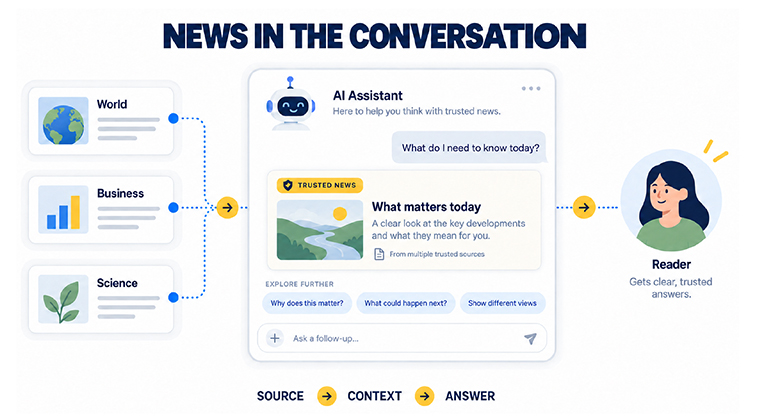
Now imagine applying that to news. I authenticate my Wall Street Journal subscription inside my personal AI. The AI knows I pay for the WSJ and value it. When WSJ journalism is relevant, it can use my entitlement to bring that reporting into my answer.
The WSJ is clearly identified. I receive benefits non-subscribers don’t. Perhaps I can go deeper, upgrade, or interact with my subscription without abandoning the AI interface.
Now the publisher hasn’t disappeared. The brand remains visible, the subscription provides differentiated value, and the consumer still understands they have a relationship with the publisher.
This is why I think the pitch to AI companies needs to evolve beyond you need our content. A stronger argument is: We can make your product better because users have chosen to trust us.
Publishers bring authority, expertise, trusted brands, and paying customer relationships. Those can help AI companies solve problems around provenance, authority, trust, and personalisation. But the exchange needs to work both ways.
The AI gets access to a trusted, permissioned source. The publisher retains identity and relationship. The consumer gets a better product.
Licensing may be tactical. Authentication feels structural.
And if that happens, the next competition isn’t simply for the consumer’s attention. It’s to be chosen by the AI acting on their behalf.
If you’d like to subscribe to my bi-weekly newsletter, INMA members can do so here.
Banner photo: Adobe stock image by InfiniteFlow.
Related Articles
-

Marketers should outsource tasks, not thinking
25 October 2026 -

What makes an AI choose your news brand?
14 October 2026 -

AI’s effect on super user math
15 September 2026 -

3 product, tech, and AI lessons from INMA’s CEO Roundtable
1 September 2026 -

At Mediacorp’s CNA, loyalty means giving audiences a reason to ...
20 August 2026 -

Tribun Network turns print “dots” into AI-powered insight
20 August 2026 -

Nation Media Group focuses editorial strategy on stories that m...
4 August 2026 -

Briefly News empowers journalists with AI tool suite Nova
4 August 2026
Upcoming Events
-

Subscriber Acquisition Master Class
10-17 November 2026
-

Media Advertising Summit
New York, United States
07-10 December 2026
-

AI-Native News Product Master Class
18-25 February 2027
-

Media Subscriptions Summit
Oslo, Norway
08-12 March 2027
-

World Congress of News Media
New York, United States
25-30 April 2027
-

Branded Content & Partnerships Master Class
20-27 May 2027
-

Subscriber Retention Master Class
17-24 June 2027
-

Conferencia Latinoamericana
15-16 July 2027
-

South Asia News Media Festival
New Delhi, India
19-22 July 2027
-

Asia/Pacific News Media Summit
19-20 August 2027
-

CEO Roundtable at Kilkenny
Kilkenny, Ireland
24-26 August 2027
-

Media Innovation Week
Amsterdam, The Netherlands
27 September - 01 October 2027








