

What makes an AI choose your news brand?
Product & Tech Initiative Blog | 14 October 2026

For most of the digital era, companies have competed for attention. Publishers wanted clicks, advertisers wanted eyeballs, social platforms wanted people to scroll, and search engines organised pages and sent traffic.
We built an enormous digital economy around capturing, measuring, and monetising human attention.
AI could move the centre of gravity somewhere else — as Shuwei Fang puts it — from attention to intention.
When I open Instagram, I’m entering an attention marketplace. When I tell my AI, “Find the best hotel for my family in Barcelona next weekend,” I’m expressing intent. I already want something; the question is who gets selected to fulfil it.
That changes competition. A hotel may no longer primarily compete for the top Google result; it competes to become the hotel my AI recommends. A retailer may compete to become the shoe selected when I ask for comfortable black flats under €200. A publisher competes to become the trusted source when I ask, “What do I need to understand about this story?”
We move from optimising for humans clicking links to being legible to machines acting for humans.
SEO is an early version of this. AEO is a newer version. But I suspect those terms will eventually feel quite narrow because the bigger question is: What makes an AI choose you?
Some of that is technical: structured information, freshness, rights, availability, and machine-readable metadata. But many of the most interesting signals are things companies already possess such as trust, brand, authority, customer relationships, subscriptions, provenance, and expertise.
These things may influence whether an AI recommends, cites, purchases from, or acts through an organisation.
For publishers, this potentially changes advertising, too. If consumers spend less time browsing destinations and more time asking AI to act, advertising based purely on exposure becomes less valuable. Commercial value moves closer to the decision.
It becomes less “How do I get your attention?” and more “How do I become the answer to your intention?”
That potentially blurs advertising with marketing, PR, commerce, product information, reputation, and machine-readable brand authority.
And it brings me back to where this series started in my previous newsletter. Models will improve, costs will fall, capabilities will be copied, and agents will proliferate. Meanwhile, the biggest AI companies are racing to occupy a more valuable layer.
For consumers, Google, Apple, Meta, and OpenAI are strong candidates to become interfaces between individuals and the digital world. For enterprises, Anthropic, OpenAI, Google, and others want to embed themselves into the context and workflows through which organisations operate.
So perhaps the strategic question isn’t who has the smartest model. It is who owns the relationship AND has permission to understand the context?
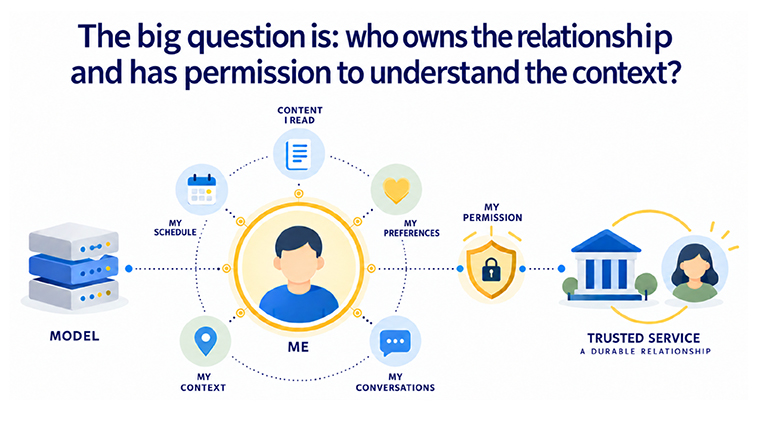
For media, that leaves us with one question I think we need to start designing around now:
If our audiences increasingly experience the world through an AI intermediary, what gives that intermediary a reason to choose us? And what ensures the audience still knows that it did?
If you’d like to subscribe to my bi-weekly newsletter, INMA members can do so here.
Banner photo: Adobe stock image by Umnat.
Related Articles
-

Marketers should outsource tasks, not thinking
25 October 2026 -

Licensing won’t save media, but authentication might
13 October 2026 -

AI’s effect on super user math
15 September 2026 -

3 product, tech, and AI lessons from INMA’s CEO Roundtable
1 September 2026 -

At Mediacorp’s CNA, loyalty means giving audiences a reason to ...
20 August 2026 -

Tribun Network turns print “dots” into AI-powered insight
20 August 2026 -

Nation Media Group focuses editorial strategy on stories that m...
4 August 2026 -

Briefly News empowers journalists with AI tool suite Nova
4 August 2026
Upcoming Events
-

Subscriber Acquisition Master Class
10-17 November 2026
-

Media Advertising Summit
New York, United States
07-10 December 2026
-

AI-Native News Product Master Class
18-25 February 2027
-

Media Subscriptions Summit
Oslo, Norway
08-12 March 2027
-

World Congress of News Media
New York, United States
25-30 April 2027
-

Branded Content & Partnerships Master Class
20-27 May 2027
-

Subscriber Retention Master Class
17-24 June 2027
-

Conferencia Latinoamericana
15-16 July 2027
-

South Asia News Media Festival
New Delhi, India
19-22 July 2027
-

Asia/Pacific News Media Summit
19-20 August 2027
-

CEO Roundtable at Kilkenny
Kilkenny, Ireland
24-26 August 2027
-

Media Innovation Week
Amsterdam, The Netherlands
27 September - 01 October 2027








