

3 product, tech, and AI lessons from INMA’s CEO Roundtable
Product & Tech Initiative Blog | 01 September 2026

At this year’s INMA CEO Roundtable, I shared a hypothesis: The biggest AI risk isn’t moving too slowly. It is using AI to optimise a business model that no longer works.
My argument rests on two shifts. Firstly, AI is moving beyond simple chat and becoming an interface through which people discover information, use software, and take action. Secondly, as AI moves from experimentation into production, its true economics — including models, data, integration, governance, and organisational change — are becoming clearer.
In this blog, I lay out both arguments and what they mean for news media leaders.
1. AI is becoming the operating system
For the past few years, we have interacted with AI through a chat box. We opened a tool, entered a prompt, and waited for an answer.
That phase is already ending.
Chat, voice, browsing, and connected applications are converging into a single interface. AI is moving from something we visit to something that sits between us and the rest of the digital world.
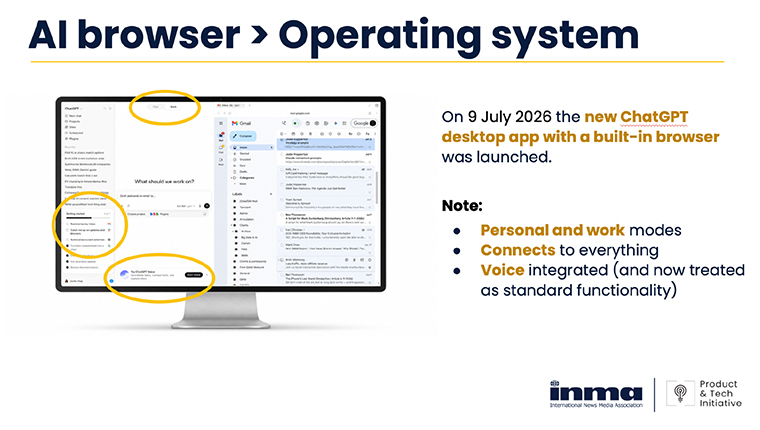
It can read the page, access other apps such as calendar, retrieve information, use software, and take action. Increasingly, the user will express an intention and leave the AI to decide which tools, sources, and steps are required.
The competitive landscape is also changing quickly. OpenAI may hold the strongest consumer position, Google has enormous distribution and integration advantages, Anthropic is building momentum in enterprise and coding, and open-source models are moving closer to the frontier.
There may not be one winner. Models are likely to become more interchangeable, while the interface, data, distribution, and customer relationship become more important.
For news organisations, this is bigger than adding a chatbot to a Web site. If AI becomes the principal interface through which people discover information and complete tasks, our journalism must work inside that environment. It must be accessible to machines, clearly attributed, consistently structured, and able to move across text, audio, video, and emerging interfaces.
The strategic question is no longer simply:
“How should we use AI?”
It is:
“What becomes of our product when AI is the operating system?”
2. AI’s gains are real — so are its costs
The first wave of generative AI was dominated by experiments.
Teams produced demonstrations, employees tried new tools, and leaders saw glimpses of dramatic productivity gains. The cost was often small enough to treat as innovation spending.
Production is different. Once AI becomes embedded in real workflows, its economics change. Model usage increases with activity. Agents make multiple calls to complete a task. Automated processes can operate continuously. Data must be prepared, stored, and governed. Outputs need evaluation and human oversight.
Meanwhile, most existing costs remain. Organisations continue paying for software licences, engineering, infrastructure, project management, and legacy workflows while adding model usage, integrations, security, governance, and change management.
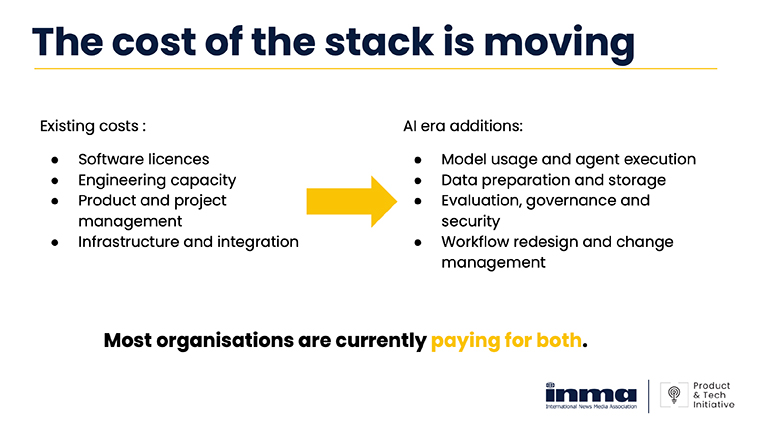
This doesn’t mean the investment is wrong. It means the business case needs to be more rigorous.
Before scaling an AI initiative, leaders should ask:
What measurable outcome will improve?
What is the full cost, including data, integration, and oversight?
Which budget owns it?
What permissions and controls are required?
Does this need deep automation, or would a simpler workflow be safer?
The organisations creating the most value are not necessarily those with the highest AI adoption. They are the ones redesigning valuable workflows and matching each task to the appropriate combination of models, software, and human judgement.
AI can make individuals faster. But sustainable value comes from changing how the organisation operates.
3. The leadership challenge is asking better questions
During periods of technological change, organisations often start with the assets and business models they already have.
How can we generate more Web site traffic?
How can we compete with ChatGPT?
How can we sell more subscriptions?
How much should an AI company pay to license our content?
These are understandable questions. But they may keep us focused on optimising a system that is already changing.

Better questions begin with the customer and the underlying value:
How do we get our journalism consumed by more people?
How do we become part of the answers people receive?
How do we become indispensable, wherever the customer chooses to interact?
How do we monetise our intellectual property across a fragmented distribution environment?
This shift matters because consumers increasingly separate the journalism they trust from the platforms they choose to use. They may value reporting from a publisher while preferring to encounter it through search, social video, audio, or an AI assistant.
That changes the value exchange.
A platform relationship is not only about licensing revenue. Traffic, customer identity, audience data, attribution, and brand visibility also move between the parties. A deal that increases one form of value while eliminating the others may not be a good deal at all.
No one knows which interface or business model will prevail. The leadership task is not to predict the winner with certainty.
It is to protect the organisation’s options.
That means maintaining a direct customer relationship while making journalism capable of travelling. It means experimenting without surrendering control of identity, rights, and data. And it means building the content and commercial infrastructure required to serve several possible futures.
The biggest AI risk isn’t moving too slowly.
It’s using AI to optimise a business model that no longer works.
If you’d like to subscribe to my bi-weekly newsletter, INMA members can do so here.
Related Articles
-

Marketers should outsource tasks, not thinking
25 October 2026 -

What makes an AI choose your news brand?
14 October 2026 -

Licensing won’t save media, but authentication might
13 October 2026 -

AI’s effect on super user math
15 September 2026 -

At Mediacorp’s CNA, loyalty means giving audiences a reason to ...
20 August 2026 -

Tribun Network turns print “dots” into AI-powered insight
20 August 2026 -

Nation Media Group focuses editorial strategy on stories that m...
4 August 2026 -

Briefly News empowers journalists with AI tool suite Nova
4 August 2026
Upcoming Events
-

Subscriber Acquisition Master Class
10-17 November 2026
-

Media Advertising Summit
New York, United States
07-10 December 2026
-

AI-Native News Product Master Class
18-25 February 2027
-

Media Subscriptions Summit
Oslo, Norway
08-12 March 2027
-

World Congress of News Media
New York, United States
25-30 April 2027
-

Branded Content & Partnerships Master Class
20-27 May 2027
-

Subscriber Retention Master Class
17-24 June 2027
-

Conferencia Latinoamericana
15-16 July 2027
-

South Asia News Media Festival
New Delhi, India
19-22 July 2027
-

Asia/Pacific News Media Summit
19-20 August 2027
-

CEO Roundtable at Kilkenny
Kilkenny, Ireland
24-26 August 2027
-

Media Innovation Week
Amsterdam, The Netherlands
27 September - 01 October 2027








