

An update on OpenAI and the LLM ad platforms
Advertising Initiative Blog | 14 September 2026

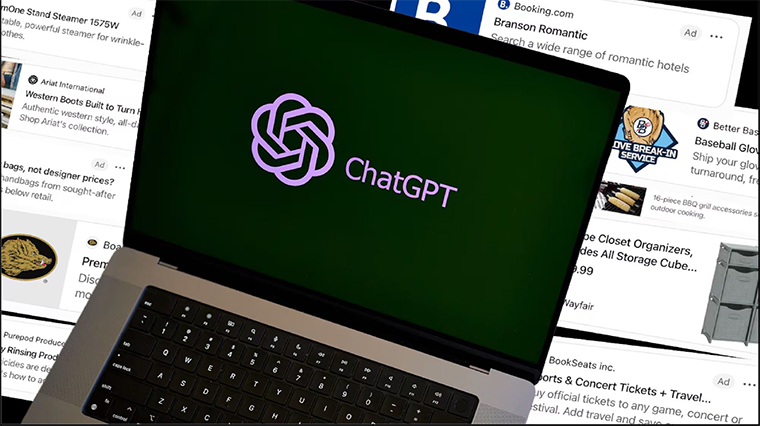
On August 31, OpenAI announced ChatGPT Ads had reached a US$1 billion annualised revenue run rate, roughly 200 days after the first U.S. test, with ads now live in more than 40 countries and self-serve opening the same day across Europe, the Middle East, India, and North Africa.
Adweek notes it’s a projection, not US$1 billion earned (yet), but Enders Analysis' Jamie MacEwan called it “impressive by any measure.”
It’s only about 2.5% of the US$40 billion-plus total run rate Bloomberg reported for OpenAI in August, and it sits well short of the US$2.5 billion OpenAI reportedly told investors it would make from ads this year. MacEwan notes, “It now seems certain that OpenAI will miss its advertising revenue target for 2026 by quite a way.”
For scale, Reddit made US$2.1 billion from ads in 2025, Snap US$5.9 billion, and Google and Meta are each growing their ad revenue by ~$1 billion a week this year.
Since I last wrote about this in June, OpenAI has been shipping product updates on a near-weekly basis.
The U.K. got self-serve and cost-per-click on June 19.Ads went live in 31 European markets on August 24, agency-first, through Publicis, Omnicom, WPP, Havas, Dentsu, and MediaPlus. OpenAI is hiring sales and customer-success roles in Paris, Munich, Dublin, and Singapore, and rolls each new country out to 10%, then 50%, then 90% of the audience while watching return rates and ad dismissals.
Cost-per-click now carries the majority of spend, per global ads chief Dave Dugan. Conversion-optimised CPC with a target CPA began rolling out in August, and a “maximise results” automated bid strategy, platform targeting, and one-day view-through conversions followed on August 24. Minimums are gone. New advertisers get US$50-US$100 in credits.
New features include first-party list uploads, custom audiences, geo include and exclude, and negative “context hints.” Adweek reported on August 26 that OpenAI is testing exclusion targeting with a small group, after buyers complained they have little control or visibility into where ads run.
LiveRamp was the first conversions-API partner in June, AppsFlyer followed on August 4 with Grubhub and 40 other brands testing in-app attribution, plus Kochava and WorkMagic. No IAS, DoubleVerify, or Zefr integration exists, and OpenAI admits it has no reliable cross-advertiser benchmarks.
Product carousels pulled from retailer feeds launched August 6, with OpenAI, not the advertiser, deciding whether to show one product or several. Search Engine Land spotted a test on July 31 where clicking an ad opens a business-specific ChatGPT conversation instead of a landing page. Job listings point to image, video, native, and conversational formats.
OpenAI replaced its chief revenue officer for the second time in a year in August, and a hire from The Trade Desk now runs partnerships. Job postings show an enterprise-first sales posture alongside a dedicated SMB unit, including vendor managers to run outsourced SMB sales the way Google and Meta do.
That remains Meta’s playbook, which is what I noted in June. Is it working?
Three independent relevance studies reported by Adweek found ads on about a quarter of commercial queries, with roughly one in seven having no topical connection to the prompt and only 38% directly relevant. MediaPost collected small-advertiser tests with 0.6% clickthrough rates, US$7 clicks, zero conversions, and OpenAI click counts two to three times what Google Analytics recorded.
Agencies are more positive: PMG says ChatGPT returns about twice the average of other platforms at today’s low spend levels. Lifesight’s Rajeev Nair told AdExchanger the platform is “very rudimentary” and dollars “will remain in ‘test’ budgets.”
Mutinex’s Henry Innis did some interesting math in August. At the roughly US$25 CPM the market has settled at, US$100 billion a year needs about four trillion impressions. ChatGPT handles something like three billion queries a day, so even at 100% fill on every query in every country, the ceiling is currently US$27 billion.
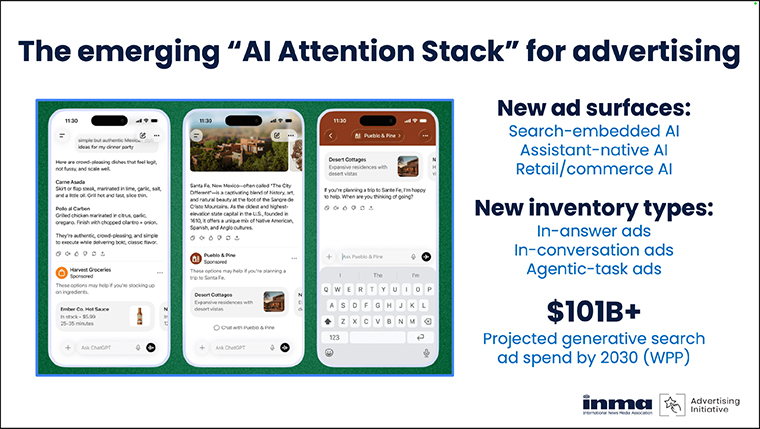
His optimistic 2030 case lands at US$50-US$55 billion, about half the current target. WPP Media’s new “generative search” line (which includes Google’s AI Overviews) is US$5.1 billion in 2026 heading toward US$100 billion by 2030.
Some news on other players.
Google told investors in July that AI Overviews and AI Mode are now one search experience and that AI Mode has more than a billion monthly users. They’re testing “Direct Offers” and “Highlighted Answers” (sponsored links inside list responses). The Gemini app, now around a billion monthly users, still carries no ads.
Amazon launched Alexa+ Agentic Ads at Cannes, where a shopper completes a purchase inside the ad. CEO Andy Jassy said in July that shoppers who click a sponsored prompt convert 48% more often.
Meta’s AI assistant has no ads, and Mark Zuckerberg’s stated model is business agents that “pay us when we achieve results.”
Perplexity has not returned to ads since exiting in February, Anthropic’s no-ads pledge stands, and Microsoft shipped nothing new for consumers.
I’ll continue watching all of this, especially in Q4, which is when advertisers traditionally set 2027 budgets.
If you’d like to subscribe to my bi-weekly newsletter, INMA members can do so here.
Banner art: Adobe stock image by Dmytro.
Related Articles
-

What makes an AI choose your news brand?
14 October 2026 -

Licensing won’t save media, but authentication might
13 October 2026 -

A short guide for publishers on Google’s adtech remedies
24 September 2026 -

In moving from an attention to an intention economy, who gets p...
16 September 2026 -

What’s really defensible in the age of AI?
30 August 2026 -

What I told 40 CEOs (and won’t gatekeep from you)
30 August 2026 -

Latin American publishers must rewrite ad strategies around out...
20 July 2026 -

Platforms took the Croisette in Cannes, and the ad business is ...
6 July 2026
Upcoming Events
-

Subscriber Acquisition Master Class
10-17 November 2026
-

Media Advertising Summit
New York, United States
07-10 December 2026
-

AI-Native News Product Master Class
18-25 February 2027
-

Media Subscriptions Summit
Oslo, Norway
08-12 March 2027
-

World Congress of News Media
New York, United States
25-30 April 2027
-

Branded Content & Partnerships Master Class
20-27 May 2027
-

Subscriber Retention Master Class
17-24 June 2027
-

Conferencia Latinoamericana
15-16 July 2027
-

South Asia News Media Festival
New Delhi, India
19-22 July 2027
-

Asia/Pacific News Media Summit
19-20 August 2027
-

CEO Roundtable at Kilkenny
Kilkenny, Ireland
24-26 August 2027
-

Media Innovation Week
Amsterdam, The Netherlands
27 September - 01 October 2027








