

With the Jagran Film Festival, Dainik Jagran turned culture into commerce
Advertising Initiative Blog | 25 June 2026

When Dainik Jagran set out to reinvent its relationship with readers, it wasn’t looking for a marketing stunt or a one‑off event; it was looking for relevance.
During this week’s members-only Webinar, presented by the INMA Advertising Initiative, members heard from Basant Rathore, senior vice president of strategic planning, brand, and business development at Jagran Prakashan, about how India’s largest news company turned to the cinema for answers.
Rathore began by pointing out that the challenge it faced wasn’t awareness. With 69 million daily readers, Dainik Jagran already dominated reach. But in a fragmented media environment where attention is split across screens, creators, and communities, the brand needed to become more than something people read. It needed to become something they experienced, remembered, and associated with culture.
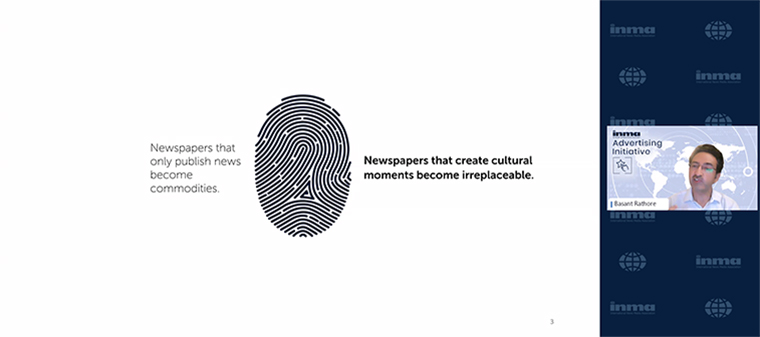
“A newspaper that only publishes news risks becoming a commodity,” Rathore said. “But a newspaper that creates cultural moments becomes much harder to replace.”
The answer, it was decided, was cinema, which Rathore said is “India’s most powerful cultural currency.”
And so it began to look at the Jagran Film Festival (JFF), a cultural property it launched in 2010 to promote cinema beyond India’s major metro cities. In the past 15 years, it has become an ambitious and popular travelling festival, and in 2025, Dainik Jagran reset its approach.
“[It] was not treated as a one-time event,” Rathore said. “It became a six-month campaign with 100 on-ground days across 14 cities and eight states. That gave the brand repeated high-impact moments at a scale that very few news brands attempt.”
The cultural connector
Cinema was the obvious choice for this cultural experience because it offers a universal appeal that resonates across regions, languages, and demographics.
“Cinema connects culturally,” Rathore said. “It could give me scale because our brand is spread across more than half or almost 40% of India.”
While cinema’s shared language transcends geography, it often feels inaccessible to audiences in smaller towns. Many people in India’s heartland have been conditioned to believe that global cinema “is not for them,” Rathore noted. It feels “distant, elite, urban, and inaccessible.”
JFF set out to challenge that belief.
Instead of creating a destination festival like Cannes or Berlin — where audiences travel to a single iconic venue — Jagran flipped the model. “Instead of asking audiences to travel to the festival, the festival travelled to the audience,” Rathore said.
This strategic shift allowed Dainik Jagran to leverage its deep presence across the heartland. The festival wasn’t being forced into unfamiliar territory; it was meeting readers where they lived, worked, and gathered.
Six months of cinema
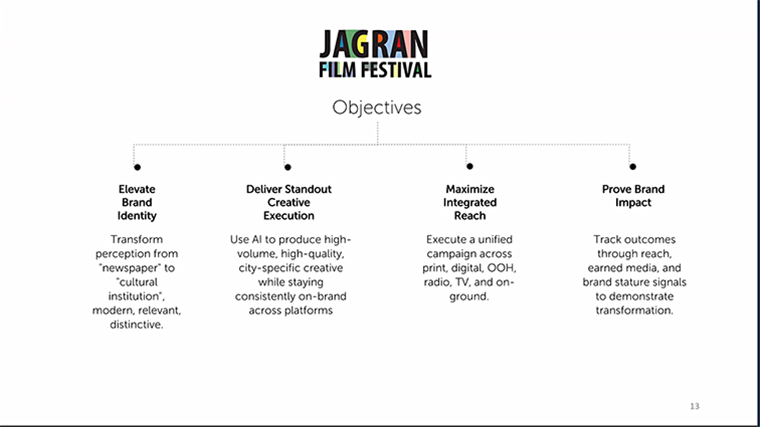
The enormous scale of the new campaign raised new questions. With 583 film screenings, films from 62 countries in 59 languages, and 72 live sessions — all done while the festival moved from one city to the next — Rathore said they wondered, “how do we deliver this without losing speed, control, or consistency?”
Each city required its own programming, celebrity guests, marketing, and audience engagement strategy.
“Different cities, different languages, different celebrities, different schedules, different audience needs,” Rathore said. “The risk was very clear … . If execution becomes inconsistent, the brand identity becomes blurred.”
And that was where AI entered the picture.
AI as the festival’s OS
AI wasn’t used as a shortcut; instead, it was established as infrastructure, ensuring a consistent, premium Dainik Jagran experience in each city.
“AI handled the complexity so that the teams could focus on creating meaning,” Rathore said. “That meant more time for curation, more time for audience experiences, more time for children’s programming, masterclasses, inclusive screenings, and the human side of the festival.”
And the human side was crucial: The festival required thousands of hyper-localised creatives who were city‑specific, celebrity‑specific, and event‑specific. For these creatives, Rathore said tools like Gamma, AI, and Café were essential, generating more than 3,500 creatives. ensuring both speed and visual consistency.
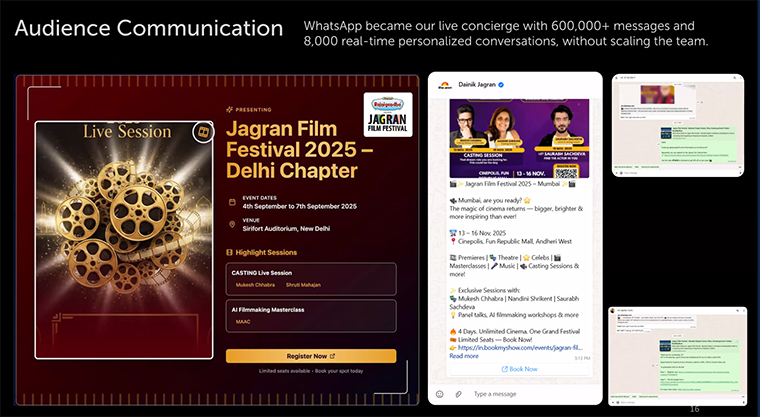
Audience communication was also outsourced to AI, and Rathore said WhatsApp “became a live concierge for the festival.” It handled 600,000 messages and enabled 8,000 real-time personalised conversations.
“This made the experience feel responsive without requiring the team to scale up in every little city,” Rathore explained.
Registrations for the festivals were also managed efficiently thanks to AI, which handled thousands of registrations with zero errors.
“That’s a very important operational point,” Rathore said. “AI was not just helping with the glamorous creative work. It was also quietly serving the boring but critical backend work that decides whether an event feels seamless or chaotic.”
A word for the sponsors
Sponsors also benefited from the new approach. Rathore said AI‑powered dashboards and chatbots provided instant support and data‑driven insights, elevating the value sponsors received far beyond logo placement, Rathore said.
“This meant sponsors were not simply attached to the festival as a logo partner. They could be serviced with better information, faster responses, clearer visibility and all of that. AI became an insight and strategy engine for us.”
The team also turned to AI for content strategy and optimisation.
“It helped with instant creative content creation … and understanding what themes would perform better,” he said.
AI also provided creative ideation for reels, posts, banners, and announcements, allowing the team to keep communication relevant as the festival kept moving from one city to another.
Microsoft Clarity helped convert Web site interaction into actionable insights, allowing the team to better understand how users navigated the festival pages online and how they looked at the films, listings, schedules, and passes.
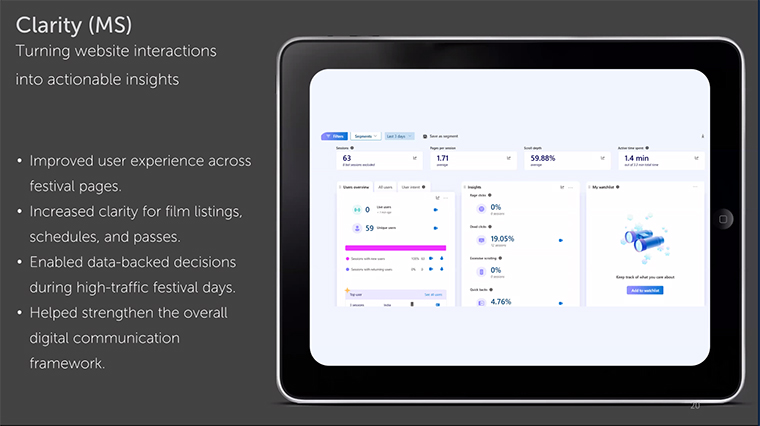
“This helped us improve the user experience during the high-traffic festival days,” Rathore said.
AI for education and access
The most interesting part, Rathore said, is that AI was not used just behind the scenes; it was also used to teach some 2,000 aspiring filmmakers how to use AI filmmaking tools.
“So the same technology powering the festival became part of the festival’s educational mission as well,” he said. And what he learned from that is, “When machines handled logistics, humans had more time to focus on meaning. The team could curate experiences that mattered to children, young filmmakers, neurodiverse audiences, and first-time festival-goers. So we focused on the human experience.”
Creating a cultural property
To transform JFF into a national cultural moment, Dainik Jagran deployed a fully integrated marketing strategy.
The festival generated more than 100 pages of unique newspaper content, strengthening the connection between the event and Jagran’s core product. Advertising also helped build awareness and momentum around the festival, Rathore said:
“The role of advertising here was not just to announce rates. It created anticipation. It created a signal of scale. It made JFF look like a cultural property.”
Additionally, with more than 2,500 posts and 35 million views, social media helped the festival “travel digitally” before and after it reached each city. Outdoor campaigns in each city ensured every location felt the festival’s arrival, which Rathore said was crucial for a travelling event.
Influencers and storytellers added to the momentum, Rathore said: “When creators and local voices talk about an event, it becomes even more believable and it becomes more culturally embedded.”
Finally, earned media boosted the campaign.
“Digital media coverage helped extend the story beyond attendees and audiences who may not have physically attended the event,” Rathore said. “On social media, earned conversations added another layer of credibility. The festival was no longer speaking about itself. Others were speaking about it.”
Across platforms, JFF reached more than 540 million people. On the ground, more than 50,000 people attended screenings and sessions.
“JFF made Dainik Jagran impossible to ignore and impossible to categorise as just a newspaper,” Rathore said. “The brand that brings people news also brought them the world.”
Related Articles
-

Marketers should outsource tasks, not thinking
25 October 2026 -

AI is now media’s operating environment
28 September 2026 -

The 3 editorial pillars of Chile’s first streaming news channel
23 September 2026 -

AI’s effect on super user math
15 September 2026 -

At Mediacorp’s CNA, loyalty means giving audiences a reason to ...
20 August 2026 -

Tribun Network turns print “dots” into AI-powered insight
20 August 2026 -

Nation Media Group focuses editorial strategy on stories that m...
4 August 2026 -

Briefly News empowers journalists with AI tool suite Nova
4 August 2026
Upcoming Events
-

Subscriber Acquisition Master Class
10-17 November 2026
-

Media Advertising Summit
New York, United States
07-10 December 2026
-

AI-Native News Product Master Class
18-25 February 2027
-

Media Subscriptions Summit
Oslo, Norway
08-12 March 2027
-

World Congress of News Media
New York, United States
25-30 April 2027
-

Branded Content & Partnerships Master Class
20-27 May 2027
-

Subscriber Retention Master Class
17-24 June 2027
-

Conferencia Latinoamericana
15-16 July 2027
-

South Asia News Media Festival
New Delhi, India
19-22 July 2027
-

Asia/Pacific News Media Summit
19-20 August 2027
-

CEO Roundtable at Kilkenny
Kilkenny, Ireland
24-26 August 2027
-

Media Innovation Week
Amsterdam, The Netherlands
27 September - 01 October 2027








