

Clarín’s AI governance, cultural change turn newsroom experiments into lasting capabilities
Conference Blog | 22 July 2026

The real challenge of AI is not adopting the technology itself but embedding it into newsroom culture, governance, and everyday decision-making, according to Leonardo Dalera, chief data and analytics officer at Argentina’s Grupo Clarín.
“The day-to-day forces us to adapt and make course corrections,” Dalera said at the recent INMA Latin American Conference. “Sometimes those sharp turns are painful, but they are necessary in the era we are living through.”
For Clarín, the goal is not to build AI products for the sake of innovation. Every initiative must generate measurable impact rather than become “a waste of time and money,” he said.
AI at scale in one of Latin America’s largest newsrooms
Clarín’s scale illustrates why efficiency and editorial impact matter.
The newsroom produces approximately 600 stories every day, serving 400 million monthly unique users, generating 200 million pageviews, and supporting a subscriber base of 750,000.
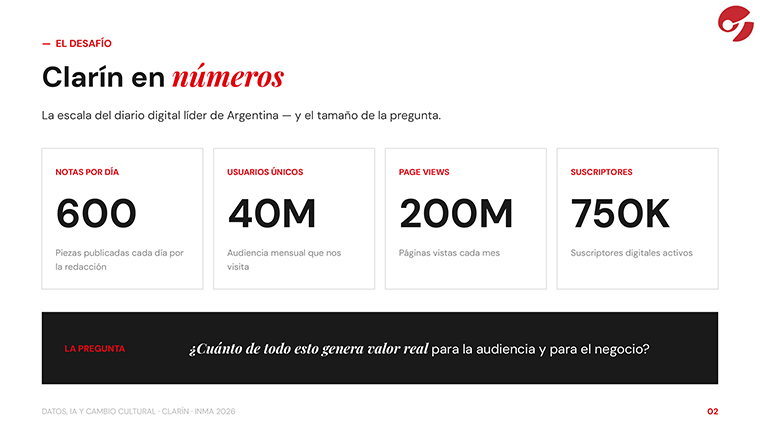
Those numbers, Dalera said, raise an important question: Is the organisation truly delivering value to audiences?
Traffic alone is no longer the primary metric. Instead, the challenge is ensuring that hundreds of daily stories create sustained audience engagement and business value. AI, he said, is fundamentally reshaping how relevant, high-quality journalism is produced and managed.
The FIFA World Cup as an AI laboratory
One of Clarín's largest AI experiments came during the FIFA World Cup, where the company treated the tournament as a live innovation lab.
For more than a month, the newsroom tested AI-assisted products including:
-
Match summaries.
-
Statistical analysis.
-
AI-assisted match reports.
-
Interactive chat experiences allowing readers to ask questions about the tournament.
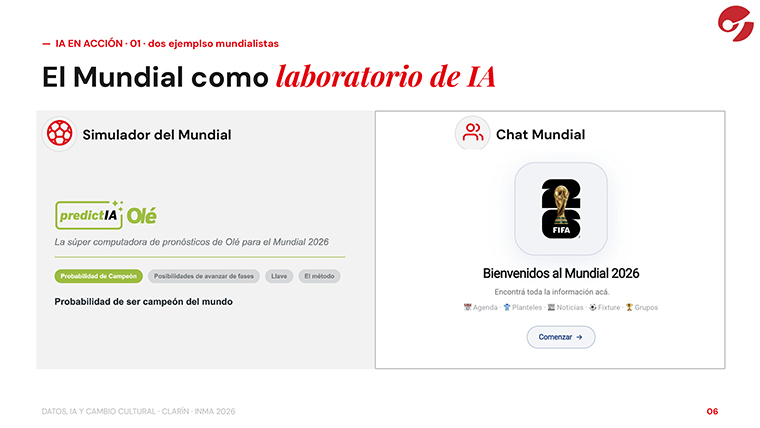
The company also developed a World Cup prediction simulator built on mathematical probability models.
The simulator calculated each national team’s chances of advancing through every stage of the tournament — from the group phase to the Round Posts of 16, quarterfinals, semifinals, and the final.
Besides increasing user engagement, the model achieved approximately 70% prediction accuracy during the tournament. Dalera joked that although he is rarely happy when mathematical models fail, he enjoyed seeing England lose to Argentina despite the simulator’s expectations.
Following the tournament’s success, Clarín plans to reuse the prediction engine for future football competitions, recognising the country’s strong football culture.
The company also produced AI-generated tournament guides, player biographies, and other editorial products related to the competition.
AI integrated directly into newsroom workflows
Rather than relying on external AI tools, Clarín has embedded AI capabilities directly inside its CMS.
Dalera described three primary editorial functions:
-
Editorial assistance that suggests headlines, decks, abstracts, and editing improvements with a single click.
-
SEO and content distribution support to optimise articles for search engines.
-
Productivity tools for audio and video transcription, translation, and content clipping.
The integrated workflow prevents staff from using separate consumer AI tools while freeing journalists from repetitive tasks so they can spend more time reporting.
Measuring value beyond pageviews
One of Clarín’s biggest changes has been redefining how editorial success is measured.
Traditional newsroom debates often revolve around questions such as whether a story is good because of its length, topic, or number of pageviews.
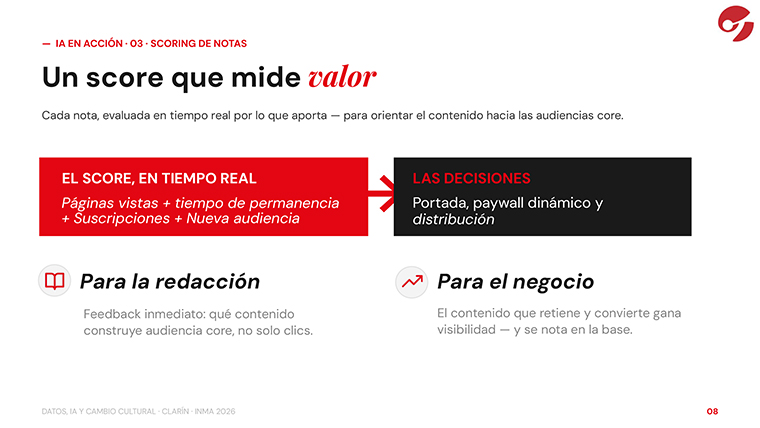
Because quality remains subjective, Clarín developed an internal scoring model that evaluates every article on a scale from one to 10.
The score combines several variables, including:
-
Pageviews.
-
Reader engagement time.
-
Subscription conversions.
-
New audience acquisition.
The resulting score offers editors what Dalera described as “a different way of observing a story’s performance.” The rating also drives editorial decisions in real time.
Stories can move onto or off the homepage depending on performance, while Clarín’s dynamic paywall can automatically lock or unlock content according to each article’s score.
The approach has fundamentally changed how the company defines quality. Instead of focusing primarily on pageviews, clicks, click through rate (CTR), rankings of the most-read stories, or publication volume, editors now emphasise:
-
Deep engagement.
-
Audience quality.
-
Registration and subscription contribution.
-
Retention.
-
Habit formation.
As Dalera summarised, a story gains value through what it builds with audiences rather than simply what it accumulates.
AI extends beyond the newsroom
Editorial operations represent only one part of Clarín’s AI strategy.
Dalera identified three broader business areas where AI is creating value:
-
The first involves operational efficiency through workflow optimisation and automation of repetitive tasks.
-
The second supports commercial teams. Sales executives, for example, can use AI assistants around the clock to answer questions about advertising formats, products, and commercial information before meeting clients.
-
The third focuses on data.
Instead of navigating dashboards manually, employees increasingly interact with analytics through natural-language chat interfaces.
“Chats are increasingly replacing traditional dashboard interactions,” Dalera said, allowing employees to ask virtually any question about business metrics.
That shift, he noted, is changing how organisations consume data and make decisions.
Governance enables innovation
Although AI receives most of the attention, Dalera said technology itself is actually “the easiest part.” Without governance, organisations cannot safely or effectively scale AI adoption.
Clarín’s governance framework rests on four pillars:
-
Clear principles and policies defining acceptable AI use across the organisation.
-
A multidisciplinary AI committee that prioritises use cases, evaluates risks, coordinates training, communicates internally, and accelerates decision-making.
-
Organisation-wide training so AI expertise extends beyond technical teams.
-
Data quality, privacy, compliance, and security to ensure reliable responses within secure internal environments.
“If someone asks a question, the answer must be accurate and free from ambiguity,” Dalera said, emphasising that sensitive company information should remain inside protected environments.
AI champions drive cultural transformation
At the top of Clarín’s governance structure sits its AI committee. Supporting it is a network of AI ambassadors embedded across business units.
These champions identify local use cases, surface operational challenges, train colleagues, and help solve day-to-day problems that eventually benefit the broader organisation.
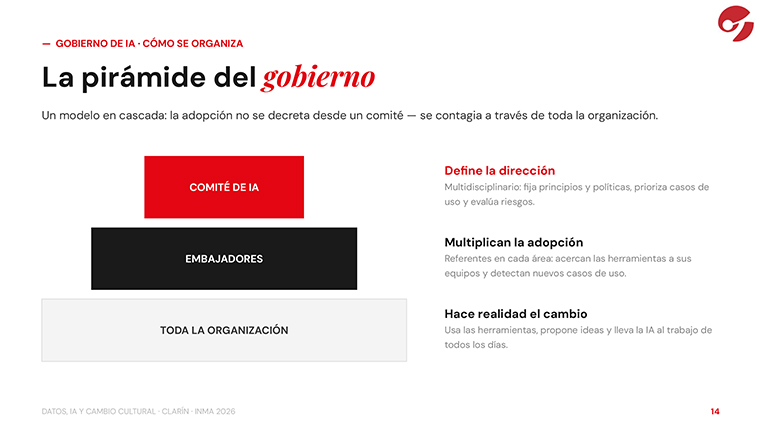
According to Dalera, these initiatives create a “spillover effect” that accelerates cultural transformation throughout the company.
AI programmes never end
AI governance should never be viewed as a temporary initiative, Dalera said: “It is not about launching a governance program that ends in six months, one year, or two years.”
Instead, governance provides the structure that allows organisations to innovate faster rather than slowing them down.
Among Clarín’s biggest lessons, he said, is that AI amplifies journalistic judgment rather than replacing it: “The best results come when journalism leads and AI executes.”
Ultimately, governance transforms isolated experiments into permanent organisational capabilities, while cultural change becomes the most important product of all.
Banner photo: Adobe Stock by patpitchaya.
Related Articles
-

Marketers should outsource tasks, not thinking
25 October 2026 -

WSJ executive councils show how publishers build communities th...
19 October 2026 -

AI’s effect on super user math
15 September 2026 -

At Mediacorp’s CNA, loyalty means giving audiences a reason to ...
20 August 2026 -

Tribun Network turns print “dots” into AI-powered insight
20 August 2026 -

AI’s value in a news company should be measured in these 4 ways
11 August 2026 -

Nation Media Group focuses editorial strategy on stories that m...
4 August 2026 -

Briefly News empowers journalists with AI tool suite Nova
4 August 2026
Upcoming Events
-

Subscriber Acquisition Master Class
10-17 November 2026
-

Media Advertising Summit
New York, United States
07-10 December 2026
-

AI-Native News Product Master Class
18-25 February 2027
-

Media Subscriptions Summit
Oslo, Norway
08-12 March 2027
-

World Congress of News Media
New York, United States
25-30 April 2027
-

Branded Content & Partnerships Master Class
20-27 May 2027
-

Subscriber Retention Master Class
17-24 June 2027
-

Conferencia Latinoamericana
15-16 July 2027
-

South Asia News Media Festival
New Delhi, India
19-22 July 2027
-

Asia/Pacific News Media Summit
19-20 August 2027
-

CEO Roundtable at Kilkenny
Kilkenny, Ireland
24-26 August 2027
-

Media Innovation Week
Amsterdam, The Netherlands
27 September - 01 October 2027








