

Journalism: the missing layer in the AI economy?
Conference Blog | 20 May 2026

Many conversations about AI and journalism revolve around automation, chatbots, and general newsroom/AI anxieties. But during this week’s INMA South Asia Webinar, Pradeep Gairola, chief digital business officer at The Hindu, focused his attention on something far more fundamental: why the AI industry cannot function without original journalism — and how that gives publishers far more structural power than they realise.
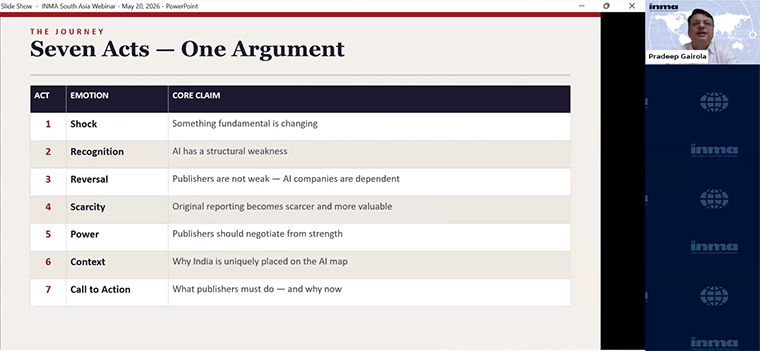
Seven acts, one argument
Gairola unfolded his theory in seven acts, the first of which is shock: “Something fundamental is changing in how knowledge gets created,” he said.
That shift, he warned, has consequences as profound as a currency collapse. He pointed to 1920s Germany, when hyperinflation destroyed the value of the mark because “once the representation was no longer a reality, then printing became infinite. And when printing became infinite, trust collapsed — not gradually, but catastrophically,” he said before drawing a metaphor for the modern world.
“Replace gold with original human knowledge. Replace paper currency with AI-generated content,” Gairola said, revealing that in November 2024, the number of AI-generated articles published on the Web surpassed the amount of content produced by humans.
However, instead of seeing this as a threat, Gairola framed it as an opportunity: “The more synthetic content floods the Web, the more valuable trusted original knowledge becomes.”
He noted that Google’s 2024 core update aggressively penalised low‑quality AI‑generated pages because “if this content becomes the new reality, then everything is destroyed.”
The correction has begun. But publishers must decide whether they will shape it — or be shaped by it.
The weaknesses of AI
Understanding the structural weakness of AI is the second act, and Gairola pointed out AI is not the first technological disruption journalism has faced; it is, in fact, the third.
“And every wave of digital technology has made one claim: it is liberating journalism,” he said. “And every wave has been partially right and incomplete.”
The first layer, the Internet, democratised publishing: “For the first time, you could publish anything without a printing press, a distribution network, or an editor’s approval,” he said. “The gatekeepers to publishing fell.”
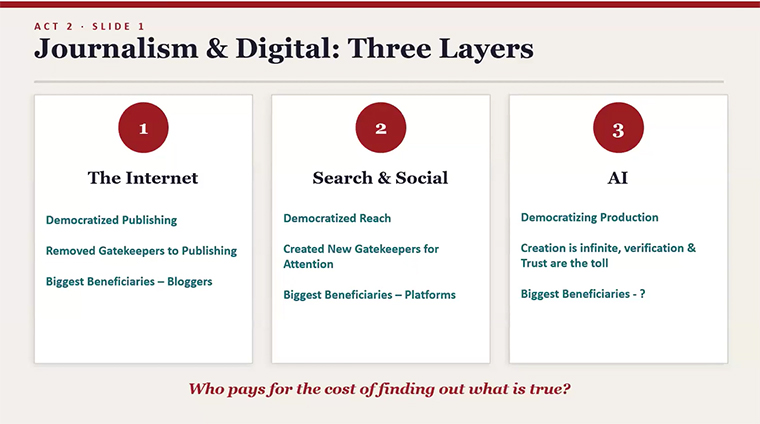
The second layer, search and social, democratised reach and “distribution effectively became free.” However, the platforms, not newspapers, saw the greatest gains from this.
“The biggest beneficiaries were the platforms themselves, who captured advertising revenue… while carrying no cost of producing the journalism,” Gairola explained.
Now, with the third layer — AI — production is democratised, and low‑end tasks such as summarising, translating, and templating are being automated.
This offers an opportunity, as it frees up journalists to perform higher-level tasks, but Gairola said it raises an important question: who benefits most? If history repeats, AI will liberate production but consolidate something even more valuable than money: knowledge itself.
This brings up what he called “the missing layer” of monetisation. AI depends on journalism to feed it fresh, updated content: “Without a continuous supply of new original human-reported knowledge, AI models will degrade,” he said.
Turning the tables
This leads to the third act — reversal. Once publishers recognise that they are neither weak nor helpless, and that AI companies depend on them for a steady stream of information, it can spark real change.
“Publishers hold more structural power than they realise, continue to negotiate individually, position themselves against each other, and fail to see what they are,” Gairola said. “In fact, they all are on the same side of democratic forces that original journalism has always served. The same side as the public, which depends on verifying knowledge to function as citizens.”
He urged publishers to consider that not only does AI have weaknesses, but that they have a power they are not yet using.
Gairola introduced what he called the Original News Production Layer, or ONPL, which maps content into two axes: originality and credibility.
“When you map it this way, something becomes immediately clear: The bottom right quadrant, derivative and low credibility, is a noise layer. And this is where almost AI-generated content currently lives.”
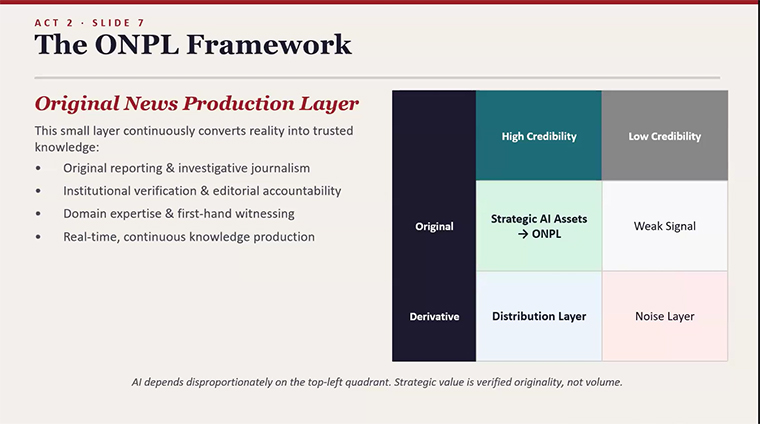
However, only one quadrant matters for AI: original material with high credibility. This is where investigative reporting, institutional verification, domain expertise, and real‑time knowledge production live.
“This quadrant is small … and yet AI depends on it disproportionately,” he said, noting AI cannot generate ONPL material. It cannot discover new facts. It cannot verify claims. It cannot witness events. It can only remix what humans have already created.
That means, he said, that “AI has three structural dependencies on us.” The model is looking for freshness, credibility, and novelty — three traits inherent to journalism.
The scarcity problem
The fourth act, scarcity, arises when AI systems run out of high-quality human text for training. As synthetic content grows exponentially, the pool of original, verified reporting shrinks.
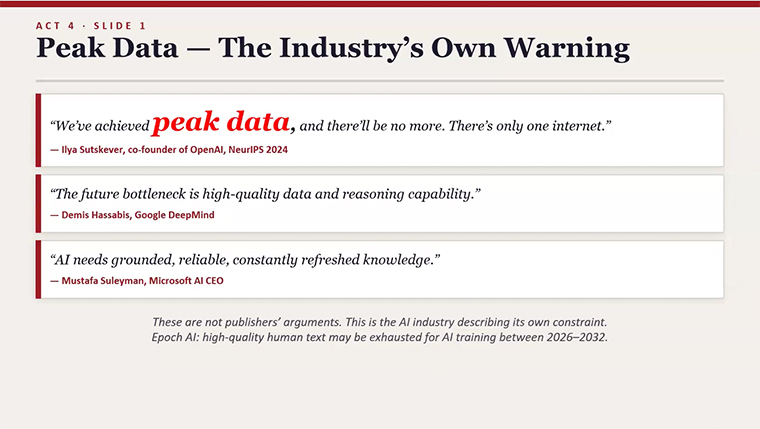
“We have established that AI depends on original journalism structurally,” he emphasised. “Now I want to show you that this dependency is not a future problem; it is a present crisis, and the evidence for it comes not from publishers but from the AI industry itself.”
The term for it is “peak data”— a phrase borrowed from the energy industry term “peak oil.” This, Gairola noted, is “the point at which global oil production reaches its maximum and begins to decline. Not all oil runs out overnight, but the easy supply is gone.”
AI, he said, has reached its own version of that moment, creating an urgent commercial question for both the AI industry and publishers.
Getting AI to pay for data is just half the battle; the other challenge lies in the degradation that occurs when models train on their own synthetic outputs.
Quality content gives way to “AI slop” that is mass-produced, low-quality, and cheap. This leads to what researchers call model collapse: “a degenerative process affecting successive generations of learning models in which the data they generate end up polluting the training set of the next generation.”
Act five occurs when publishers understand how much power they hold. For 30 years, publishers have been the extractable layer at the bottom of every digital value chain; AI changes the structure.
Unlike the Internet or social platforms, AI needs journalism to survive. It cannot engineer their way out of its dependency on fresh, continuously updated reporting, verified facts, and original discoveries. And that gives publishers leverage they have never had before.
To provide context — the sixth act — Gairola explained India’s unique position as a potential “most important protagonist” in the global economy. AI leaders are making “commercial commitments of extraordinary scale” to India, not out of diplomacy but necessity.
With 32 languages and hundreds of dialects, India is home to one of the richest and most complex linguistic ecosystems in the world. “Nobody can serve India without knowing them,” Gairolsa said, and AI systems cannot answer complex questions about specific events unless they are trained on high‑quality Indian reporting.
India’s linguistic and cultural depth makes its journalism an indispensable infrastructure for any AI model that hopes to operate meaningfully in the country.
After a decade of chasing traffic, he said, Indian publishers must recognise their structural power and organise around it — because AI cannot function in India without them.
A call to action
Finally, Gairola said, publishers must realise the window that has opened and move through it before it closes. He said early deals have already been made, as data exhaustion has begun, and by 2032, that opportunity will be much weaker for publishers.
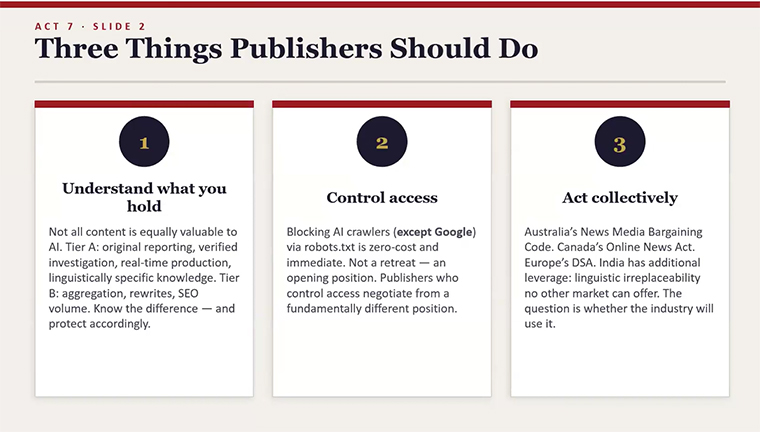
“For 30 years, technology has worked for journalism. Now it must work for monetisation,” he said. “AI systems cannot sustain themselves without original, verified, human-generated knowledge.”
That puts the power in the hands of the news media industry, and it is up to publishers to negotiate and claim their true value. The question is, he said, “Whether publishers will negotiate like they understand the value of what they hold … and come to the table with the clarity, the confidence, and collective will to claim what is structurally, commercially, and urgently there.
“This is the choice we need to make.”
Related Articles
-

Marketers should outsource tasks, not thinking
25 October 2026 -

Bundling is a pricing decision, rebundling is an organisational...
18 October 2026 -

AI’s effect on super user math
15 September 2026 -

At Mediacorp’s CNA, loyalty means giving audiences a reason to ...
20 August 2026 -

Tribun Network turns print “dots” into AI-powered insight
20 August 2026 -

Nation Media Group focuses editorial strategy on stories that m...
4 August 2026 -

Briefly News empowers journalists with AI tool suite Nova
4 August 2026 -

Indian Express builds a video-first future around trusted journ...
20 July 2026
Upcoming Events
-

Subscriber Acquisition Master Class
10-17 November 2026
-

Media Advertising Summit
New York, United States
07-10 December 2026
-

AI-Native News Product Master Class
18-25 February 2027
-

Media Subscriptions Summit
Oslo, Norway
08-12 March 2027
-

World Congress of News Media
New York, United States
25-30 April 2027
-

Branded Content & Partnerships Master Class
20-27 May 2027
-

Subscriber Retention Master Class
17-24 June 2027
-

Conferencia Latinoamericana
15-16 July 2027
-

South Asia News Media Festival
New Delhi, India
19-22 July 2027
-

Asia/Pacific News Media Summit
19-20 August 2027
-

CEO Roundtable at Kilkenny
Kilkenny, Ireland
24-26 August 2027
-

Media Innovation Week
Amsterdam, The Netherlands
27 September - 01 October 2027








