

La Nación builds a secure AI ecosystem for journalism
Conference Blog | 22 July 2026

La Nación has moved beyond experimenting with generative AI to building a company-wide infrastructure that integrates AI into newsroom workflows while maintaining strict editorial oversight, according to executives speaking at the INMA Latin American Conference.
Florencia Coelho and Martín Pascua, who both work in multimedia and data development at the Argentina-based company, outlined how the media company has deployed generative AI across multiple departments to optimise processes, reduce costs, and save time within a secure, controlled environment.
Rather than limiting AI adoption to the newsroom, La Nación has involved six business units in the initiative, including editorial, product and technology, data and analytics, training, and other areas of the organisation.
Building AI around newsroom needs
The company’s AI ecosystem is presented as a toolkit for journalists that combines several capabilities into a centralised platform. These include an integrated writing assistant, automatic content tagging, workflow automations connected to large language models (LLMs), centralised model integration, and AI agents.
A core principle behind the initiative is ensuring generative AI operates within a controlled environment to prevent external exposure of company data.
Equally important is the newsroom’s commitment to keeping humans in charge.
“We use the concept of human in the loop,” Coelho explained. “Journalists review, edit, or discard what AI produces. Nothing is published without editorial control.”
Training came before technology
Before designing training programmes, La Nación surveyed employees to understand how different teams were already using AI and analysed how other news organisations had implemented similar technologies.
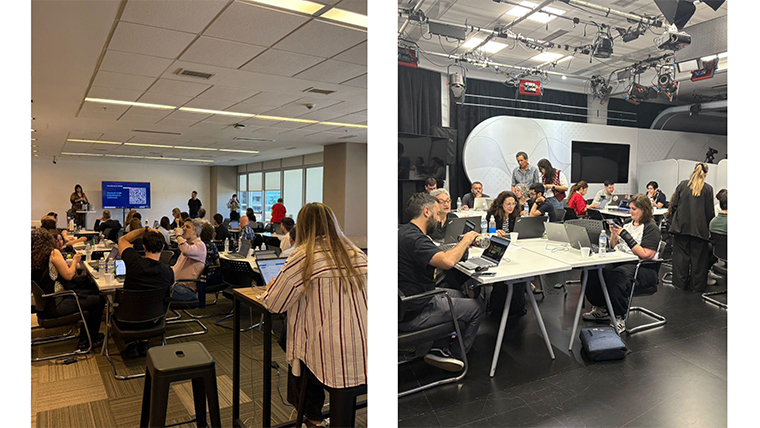
Those findings shaped workshops that introduced editorial guidelines and practical criteria for using AI responsibly.
“The idea was to accompany them and guide them through the process,” Coelho said.
La Nación also developed many of its newsroom tools collaboratively with journalists, ensuring that the technology addressed real editorial needs rather than imposing external workflows.
A newsroom toolkit built in-house
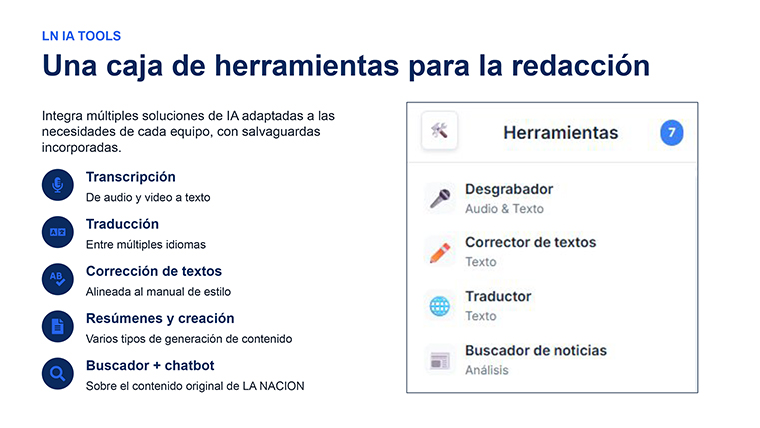
The resulting AI toolkit includes:
-
Audio and video transcription into text.
-
Translation between multiple languages.
-
Text correction aligned with La Nación’s style guide.
-
Summarisation and assistance in creating certain types of content.
-
A semantic search engine.
-
A chatbot capable of answering questions using La Nación’s original content archive.
The search tool retrieves information directly from the newspaper’s editorial archive and is enhanced with an AI assistant that discusses only search results while displaying related images from the company’s PhotoCenter.
Journalists can search by section, tags, specific time periods, headlines, or keywords.
Automatic content tagging also became a key component of the workflow. The system can assign up to five tags per article, while editors review and refine the suggestions. The newsroom also maintains a “red list” of excluded tags and the tagging system integrates with other editorial solutions.
Pascua emphasised the tagging tool does not invent or create new metadata. “It searches existing tags and presents them. It doesn’t create new ones.”
Centralising AI connections
Another major component is a series of automations connected to large language models. According to Pascua, these tools were developed internally using open-source software and hosted on the company’s own servers.
Coelho illustrated one newsroom application: monitoring speeches by Argentine President Javier Milei. The workflow automatically transcribes speeches, classifies them using AI, and then sends the output to a human editor for verification.
To avoid configuring each language model individually, the technology team centralised all model connections behind a unified backend. That architecture standardises the technical integrations while simplifying future upgrades.
If a new AI model or capability becomes available, the newsroom can deploy it rapidly without rebuilding every workflow.
Measurable operational and cultural impact
According to Coelho, generative AI has accelerated newsroom operations through assisted tagging, automated text correction, and semantic archive searches.
The internal search engine has proven particularly successful, surpassing both the company’s previous search system and external platforms such as Google for editorial archive retrieval.
The implementation also created continuous feedback loops between journalists, editors, and developers, allowing internal tools to evolve while maintaining data privacy.
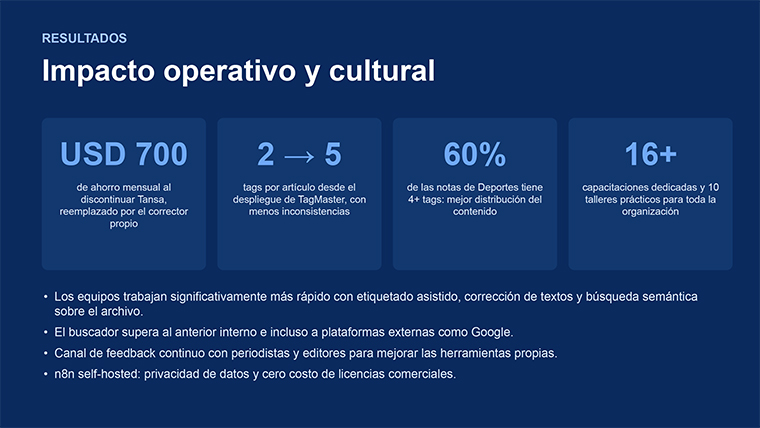
Because the company built many of its own solutions, it eliminated commercial licensing expenses. One example was replacing a previous correction system with its proprietary editor, generating savings of approximately US$700 per month.
The expansion from two to five relevant tags per article also improved content distribution across platforms.
To support adoption, La Nación conducted nearly 20 training sessions, reaching 242 active users.
AI for football coverage
AI for football coverage
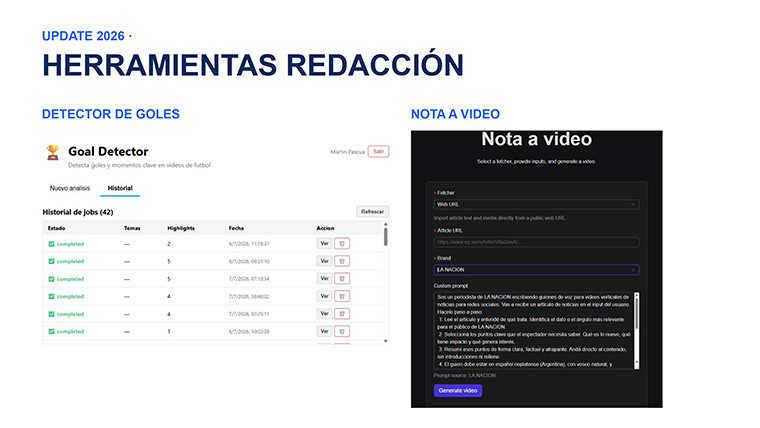
Recognising Argentina’s passion for football, the AI team also developed specialised tools for sports coverage. One detects goals in real time during FIFA World Cup matches as highlights become available.
Due to FIFA copyright restrictions, La Nación can embed goal videos only for audiences in Argentina through its proprietary video platform. Although initially designed for the World Cup, Pascua said the technology will be reused for future football tournaments.
The company also created its own World Cup prediction simulator based on a mathematical model developed by an Argentine university.
Meanwhile, with support from Scandinavian media company Schibsted, La Nación is adapting technology capable of converting written articles into videos.
Another innovation is ChatLab Arena, an AI chat system that answers questions using La Nación’s own editorial archive rather than relying solely on general-purpose AI models.
For example, a journalist can ask for a match chronicle of Argentina versus England, and the system generates multiple versions based on the newspaper’s historical reporting, allowing the reporter to select the most appropriate one.
The long-term goal is to expand this archival AI assistant beyond sports into other editorial areas, further embedding generative AI into the newsroom’s daily operations while preserving human editorial judgment.
Banner photo: Adobe Stock By InfiniteFlow.
Related Articles
-

Journalists create agentic workflows at Bonnier
25 October 2026 -

AI is now media’s operating environment
28 September 2026 -

The best use of agentic AI in a newsroom is the job nobody want...
20 September 2026 -

What news CEOs are investing in — and what they are killing
8 September 2026 -

Inside MK Media Group’s AI transformation journey
25 August 2026 -

WSJ Japan finds AI translation is “not a one-and-done deal”
24 August 2026 -

La Nación built an AI infrastructure — not just a toolbox
9 August 2026 -

Clarín’s AI governance, cultural change turn newsroom experimen...
22 July 2026
Upcoming Events
-

Subscriber Acquisition Master Class
10-17 November 2026
-

Media Advertising Summit
New York, United States
07-10 December 2026
-

AI-Native News Product Master Class
18-25 February 2027
-

Media Subscriptions Summit
Oslo, Norway
08-12 March 2027
-

World Congress of News Media
New York, United States
25-30 April 2027
-

Branded Content & Partnerships Master Class
20-27 May 2027
-

Subscriber Retention Master Class
17-24 June 2027
-

Conferencia Latinoamericana
15-16 July 2027
-

South Asia News Media Festival
New Delhi, India
19-22 July 2027
-

Asia/Pacific News Media Summit
19-20 August 2027
-

CEO Roundtable at Kilkenny
Kilkenny, Ireland
24-26 August 2027
-

Media Innovation Week
Amsterdam, The Netherlands
27 September - 01 October 2027








