

La Nación built an AI infrastructure — not just a toolbox
Ideas Blog | 09 August 2026

One year ago, a journalist at La Nación who needed to transcribe a presidential speech had to do it manually. Today, the same journalist logs a new appearance by President Milei into a shared spreadsheet, and within minutes, an automated workflow delivers a transcription back to that same cell.
No third-party subscription required. No sensitive audio leaving the building.
That shift — from ad hoc experimentation to embedded infrastructure — is our journey at La Nación. Our team spent the past two years building not a collection of AI gadgets but a coherent, secure, and human-supervised ecosystem that serves the entire organisation, based on our internal users’ needs.
The challenge: speed without recklessness
Like most news organisations, La Nación faced a familiar tension: pressure to publish faster and do more with fewer resources, while preserving the editorial standards and data security that readers and advertisers trust.
The risk of simply pointing journalists at generic AI platforms was clear — sensitive sources, unpublished drafts, and proprietary data would flow through external servers with no guarantee of confidentiality.
The answer was to build something in-house, guided by a non-negotiable principle: every AI-generated output must remain fully reviewable, editable, and discardable by a journalist. AI assists, but humans decide.

A suite of tools built around real newsroom needs
The centrepiece is LNIAtools, a proprietary toolbox that brings transcription, translation, text correction, summarisation, customised formats for content creation, related photo and image search, and podcast script generation into a single, access-controlled interface.
The most-used feature is a semantic search engine over La Nación’s own archive — decades of original journalism, now accessible via an AI chatbot that cites its sources and never hallucinates outside the corpus.
Alongside the toolbox, a Chrome extension integrates a generative AI corrector directly into ARC Composer, the newsroom’s CMS. The corrector applies La Nación’s own style guide in real time, flagging errors as journalists write.
The result: The newsroom cancelled its external grammar-correction service, saving US$700 per month from day one.
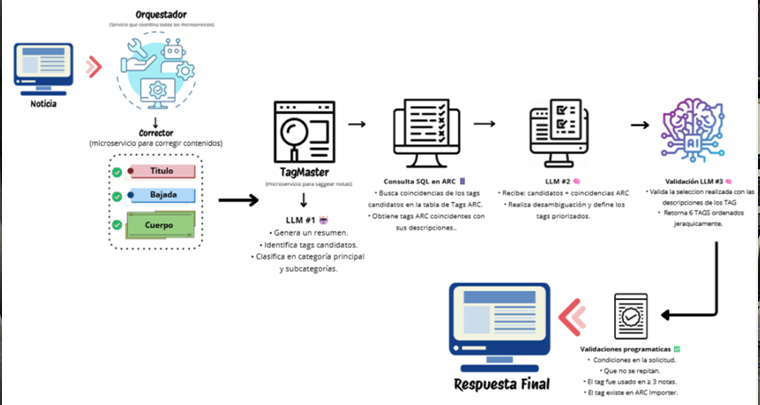
A third pillar is what we named TagMaster: an automated tagging microservice built on large language models.
Before TagMaster, the average article carried 1.5 manually assigned tags. Today it carries more than four, a 170% increase that has measurably improved content distribution. The same tagging intelligence was then wired into the archive search engine, making it significantly more accurate than the previous tool.
Automation to free journalists, not replace them
Beyond the newsroom toolkit, La Nación deployed n8n, a self-hosted open-source automation platform, to connect workflows across departments.
In the politics section, every presidential speech or interview triggers an automated transcription pipeline. In data journalism, the same platform classifies UN voting records and measures the impact of legislation by reading the text and applying a customised impact score. Because n8n runs on La Nación’s own infrastructure, no audio or text touches an external server.

Underpinning all of this is our IA Core Wrapper, an internal LLM integration layer that consolidates access to multiple AI models behind a single API. Any team inside the organisation can call a language model without configuring credentials or managing rate limits. Token consumption is tracked on a dedicated dashboard, providing leadership with full cost visibility.
Leadership, culture, and the two speeds of innovation
None of this would have been possible without explicit support from the top. The CEO and the heads of content and technology made AI transformation a strategic priority — not a side project.
That mandate created the conditions for what became a deliberate dual-speed model: an experimental track (LN IA Labs) where the team moves fast with the newsroom, tests hypotheses, and accepts failure as part of the process; and a formal track (IA Core workflows) where proven solutions are hardened, secured, and scaled across the organisation together with the IT and product departments. Both lanes run in parallel and feed each other.
Once the right mindset is in place and leadership keeps the doors open, the real competitive differentials become learning velocity, motivation, and creativity. The technology itself is increasingly accessible to everyone; what sets a newsroom apart is how quickly its people adopt new tools, how willingly they experiment, and how imaginatively they apply AI to problems uniquely theirs.
Technology alone does not transform a newsroom. La Nación’s training department, together with the AI newsroom team, ran more than 16 structured training sessions and 10 hands-on workshops — not to teach prompting tricks but to build AI literacy, reinforce editorial standards, and make clear where human judgment is irreplaceable.
A continuous feedback loop between journalists, editors, key user groups and the Data & AI Core Lab ensures that tools evolve based on the people who use them daily.
The initiative has also produced original journalism that would have been impossible without generative AI:
- An AI-assisted video documentary about René Favaloro — the Argentine surgeon who invented the coronary bypass — combined Photoshop compositing, Sora-generated visuals, and Runway motion to recreate medical scenes with archival sensitivity.
- A data-journalism project used automated transcription and AI classification to systematically analyse months of presidential discourses, more than 90 hours of audio and video, and thousands of original tweets on X.

The lesson: infrastructure before features
What La Nación has learned is that the most durable AI implementations are not the most visible ones.
The tagging engine no journalist ever opens, the LLM wrapper no editor ever sees, the self-hosted automation that runs silently at midnight — these are the foundations that make the flashier tools sustainable.
Building that layer in-house, with privacy and human oversight baked in from the start, is what separates a genuine editorial infrastructure from a collection of disconnected experiments.
Once again, in this new, fast-moving technological moment, infrastructure is not a replacement for journalism; it is what enables journalists to keep doing journalism.
Related Articles
-

Marketers should outsource tasks, not thinking
25 October 2026 -

AI is now media’s operating environment
28 September 2026 -

AI’s effect on super user math
15 September 2026 -

At Mediacorp’s CNA, loyalty means giving audiences a reason to ...
20 August 2026 -

Tribun Network turns print “dots” into AI-powered insight
20 August 2026 -

Nation Media Group focuses editorial strategy on stories that m...
4 August 2026 -

Briefly News empowers journalists with AI tool suite Nova
4 August 2026 -

AI adoption in newsrooms should move from experiment to strateg...
12 July 2026
Upcoming Events
-

Subscriber Acquisition Master Class
10-17 November 2026
-

Media Advertising Summit
New York, United States
07-10 December 2026
-

AI-Native News Product Master Class
18-25 February 2027
-

Media Subscriptions Summit
Oslo, Norway
08-12 March 2027
-

World Congress of News Media
New York, United States
25-30 April 2027
-

Branded Content & Partnerships Master Class
20-27 May 2027
-

Subscriber Retention Master Class
17-24 June 2027
-

Conferencia Latinoamericana
15-16 July 2027
-

South Asia News Media Festival
New Delhi, India
19-22 July 2027
-

Asia/Pacific News Media Summit
19-20 August 2027
-

CEO Roundtable at Kilkenny
Kilkenny, Ireland
24-26 August 2027
-

Media Innovation Week
Amsterdam, The Netherlands
27 September - 01 October 2027








