

Publisher culture, not tech, is the real constraint on AI in Latin America
Conference Blog | 27 July 2026

The news companies furthest along with AI have stopped talking about AI. They talk instead about committees, training schedules, data schemas, and who in the building is allowed to approve a new tool.
The technology, several of Latin-American news companies said outright, is the easy part. What’s hard is getting an organisation to change its mind about what it values — and no amount of engineering budget shortens that.
That conclusion surfaced repeatedly at INMA’s recent Latin American Conference, a two-day virtual programme organised around agentic AI and revenue diversification. The 10 sessions brought speakers from Oslo, Buenos Aires, São Paulo, Mexico City, Porto Alegre, and Tegucigalpa, working at very different scales and in very different markets.
Often, they arrived at the same answers without having compared notes.
The constraint was never the technology
Leonardo Dalera, chief data and analytics officer at Grupo Clarín, put it most bluntly, and his answer was structural. Clarín’s governance framework rests on four pillars — clear principles and policies, a multidisciplinary AI committee, organisation-wide training, and data quality and security.
Beneath the committee sits something more interesting: a network of AI ambassadors embedded across business units who identify local use cases, surface operational problems, and train colleagues.
Dalera called the result a spillover effect. Governance, in his telling, is what converts isolated experiments into permanent organisational capability, and cultural change is the most important product of all.
Fernanda Kobelinsky, editor at Infobae, reached the same conclusion from the newsroom floor. While many organisations were still debating whether to adopt AI, Infobae had already been building. What resisted wasn’t the software.
“AI frees time, but it does not replace editorial judgment,” she said — and the fear that AI would replace journalists dissolved only where leaders actively walked staff through the transition.
La Nación built its programme in that order deliberately. Before designing anything, Florencia Coelho and Martín Pascua, both of whom work in multimedia and data development at the Buenos Aires-based company, surveyed employees to learn how teams were already using AI.
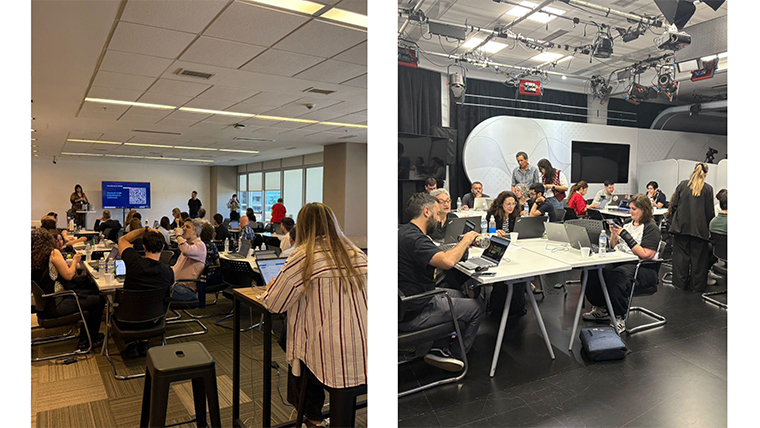
Training and editorial guidelines came first; tools came second, developed collaboratively with the journalists who would use them.
“Journalists review, edit, or discard what AI produces,” Coelho said. “Nothing is published without editorial control.”
Then there was the unexpected convergence. At Schibsted, every department appoints AI champions responsible for distributing knowledge and maintaining adoption metrics — the same structure Clarín built, arrived at independently, roughly 12,000 kilometres apart.
Experiments don’t scale — infrastructure does
The regional pattern is that nobody is building an AI tool. They’re building the layer underneath it.
La Nación centralised all its model connections behind a unified backend so a new model can be deployed without rebuilding every workflow. By building in-house on its own servers, it eliminated licensing costs, including roughly US$700 per month saved by replacing a commercial correction tool with its own.

Infobae’s Scribnews routes across multiple AI providers and selects the model best suited to each task — and journalists never write a prompt because the platform already knows which newsroom and section they’re writing for.
Juan Carlos López Calvet, director of data and AI at Schibsted Media, supplied the outside comparison and the cautionary numbers. The hardest work of the Norwegian company’s past two years had almost nothing to do with AI: Traffic events had been measured differently across products for years, and standardising those schemas cut costs by as much as 40%.
He also brought the sharpest warning of the two days — after a new model release, Schibsted went from not thinking about AI costs at all to watching developers spend US$300 a day on tokens.
Three companies, three architectures, one conclusion: The advantage isn’t in any individual tool. It’s in the invisible layer that makes tools scalable, governable, and cheap enough to keep.
Changing what counts as success
If the first half of the conference was about capability, the second was about measurement — and about how much has to change before new capability produces anything.
Clarín now scores every article from one to 10, combining pageviews with reader engagement time, subscription conversions, and new audience acquisition. That score isn’t a report. It moves stories on and off the homepage in real time and drives a dynamic paywall that locks or unlocks content automatically.
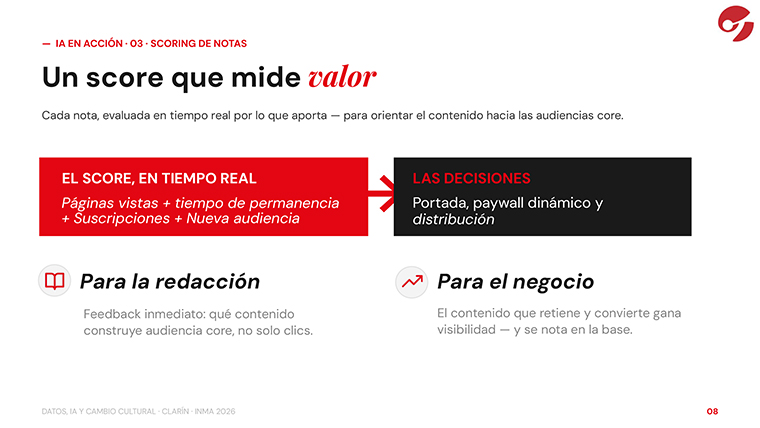
As Dalera framed it, a story earns value through what it builds with audiences rather than what it accumulates.
Juan Manuel Nava, audience and loyalty programme manager at Milenio, made the same argument in commercial terms.
For years, success meant clicks, pageviews, and reach — a model with a hard ceiling because it doesn’t build relationships. And without relationships there’s no sustainable business.
Puntos Milenio rewards behaviours rather than clicks: Readers earn points only after reaching a certain scroll depth, and for commenting, sharing, and listening. Registered users in the programme consume seven times more pages than registered users outside it and spend 30% more time reading.
Schibsted’s dynamic paywall applies the same logic in reverse — adapting to age, behaviour, origin, and engagement, so younger visitors may encounter no paywall at all while they build the habit.
Rebuilding revenue away from the open Web
Gabriel Dorosz, who leads INMA’s Advertising Initiative, framed day two around four forces — falling traffic, creators, mobile video, and agentic AI — converging on a market where Google, Meta, and Amazon capture 60%-70% of global ad spend.
His more provocative point was regional: Because Latin American publishers were pushed off the open Web earlier, they built diverse solutions before their peers elsewhere, with branded content and events already accounting for 25% or more of revenue at some houses.
The conference supplied the case studies.
Editora Globo drew 60% of its advertising revenue last year from projects — branded content, custom publishing, and events — with events alone accounting for 32% of total revenue across more than 200 productions. Tiago Afonso, sales and digital development director at the São Paulo-based company, framed it as no longer selling placements but selling outcomes.
Lizza Bobadilla de Handal, manager of segmented audiences at Grupo OPSA, described rebuilding Estrategia & Negocios from a loss-making magazine into a profitable regional platform where branded content now represents 90% of advertising revenue, with double-digit growth every year for five years.
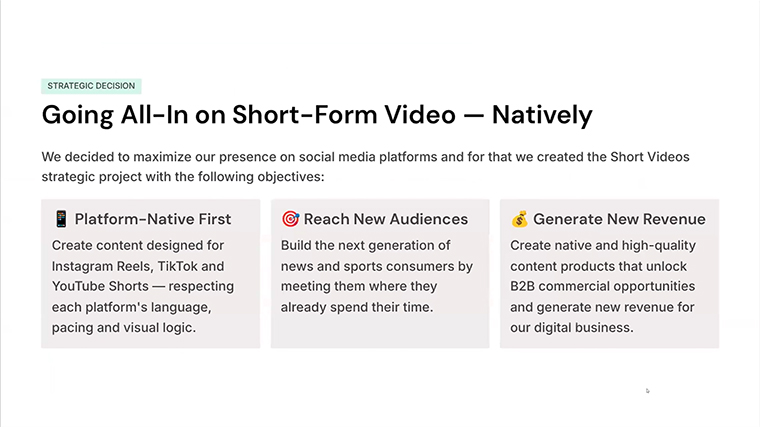
And Débora Pradella, digital product executive manager at Grupo RBS, turned short-form video into an editorial product rather than a distribution channel — 13,000 videos from a team of six, more than 500 million views, and a 70% operating margin.
What’s actually left to defend
Earl Wilkinson, executive director and CEO of INMA, offered a perspective that ties the rest together.
There’s no longer a meaningful distinction between a print brand and a digital brand, he said: “There’s just brand.” And brand has stopped being a marketing function — it’s the operating system of the news company, determining which stories run, who gets hired, how products feel, and what a company licenses to AI.
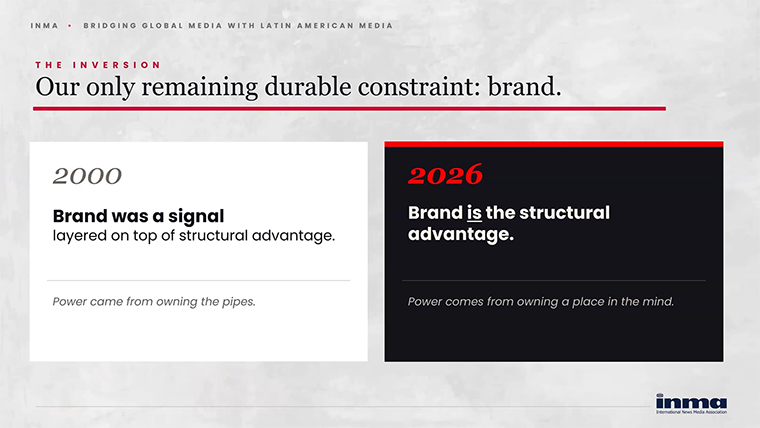
The urgency comes from arithmetic. In 2010, 95% of daily online content was human-produced. Today it’s 26%. Within a decade, Wilkinson projects, it may be under 1%.
At that point readers stop asking whether something is true and start asking whether it’s real, who made it, and whether it can be verified — which makes verified human authorship a premium category rather than a baseline assumption.
Everything else at this conference was, in the end, a way of being someone in particular. The governance frameworks, the standardised schemas, the loyalty architectures, the events businesses: none of them are ends.
“You only have one thing left that is actually yours,” Wilkinson said, “and that is who you are.”
Related Articles
-

Marketers should outsource tasks, not thinking
25 October 2026 -

Bundling is a pricing decision, rebundling is an organisational...
18 October 2026 -

AI’s effect on super user math
15 September 2026 -

At Mediacorp’s CNA, loyalty means giving audiences a reason to ...
20 August 2026 -

Tribun Network turns print “dots” into AI-powered insight
20 August 2026 -

Nation Media Group focuses editorial strategy on stories that m...
4 August 2026 -

Briefly News empowers journalists with AI tool suite Nova
4 August 2026 -

AI adoption in newsrooms should move from experiment to strateg...
12 July 2026
Upcoming Events
-

Subscriber Acquisition Master Class
10-17 November 2026
-

Media Advertising Summit
New York, United States
07-10 December 2026
-

AI-Native News Product Master Class
18-25 February 2027
-

Media Subscriptions Summit
Oslo, Norway
08-12 March 2027
-

World Congress of News Media
New York, United States
25-30 April 2027
-

Branded Content & Partnerships Master Class
20-27 May 2027
-

Subscriber Retention Master Class
17-24 June 2027
-

Conferencia Latinoamericana
15-16 July 2027
-

South Asia News Media Festival
New Delhi, India
19-22 July 2027
-

Asia/Pacific News Media Summit
19-20 August 2027
-

CEO Roundtable at Kilkenny
Kilkenny, Ireland
24-26 August 2027
-

Media Innovation Week
Amsterdam, The Netherlands
27 September - 01 October 2027








