

South Asia’s publishers have the trust but not yet the revenue to match
Conference Blog | 26 July 2026

The framing at the INMA South Asia News Media Conference last week in New Delhi was familiar: Platforms have taken distribution, AI has collapsed the marginal cost of content, and what remains defensible is identity, trust, and direct relationships.
INMA Executive Director and CEO Earl J. Wilkinson put it in operational terms in the opening keynote: “Brand as marketing has shifted to brand as operating system … it belongs in the C-suite.” His prediction for an Internet of synthetic content was that “verified human journalism will become a premium category.”
Nobody disputed that trust is the asset. What the room could not agree on was what it is worth, who will pay for it, or how to prove it — and the sharpest challenges came from people who buy media rather than sell it.
Here are the seven themes that came from the two-day conference part of the INMA South Asia News Media Festival, and what they mean for news companies inside and outside the region.
1. Trust is the asset nobody has priced
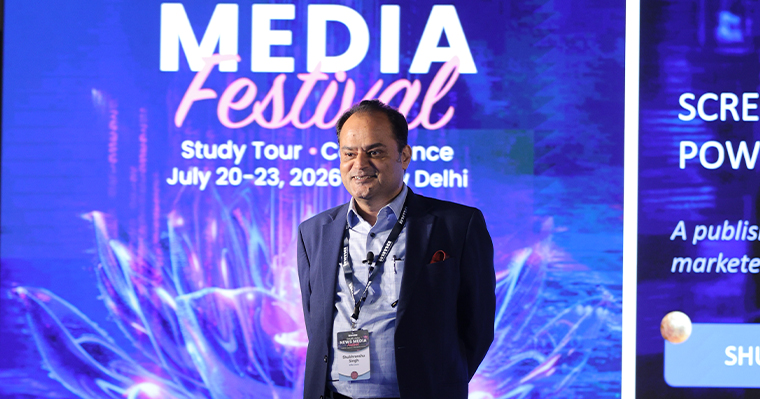
Shubhranshu Singh, former chief marketing officer of Tata Motors Commercial Vehicles, put it bluntly from an advertiser’s seat: “I have no shame in confessing that in the last three to four years, unless pressed to it, we have not been investing in news.”
News publishers, he argued, have let procurement set the terms: “Point of view is never discussed; pageviews are discussed.”
Not every advertiser has walked away. Saahil Khan, marketing head at myTrident, said his brand holds a fixed share: “We always ensure that at least 10 to 15% of our budget pie is always invested into the print.”
Karthik Shankar, senior vice president for digital investments and partnerships at WPP Media, said his agency makes the same case to clients: “In all our pitches, we always go and say, ‘Build a brand,’ because performance is going to be cash flow for today. A brand is a more sustainable one.”
He put the pricing problem outside the agencies: If inventory sold to WPP at 100 goes to a platform at 10, who is really taking the value?
Sameer Singh, CEO of HT Media and an INMA South Asia board member, rejected the idea that trust sits outside the market. “There’s almost a narrative that trust stands above the market,” he said. “I don’t agree with that narrative.”
Where trust and engagement come together, value follows and can be measured in returns — and on that basis, he argued, print performs very well.
The audience evidence supports him.
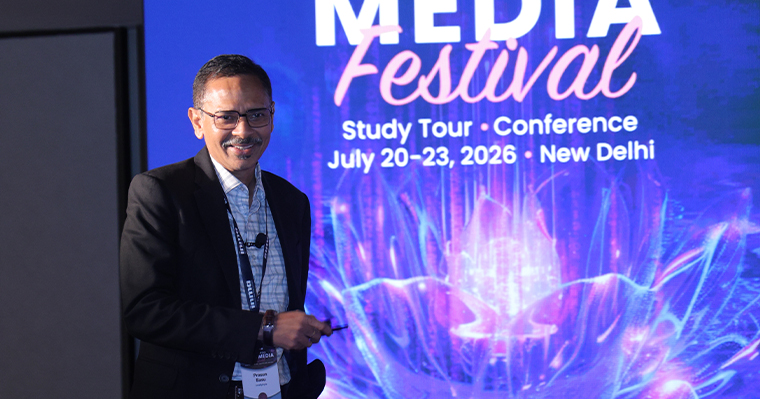
Prasun Basu, co-founder and CEO of Inteliphyle, showed newspaper readership in surveyed markets rising from 16 million to 18 million even as advertising expenditure stayed flat: “The audiences have not left us.”
Mohit Jain, COO and board member of Bennett Coleman & Co. said the Indian Readership Survey is being rebuilt to measure brand strength, engagement, and trust rather than reach: “Print today is not about its relevance, but it is about its resonance.”
Takeaway: Selling reach concedes Singh’s point. Publishers need proof of impact, and an industry measure of trust, before charging a premium for it.
2. Trust is also under attack, not just underpriced
The trust panel moved from pricing to defence. Daniel Funke, head of digital investigations for APAC at AFP, said his team increasingly investigates “deepfakes of people without their knowing, without their knowledge, without their consent,” amplified by platforms because they perform.
His answer for publishers was not technological: “What sets us apart is quality content.”
Content creator Satshya Anna Tharien described finding herself in a fabricated endorsement video. Reporting it produced a takedown and an apology, nothing more. “There’s no repercussions for these people,” she said; creators without a major celebrity’s profile have no personality rights to fall back on.
Bharat Gupta, founder of ToBe Online and former CEO of Jagran New Media, added that verification is expensive, and a trusted brand’s provenance is not the same as accuracy — audiences believe what carries the masthead, which raises the cost of getting it wrong.
Takeaway: The trust premium publishers want to charge is being eroded from outside. Verification capacity is now a brand-protection cost, not an editorial luxury.
3. The traffic shock has landed, and publishers are repricing
Gabriel Dorosz, INMA’s Advertising Initiative lead, reported referral declines that hit the U.S. and Europe earlier arrived here in the fourth quarter at a consistent minus 40%. “I heard that from almost everyone,” he said, calling India the last major market where “print here is not yet in managed decline.”
Publishers were less fatalistic.
Puneet Gupt, COO of Times Internet, expects at least a 30% increase in display eCPMs in India over the next few years as open Web supply shrinks but was blunt about what publishers squandered: “We built stadiums to fill them with people, but we didn’t take phone numbers of people who came in.”
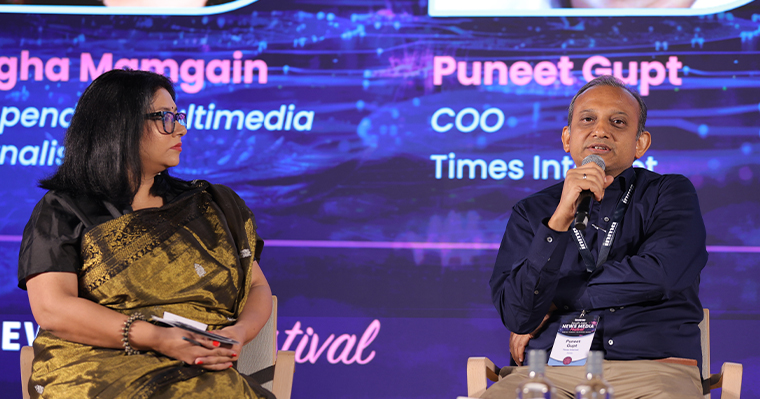
Puneet Jain, CEO of HT Digital, reported double-digit annual CPM growth and urged publishers to “stop treating traffic as a destination and start seeing it as a launchpad.”
Takeaway: Falling impressions need not mean falling revenue — but only for publishers who improve inventory quality and enrich audience data first.
4. Habit is the business
Siddharth Sharma, head of content and production for sports at JioStar, showed how a 72.5 million global concurrency record was engineered rather than won. Bhojpuri and Haryanvi (regional languages and cultures in India) commentary, launched with distinct identities rather than as Hindi spillover, grew threefold and now rank in his top five languages. “Habit is the business. Live is just a spark.”
The habit-building newsroom panel was candid about how little legacy publishers had engineered.
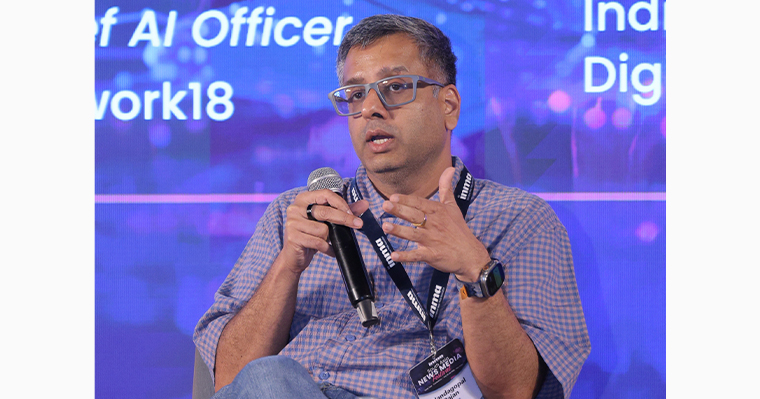
Nandagopal Rajan, CEO of Indian Express Digital, noted the only daily habit print ever created was the horoscope — since dropped from his Web site — and that digital had quietly accepted defeat by calling someone a loyal user at 15 visits a month.
Sanjoy Majumder, managing editor and deputy director of journalism at Collective Newsroom, called that a structural inheritance: Most legacy digital operations began as extensions of print. He also warned against designing for an average reader: “Your audience is not monolithic.”
Mehak Kasbekar, country manager and editor-in-chief of Brut India, made the generational version of the argument. Brut has run a little over 8 billion views and 1.7 billion engagements in 2025, with 18 million followers and 89% of its audience under 34 — and she expects engagement, not views, to become “the gold metric.”
Her challenge to the room was about effort, not format: “The younger generation wants us, as news publishers, to work harder to speak to them in their language.” The discipline underneath is unglamorous: a correction rate of 0.001%, tracked on a spreadsheet since launch.
Takeaway: As HT Digital’s Jain put it, “reach without relationship is a depreciating asset.” Measure return frequency, not audience size.
5. AI is in production across the region, but not in judgment
The deployments came with numbers. Pundi Sriram, product head at The Hindu, said an in-app summary and FAQ feature lifted daily consumption of premium stories from about 6% of pageviews to 36%, and the app now accounts for more than 35% of subscription revenue.
Sriram’s governance rule, after ChatGPT gave him the wrong time zone for Sri Lanka: “The ownership must stay with the human.”
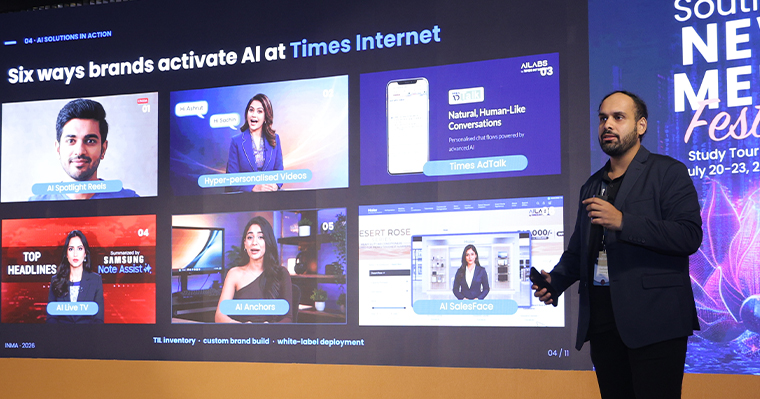
Siddhant Satsangi, head of growth and AI strategy at Times Internet, showed six live AI applications, including an AI anchor and an automated astrology product with about 5 lakh users and 50,000 paying: “You have to bring that AI into the DNA of the publisher.”
Sannuta Raghu, head of AI product at Scroll, priced the alternative: Commercial models would have cost roughly US$150,000 to restructure the archive, so her team runs small models on a desk-side device, no article leaving the building. “Liquid content is not a front-end gimmick; it’s a content infrastructure choice.”
The AI-in-the-newsroom panel drew the line at judgment. Sukumar Ranganathan, editor-in-chief of Hindustan Times, dispensed with the session title — “there are no print newsrooms anymore,” he said, having stopped calling the product a newspaper in 2006 — and said page-making would be automated tomorrow if cost allowed, but decisions never: “We’ll never outsource it to AI. Never.”
Rohit Saran, managing editor of The Times of India, described a newsroom three months into a content management system rebuilt to carry AI through the workflow and set a narrow rule for synthetic imagery: There is a role for AI images “only when you’re describing or trying to visualise a situation that a camera cannot or has not captured,” and always labelled. “We should always say ‘AI generated’.”
Harsha Mathew, chief resident editor and director of Malayala Manorama, made the case for local-language newsrooms. The news company has put AI over its own archive, and the archive is the point: One built over 40 years, he said, “is fundamentally different from what a random AI tool can summarise.”
On language, he was unsentimental. Malayalam carries many dialects — north and south Kerala do not sound alike — and AI handling all of them produces “total confusion.” Credibility, he said, “is a power of local language newsrooms.”
Takeaway: Publish an internal division of labour — what AI may touch, what it may not, who owns the outcome — before scaling a pilot.
6. The growth is at the edges
L V Navaneeth, CEO of The Hindu Group described a “core and moat” structure — print at the core, events, education, and publishing solutions around it — while insisting “our core product is journalism.”
Print in India “will grow for the next three to four years,” he said, though the industry is adding young news readers, not young newspaper readers.
Dhruba Mukherjee, CEO of of ABP, reported profitable concerts for younger audiences and raised a threat absent from global agendas: The hawker network is thinning as delivery staff leave for quick commerce.
B Srinivasan, managing editor of Vikatan, where 75% of print revenue comes from readers, said Reels will never pay but absence is fatal: “If you are not there, your brand is going to become invisible.”
Branded content has made the same journey from experiment to core. Gaurav Arora, COO of Jagran New Media and an INMA South Asia board member, said it has moved from “a weekend experiment with line items in the media plan” to a strategic revenue driver.
He rejected the publishers-versus-creators framing: “We’ve never seen them as competition.”
What publishers add, he said, is decades of accumulated credibility plus production and research capacity creators lack.
Mona Jain, president/revenue growth and business development at ABP Network, called the metrics shift a move towards “content commerce” — dwell time, shareability, and a route to sales rather than impressions.
Rituraj Das, editor/creative solutions at The Quint, offered the sharpest discipline: Know what space you credibly own, and decline briefs outside it, even when the revenue hurts.
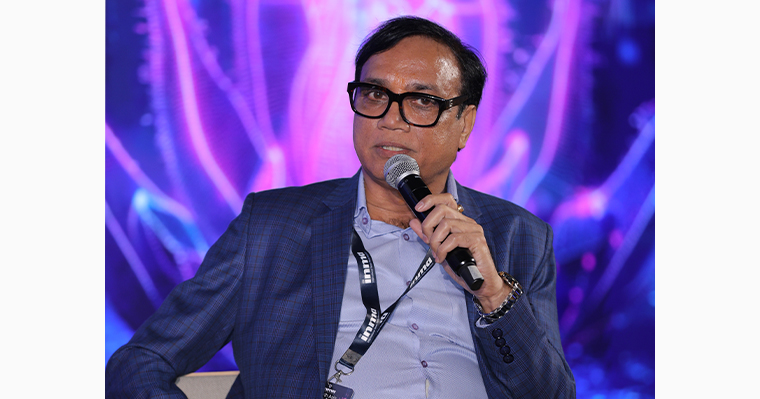
In the most practical session of the two days, Mathrubhumi’s Sudeep Kumar described a Calicut education consultancy that became the region’s No. 2 player over five years of co-branded seminars. Ashok Sharma, head revenue strategy and planning at Amar Ujala, described moving a Bulandshahr jeweller out of advertising and into events that built a network among the city’s elite.
Takeaway: SMEs and branded-content clients buy reach but judge outcomes. Sell solutions, not space — and be willing to decline what your brand cannot carry.
7. Renewal is generational, not just digital
Two panels — legacy-media directors on day one, emerging leaders including INMA 30 Under 30 winners on day two — both landed on the topic of transparency.
Janhavi Pawar, director of Sakal Media, said forcing young readers into print “is a waste of resources”... the real asset is “the relationships that you build.”
Sambridhi Gyawali, managing director of Nepal Republic Media, said that after Nepal’s Gen Z movement audiences returned to established outlets: “The credibility compounded by legacy media actually tops everything else.”
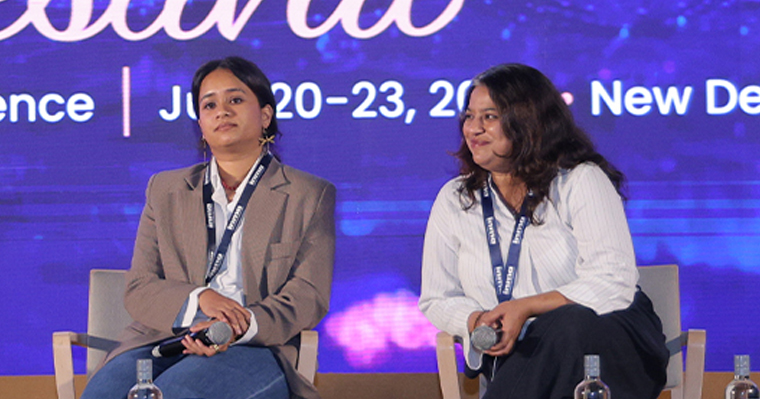
Debosmita Bhattacharya, head of product at ToBe Online, said the skill that matters is the one machines lack: “AI can automate tasks and answer all your queries, but it cannot automate human judgment.”
Kivleen Sahni, brand content producer at Brut India, said her peers are misread as delicate — “We are not fragile at all” — and that what they struggle with is silence, not bad news.
Matiur Rahman, editor of Prothom Alo, recounting 79 legal cases and an arson attack on his office, supplied the line the commercial sessions kept circling: “Audience trust is our only currency.”
Proving its price is the work now.
Related Articles
-

Marketers should outsource tasks, not thinking
25 October 2026 -

AI’s effect on super user math
15 September 2026 -

At Mediacorp’s CNA, loyalty means giving audiences a reason to ...
20 August 2026 -

Tribun Network turns print “dots” into AI-powered insight
20 August 2026 -

Nation Media Group focuses editorial strategy on stories that m...
4 August 2026 -

Briefly News empowers journalists with AI tool suite Nova
4 August 2026 -

Economist launches subscription tier targeting younger audience...
20 July 2026 -

AI adoption in newsrooms should move from experiment to strateg...
12 July 2026
Upcoming Events
-

Subscriber Acquisition Master Class
10-17 November 2026
-

Media Advertising Summit
New York, United States
07-10 December 2026
-

AI-Native News Product Master Class
18-25 February 2027
-

Media Subscriptions Summit
Oslo, Norway
08-12 March 2027
-

World Congress of News Media
New York, United States
25-30 April 2027
-

Branded Content & Partnerships Master Class
20-27 May 2027
-

Subscriber Retention Master Class
17-24 June 2027
-

Conferencia Latinoamericana
15-16 July 2027
-

South Asia News Media Festival
New Delhi, India
19-22 July 2027
-

Asia/Pacific News Media Summit
19-20 August 2027
-

CEO Roundtable at Kilkenny
Kilkenny, Ireland
24-26 August 2027
-

Media Innovation Week
Amsterdam, The Netherlands
27 September - 01 October 2027








