

Why Madrid may be the most dynamic news media city in Europe
Conference Blog | 20 September 2026

There are cities where news media is a business, and there are cities where news media is a contact sport. Madrid is emphatically the latter.
That is one reason INMA chose the Spanish capital to host its annual Media Innovation Week — a five-day immersion that opens with a two-day study tour of Spain’s leading news media companies and culminates in the European News Media Conference, exploring how to grow and transform at the intersection of media and tech.
The choice of city was not incidental. A walk through Madrid — from the PRISA tower on Gran Vía to the newsrooms scattered across the Castellana corridor — reveals a paradox. These are publishers selling into a market with some of the most challenging fundamentals in the developed world.
Trust in news sits at 33%, according to the Reuters Institute, meaning two-thirds of Spaniards do not trust the journalism produced for them. Only about one in 10 pays for online news. Some 74% say they worry about telling true news from false online, the highest level recorded in Spain since the series began. Political polarisation runs hot enough that the press itself has become a political battleground.
And yet Madrid may be producing more business model innovation per square kilometre than any media capital in Europe. That tension — hard conditions, constant reinvention — is what makes the city worth studying.
A density of competition found almost nowhere else
Start with the structure of the city. Madrid is home to three legacy national newspaper groups — PRISA (El País, AS, Cadena SER), Unidad Editorial (El Mundo, Marca, Expansión), and Vocento (ABC) — all competing for the same national audience from the same few square kilometres.
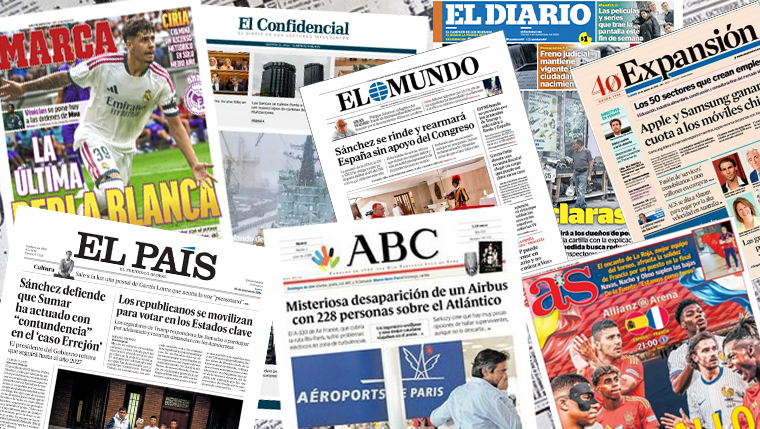
Layered on top is one of the world’s most vibrant clusters of digital natives: El Confidencial, elDiario.es, El Español, OKDiario, infoLibre, and a long tail of others. Add the broadcasters — RTVE, Atresmedia, Mediaset España — plus a radio culture that remains among the strongest in the world, and you have an extraordinary concentration of national newsrooms fighting for attention in one city.
Most markets consolidated their way out of this kind of competition decades ago. Madrid never did, and the pressure shows in how quickly propositions get sharpened.
The subscription story nobody predicted
Six years ago, Madrid was Exhibit A for the proposition that Southern Europe would never pay for news. There were effectively no national paywalls before late 2019.
Today, the paywalls of PRISA, Unidad Editorial, Vocento, and Godó collectively hold roughly one million subscriptions. El País passed 475,000 digital subscribers in June 2026, up 15% year-on-year, with a churn rate of 2.0%, and PRISA has committed to 800,000 by 2029. El Mundo and Expansión each built six-figure subscriber bases from a standing start — as did Barcelona’s La Vanguardia, keeping the pressure national.
Part of the explanation is timing. Madrid’s publishers started their digital subscription journeys later than the Nordics or Germany, and that lateness turned out to be an advantage. Arriving after the pioneers meant arriving after the pioneers’ mistakes: They could skip a decade of expensive experiments in paywall design, pricing, and onboarding and go straight to what had been proven to work.
PRISA group chair Joseph Oughourlian has said as much, recently saying that being so far behind the Anglo-Saxon world and the rest of Europe meant PRISA barely had to deliberate over strategic priorities — the sector had already established what they were. The company had, he said, been “giving away our product for way too long.”
In a country where roughly one consumer in 10 pays for online news, Madrid’s publishers built a million-subscription economy in six years. That is a market writing a playbook rather than following one.
The Spanish-language media capital
There is a second structural advantage no other European city has. The publishers on the Castellana don’t think of themselves as Spain’s media. They are building for a Spanish-speaking world of nearly 600 million people, and Madrid is where that content is commissioned, edited, and monetised.
That changes the arithmetic on everything: the addressable market for a subscription product, the return on a format experiment, the case for standing up a new vertical.
A Madrid newsroom is not competing for a domestic audience of 48 million. PRISA’s América editions are run from Madrid. So is the world’s largest Spanish-language audio operation. Oughourlian has been explicit that Latin America is where PRISA sees its next stage of growth, and the newsrooms serving it are being built out from here.
The hosts: A study tour of Spanish media innovation
The Media Innovation Week study tour takes delegates inside the companies driving that reinvention. Each host represents a distinct answer to the question of what a sustainable news business looks like.
PRISA Media is the closest thing the Spanish-speaking world has to a global news company. El País has built the largest digital subscription base in Spanish-language news, alongside 13 million registered users — a figure that matters increasingly in a zero-click environment — while its América editions extend the brand’s reach across Latin America.
Delegates will see how a legacy publisher engineered a subscription-first transformation while pursuing an audience of nearly 600 million Spanish speakers.
Unidad Editorial, owned by Italy’s RCS MediaGroup, runs three national champions from one newsroom complex: El Mundo, Spain’s second general-news subscription brand; Marca, the sports giant with one of the largest audiences in Spanish media; and Expansión, the business daily whose six-figure subscriber base proves premium financial journalism scales in Spanish.
What sets the group apart is its shift toward cross-brand synergy, consolidating subscription, advertising, and product teams to drive scale and reader revenue growth.
Vocento brings the national-plus-regional model: ABC, the storied conservative daily relaunching its digital subscription offer in 2026, alongside 11 regional titles — led by Bilbao’s El Correo — and the Colpisa news agency, giving Vocento a local footprint no Madrid rival can match. The group has been pioneering subscription strategies since 2015 and aims to double its subscriber base by 2029.
elDiario.es offers the counter-model: a digital native funded by members rather than a paywall, and profitable without a legacy brand or a legacy cost base. It closed 2025 with €17.35 million in revenue, up 11.8%, and a €1.48 million surplus, and it carries no financial debt. The revenue split is what makes it unusual — advertising at 50.5% and member contributions at 42.1%, a balance few digital publishers manage. Membership passed 121,000 this year, audited by OJD, and the company publishes its full accounts annually. It has also built out editions across all 17 Spanish regions and diversified into events, podcasts, and audience clustering for advertising.
PRISA Radio anchors the audio story. Cadena SER, Los 40, and W Radio together reach more than 26 million listeners, and PRISA has parlayed that heritage into the world’s leading producer of Spanish-language audio — spanning podcast ventures, Latin American networks, and a U.S. partnership with iHeartMedia.
La Voz de Galicia shows what the model looks like outside the capital. Spain’s third-largest general-interest newspaper commands a 63% share in Galicia and a nationwide audience approaching 400,000 readers, and it has built one of Europe’s most admired regional reader revenue models — an editor-centred strategy that lets a regional brand thrive on subscriptions while competing directly against the national giants headquartered in Madrid.
Taken together, the hosts form a map of the modern news business: legacy transformation, multi-brand consolidation, membership, audio, and regional resilience — all within a single market.
Madrid’s young-audience laboratory
The digital natives listed above are more than competitors to the legacy groups. They are the reason Madrid has developed an unusually strong ecosystem around young audiences, and the interesting part is not legacy publishers experimenting with TikTok. It is that an active digital-native scene operates alongside the traditional media in the same city, and the competition between them has pushed the whole market forward.

A lot is happening in Madrid around social video, podcasts, creator-style journalism, and new approaches to building communities.
Spanish publishers are working against real disengagement: 53% of Spaniards under 25 have both low trust in and low interest in news, against 35% of the general population, and 40% of Spaniards got news from an influencer or content creator in the past week.
Here the two advantages compound. When a Madrid publisher tests a vertical video format or a creator-led podcast, the potential audience is not only young people in Spain but young people across Latin America — a far larger playground for experimenting with formats, distribution, and new products than any single European market offers.
Dynamism under pressure
None of this means the market is comfortable.
The first half of 2026 brought what the Spanish trade press called a “perfect storm” for the legacy groups: soft advertising, the continuing drag of print, rising costs, and early signs that subscription growth is maturing.
The government’s Plan for the Digitalisation of Media, part of its Plan de Acción por la Democracia, carries €124.5 million in support for the sector, and a proposed mandatory register requiring outlets to disclose ownership and advertising revenue has drawn warnings that it could be used to pressure critical media.
Polarisation colours everything.
Not every indicator points down. Interest in news in Spain rose this year to 54%, the highest in four years, lifting Spain from 16th to seventh among the 48 markets the Reuters Institute surveys, and trust ticked up two percentage points — one of only five markets globally where it rose at all.
The cumulative decline since 2018 remains steep, and the age gap is stark, but 2026 is the first year in some time that the direction of travel is arguable.
The response from Madrid has been to move faster.
In a KPMG survey of 60 Spanish media executives cited by the Reuters Institute, 57% said their organisations had already incorporated AI tools, with a further 37% planning to soon — used mainly for generating content, analysing data, and automating editorial processes. Registered-user strategies are accelerating as publishers prepare for a zero-click Web. Bundling, events, audio, and vertical brands are all in play.
The lesson for everyone else
The most instructive media cities are not the richest ones but the most contested ones. Madrid qualifies on every count: maximum competition, minimum consumer willingness to pay, deep political division — and, despite all of it, a million paying subscribers, profitable digital natives, and a language that reaches across an ocean.
That is what Media Innovation Week delegates will walk into — not a showcase of comfortable success stories but a working laboratory of reinvention under pressure. The useful question for anyone travelling to Madrid is not whether these publishers succeeded against the odds, but which of the odds they faced look familiar from home.
Banner art: Adobe stock image by mrks_v.
Related Articles
-

5 questions from INMA’s time in Silicon Valley
27 October 2026 -

New regulatory era requires readjustment of subscription growth...
13 October 2026 -

Four advertising lessons from Media Innovation Week
12 October 2026 -

What I told 40 CEOs (and won’t gatekeep from you)
30 August 2026 -

“Faces and Voices” drives success at Immediate Media
11 May 2026 -

8 global media leaders reveal what’s next for subscriptions in ...
30 April 2026 -

A subscription pricing playbook in an inflation shock
6 April 2026 -

Inflation is back: Should you raise subscription prices for new...
5 April 2026
Upcoming Events
-

Subscriber Acquisition Master Class
10-17 November 2026
-

Media Advertising Summit
New York, United States
07-10 December 2026
-

AI-Native News Product Master Class
18-25 February 2027
-

Media Subscriptions Summit
Oslo, Norway
08-12 March 2027
-

World Congress of News Media
New York, United States
25-30 April 2027
-

Branded Content & Partnerships Master Class
20-27 May 2027
-

Subscriber Retention Master Class
17-24 June 2027
-

Conferencia Latinoamericana
15-16 July 2027
-

South Asia News Media Festival
New Delhi, India
19-22 July 2027
-

Asia/Pacific News Media Summit
19-20 August 2027
-

CEO Roundtable at Kilkenny
Kilkenny, Ireland
24-26 August 2027
-

Media Innovation Week
Amsterdam, The Netherlands
27 September - 01 October 2027








