

New regulatory era requires readjustment of subscription growth strategy
Media Leaders | 13 October 2026

From digital music platforms to meal kits, the subscription economy has grown to become a large segment of consumer spending. Now said to be worth more than US$720 billion globally and expected to grow 66% by 2030, the market has entered a new phase in which policymakers are moving to strengthen consumer protections.
Recently passed laws in Canada and several states in the United States, including Colorado and Maryland, are giving consumers greater control over recurring contracts while Europe and the United Kingdom are preparing or implementing their own measures. As a result, companies will be required to explain renewal terms more clearly, notify customers before contract changes, and make cancellation significantly easier, among other requirements.
For news and academic publishers, these new rules could expose where subscription growth has become dependent on customer inertia or cancellation friction. It is worth understanding how publishers can adapt their commercial and operating models to take advantage of these changes and to build a healthier recurring revenue model.
Understand where you are most exposed
Map the new requirements across the full subscription cycle, identifying the aspects of the journey that need to be updated as a result of new laws. This will require legal input, but product, subscription and customer experience should be involved to shape what customers actually see and experience.
For large publishers operating across multiple jurisdictions, the key question is whether to manage market-specific customer journeys or create an improved global standard that is based on one jurisdiction and can be adapted locally. This decision will not only affect customer experience but also technical complexity and operating cost.
Audit how much of your retention is earned
Review subscription data to better understand which customers are being sustained by inertia and are at risk. This could include:
- Low-engagement customer segments.
- Number of billing complaints.
- Unsuccessful cancellation attempts.
- Triallists who do not establish a habit.
- Subscribers who make little use of paid content or features.
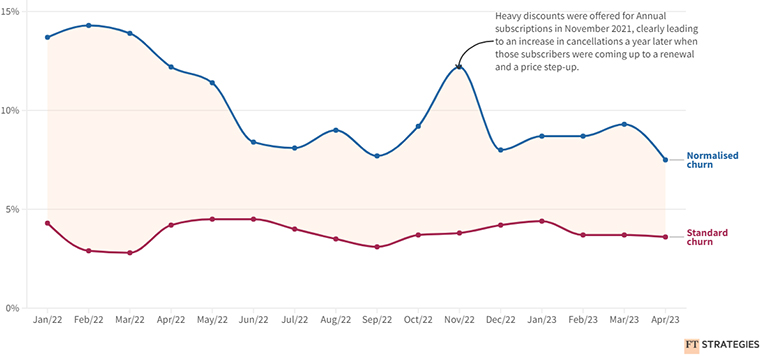
This analysis can help distinguish earned retention as a proportion of overall churn rates. It can also improve forecasting by going beyond aggregate churn metrics to understand where customer value is driven by product use and where it is not.
Review whether your proposition creates customer value
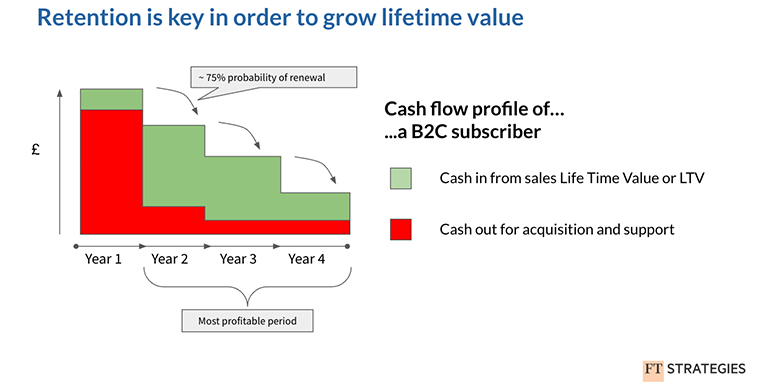
With customers empowered to cancel, the amount that publishers can afford to spend in acquiring them may fall if weakly engaged customers leave sooner. Therefore, it is important to assess whether introductory offers and trials are attracting the right audience rather than simply generating low-cost starts.
This is primarily a question for marketing teams but product, editorial, and audience teams can play a role by identifying behaviours closely associated with long-term retention and designing a proposition and onboarding journey around them. The Financial Times has done significant work on this in recent years.
Qualitative research can also explain why customers subscribe, what they value, and where the proposition falls short. These insights can help distinguish between a weak proposition, poor communication of value, and an experience that fails to deliver on the sell.
The goal is to ensure the proposition gives customers a clear and continuing reason to stay.
Map new journeys, data, and technology
Most subscription billing platforms and customer relationship management (CRM) tools should enable many of the changes required by these new laws but it is still important to check that contracted vendors and tools have the necessary features. For example, users should receive cancellation reminders at the prescribed time and systems should be able to provide evidence that obligations have been met in the case of a customer complaint or regulatory enquiry.
Publishers will increasingly also need data to show not only when a customer leaves but why. Without this capability, it will be difficult to separate product, pricing, or engagement issues from regulatory effects and thus harder to segment and improve different types of retention.
Decide who owns the response
With subscription revenue cutting across multiple departments, fragmented ownership of these changes is a significant risk.
Designate a senior leader to own any changes to the end-to-end subscriber relationship with input from legal, commercial, product, technology, data, finance, and customer service. That owner should establish a cross-functional programme, agree on the global and local principles mentioned above, and define how the commercial impact will be measured.
Boards should be briefed on the implications for churn, lifetime value, acquisition costs, and proposition strength. There may be a case to make additional investment in subscription technology, customer data, or retention capabilities.
For many publishers, these considerations will require a combined regulatory, commercial, and operational assessment. Organisations such as FT Strategies can help your business qualify the potential effect on subscription revenue and identify where stronger customer value and a more coherent operating model can protect long-term growth.
This article is for general information only and is not legal advice.
Banner image: Adobe stock image by Majed.
Related Articles
-

WSJ executive councils show how publishers build communities th...
19 October 2026 -

Bundling is a pricing decision, rebundling is an organisational...
18 October 2026 -

7 themes from Madrid show publishers trading traffic for relati...
28 September 2026 -

AI is now media’s operating environment
28 September 2026 -

5 lessons from the INMA Young Audiences Summit
28 September 2026 -

AI’s effect on super user math
15 September 2026 -

What I told 40 CEOs (and won’t gatekeep from you)
30 August 2026 -

At Mediacorp’s CNA, loyalty means giving audiences a reason to ...
20 August 2026
Upcoming Events
-

Subscriber Acquisition Master Class
10-17 November 2026
-

Media Advertising Summit
New York, United States
07-10 December 2026
-

AI-Native News Product Master Class
18-25 February 2027
-

Media Subscriptions Summit
Oslo, Norway
08-12 March 2027
-

World Congress of News Media
New York, United States
25-30 April 2027
-

Branded Content & Partnerships Master Class
20-27 May 2027
-

Subscriber Retention Master Class
17-24 June 2027
-

Conferencia Latinoamericana
15-16 July 2027
-

South Asia News Media Festival
New Delhi, India
19-22 July 2027
-

Asia/Pacific News Media Summit
19-20 August 2027
-

CEO Roundtable at Kilkenny
Kilkenny, Ireland
24-26 August 2027
-

Media Innovation Week
Amsterdam, The Netherlands
27 September - 01 October 2027








