

Four advertising lessons from Media Innovation Week
Advertising Initiative Blog | 12 October 2026

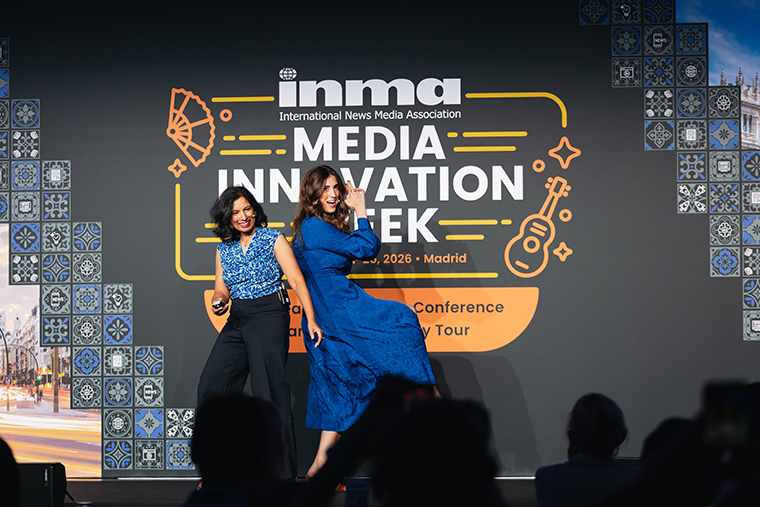
The Madrid programme at there recent INMA Media Innovation Week covered everything from subscriptions to product to newsrooms to young audiences, with advertising programming wrapping up the week.
But the advertising lessons were woven throughout.
1. Scarcity is the business model now
INMA’s Earl Wilkinson opened the conference with some framing borrowed from the CEO Roundtable in Vail: “You build businesses around things that are scarce,” and AI has just made yesterday’s scarcities (the article, the answer, reach, speed) abundant. What stays scarce is trust, judgment, habit, a person the audience follows by name, and proof of what any of it is worth.

Anders Braso, Monocle’s chief marketing officer, made the same case from the POV of a publisher whose revenue is 60% advertising. Asked by a Norwegian subscriber how advertisers can pay for something so small:
“I think the challenge of our industry is that everyone is chasing scale. It used to be that way with advertisers, too. But I think what we are seeing is that this is changing quite a lot. We have advertisers who come to us and say, ‘We only want to do an event for 12 people. We don’t want more than 50 people at our event.’”
Eimear Moran, group marketing director for The Irish Times Group, closed the week with a perfectly short version: “Scarcity makes a premium. Scarcity is like selling diamonds..
2. Brand matters, but nobody is planning to fund it
The INMA European Board panel asked the room where it would bet an entire 2027 budget: creators, talent, brand, or future audiences.
Eimear read the result: “Brand is the thing that 39% of people say they would put their entire budget on. How many people in the room have plans to invest in brand in 2027? One. Brand is the first thing that often gets cut in budget conversations.”
Marc Isler of Tamedia chose brand, too. It’s “not something you get for free, not something you get with one click somewhere else.” Isabel Russ of Russmedia: “Awareness is a growth channel again: Brand marketing, long treated as a cost, is re-emerging as the top of the subscription and advertising funnel.”
3. Trust travels with people, especially young audiences
Kamran Ullah, editor-in-chief of De Telegraaf: “Faces matter more than logos ... . People connect with people. People trust other people.” His newsletters now go out under journalists’ names rather than the masthead, and open rates run 70% and 85% against a Dutch benchmark of about 40%.
INMA’s Kerstin Hasse and Sonali Verma brought us numbers on what young audiences will accept from Mediahuis research behind its Gen Z brand Spil: 71% of Dutch youth do not want to pay for news, 90% of Spil’s followers are open to branded content, and 70% of Dutch youth prefer social content with creators over regular display ads. Spil keeps its journalists out of paid partnerships and uses outside creators for the commercial work.
My favourite execution of the week was Factos Franquistas, presented by Izaskun Pérez at eldiario.es: TikTok-style videos with two historian-creators “spitting facts” at the Franco regime’s favourite myths made for the 50th anniversary of Franco’s death after a CIS survey found 38% of Spaniards under 24 would not mind a “somewhat undemocratic” regime. More than half the views came from 18-to-34-year-olds.
In one brilliant execution, Franco was described as “un fanboy” when he offered his services to Hitler in 1940. Brilliant stuff.
Jonas Lips of DPG Media has almost 100,000 people a day watching HLN’s vertical news videos on its own site, “but we are still waiting for advertising in vertical video.” And Amedia grew video advertising revenue 54% in a year across 129 newsrooms with a very important principle that guides the approach:
“Audience before ads: If you make the right videos, the audience will come. Then you can monetise. The other way around is harder.”
4. Super users carry the business (with a caveat)
Greg Piechota presented INMA benchmark data showing the 1% of users who subscribe generate about 27% of pageviews, and when three INMA members allocated subscription and advertising revenue to them, “1% of people are making around 72% to 81% of total revenue.”
Meanwhile the median brand’s monthly users are down 14% against 2024 and heavy users are flat. The audience that is leaving is the casual, anonymous one display advertising was built on, and we heard that over and over throughout the week from other presenters.
Greg’s caveat, which I’d ask every publisher to reflect on alongside the first point: “It’s a myth that you can have a much smaller but much more loyal audience.”
Across hundreds of brands, reach and loyalty move together, so the direct relationship is “not necessarily the main place where you meet people but the place where you monetise.” Greg appropriately emphasises growth while I urge publishers to do the work to understand the super users you already have qualitatively to best serve and sell them.
Where we go next
In Madrid, I argued that none of this is a subscription story alone. The same 1% who drive reader revenue are the most valuable and most receptive advertising audience a publisher has. And the business worth building leads with selling trust and relationships to fewer, better partners instead of just selling inventory to anyone at any price.

I’ll make that case in full on October 14, and, in my next newsletter, I’ll unpack in detail what I said in Madrid, what Tom Armstrong said about how The New York Times built six straight quarters of double-digit digital advertising growth, and what I took away from three fantastic case studies from DPG Media, Ozone, and Mediahuis Ireland on transforming and taking the ad business back.
Until then, Eimear’s one-sentence summary of the week: “Reach the ones that count. Don’t count the ones you reach.”
If you’d like to subscribe to my bi-weekly newsletter, INMA members can do so here.
Related Articles
-

Bundling is a pricing decision, rebundling is an organisational...
18 October 2026 -

7 themes from Madrid show publishers trading traffic for relati...
28 September 2026 -

AI is now media’s operating environment
28 September 2026 -

5 lessons from the INMA Young Audiences Summit
28 September 2026 -

The 3 editorial pillars of Chile’s first streaming news channel
23 September 2026 -

AI’s effect on super user math
15 September 2026 -

What I told 40 CEOs (and won’t gatekeep from you)
30 August 2026 -

Economist launches subscription tier targeting younger audience...
20 July 2026
Upcoming Events
-

Subscriber Acquisition Master Class
10-17 November 2026
-

Media Advertising Summit
New York, United States
07-10 December 2026
-

AI-Native News Product Master Class
18-25 February 2027
-

Media Subscriptions Summit
Oslo, Norway
08-12 March 2027
-

World Congress of News Media
New York, United States
25-30 April 2027
-

Branded Content & Partnerships Master Class
20-27 May 2027
-

Subscriber Retention Master Class
17-24 June 2027
-

Conferencia Latinoamericana
15-16 July 2027
-

South Asia News Media Festival
New Delhi, India
19-22 July 2027
-

Asia/Pacific News Media Summit
19-20 August 2027
-

CEO Roundtable at Kilkenny
Kilkenny, Ireland
24-26 August 2027
-

Media Innovation Week
Amsterdam, The Netherlands
27 September - 01 October 2027








