

Ask! Nikkei reaches into its own archives to answer reader questions
Ideas Blog | 15 September 2026
Ask! Nikkei is a feature built into Nikkei’s digital edition that answers readers’ questions in real time, drawing only on Nikkei’s own articles. It means readers never have to leave the reading experience to get an answer.
We started development in January 2024 and spent about a year in testing before rolling it out to nearly all of our paying subscribers. It runs on a RAG (retrieval-augmented generation) architecture and won the Technology Award from the Japan Newspaper Publishers and Editors Association in 2025.
Since launch, more than 500,000 readers have used it, asking more than 4 million questions. Close to 90% of the feedback on individual answers says the answer was helpful.
Why we built it
Our readers range from young professionals fresh out of university to veterans with decades in finance. Younger readers often ran into unfamiliar background and vocabulary. More experienced readers said deep research on a topic took too long. Some told us they simply gave up on following the story halfway through.
As AI models improved, we saw a way to help readers close these gaps without leaving the article. Two requirements guided us from the start: The service had to be trustworthy, and it needed to fit how readers were already using the digital edition.
Deliberately not an “ask-anything” tool
Ask! Nikkei only draws on Nikkei articles. That is a deliberate choice, and it has a cost. A general-purpose chatbot like ChatGPT or Claude can answer far more than Ask! Nikkei ever will. “What’s the weather today?” and “Fix the bug in my code” are not questions this service is meant to handle.
Instead, we wanted readers to get answers to questions that arose while reading a Nikkei article.
Four suggested questions sit directly under each article, written in advance by an LLM using carefully tuned prompts. A free-text box is on the page too, but we don’t give it visual prominence. Ask! Nikkei should feel like an answer to the question you just had about the article, not a general chat box.
The design is working as intended. Today, 75% of Ask! Nikkei sessions begin with one of the suggested questions.
From article to answer in five seconds
Tapping one of the suggested questions starts a response within half a second and completes it within five seconds. Answers stream in word by word, which keeps readers engaged and drop-off low. Once the answer is complete, three follow-up questions appear, and readers can also type their own.
Every answer is shown with the Nikkei articles behind it. A single tap takes the reader straight to the source. The full loop of reading, asking, and returning to the article happens inside the Nikkei digital edition, on the Web and in the app.
Why RAG?
Reader trust is Nikkei’s most important asset, and we treated it as the first requirement for Ask! Nikkei. Answers are not generated from the LLM’s own memory. They are drawn from Nikkei articles, and each answer is accompanied by its sources so readers can verify the basis for themselves.
This fits with Nikkei’s principle that responsible journalism is done by people. We do not publish AI-generated text or images as articles, and every piece of reporting is reviewed by a human editor. Ask! Nikkei is not journalism itself. It helps readers navigate the journalism Nikkei has already published.
Ask! Nikkei can cite more than 500,000 Nikkei articles. For each question, we need to retrieve the relevant ones from that archive and pass them to the LLM.
We use a general-purpose LLM for the answer itself. For retrieval and re-ranking, we built our own models, trained on Nikkei articles. The pipeline runs in four stages:
- We extract the underlying search intent from the reader’s question.
- A hybrid search narrows the archive down. This combines sparse retrieval based on word matching (using our own model, Nikkei SPLADE, trained on Japanese-language news) with dense retrieval based on context vectors.
- A judge model we fine-tuned decides which of the remaining candidates actually help answer the question. Only those go to the LLM in the final stage.
- Because the earlier stages have already filtered the candidates heavily, even a lightweight LLM produces good answers. The first character appears about 500 milliseconds after the reader clicks.
We host all of these models ourselves, so our costs don’t scale with usage. The total additional operating cost of Ask! Nikkei comes in at under 1% of Nikkei digital edition’s cloud infrastructure bill.
The whole system, from the retrieval models to day-to-day operations, is run by a team of about five people, internal staff, and external partners combined.
Results
With 500,000 cumulative users, roughly one in two of our paying subscribers has tried Ask! Nikkei at least once. The near-90% “helpful” rating is based on more than 100,000 pieces of feedback. We released the service with confidence, but that rating still surprised us. Japanese readers are famously tough on quality.
The feedback also tells us how readers use Ask! Nikkei. Some prepare materials for work. Others practise for job interviews. Many use it simply to understand a news story more deeply.
Ask! Nikkei in schools
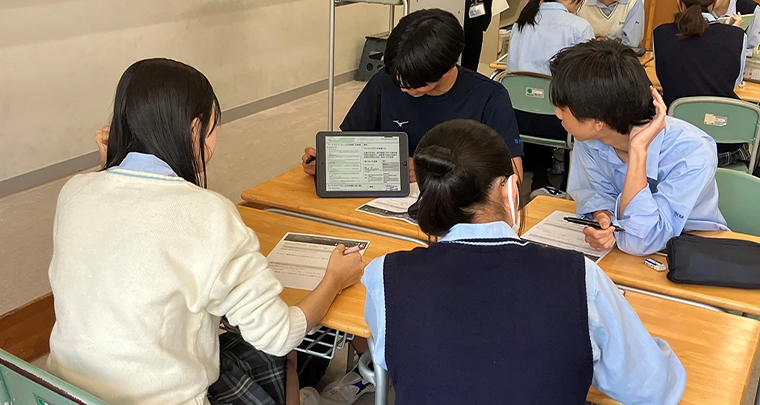
Education has become one of the clearer use cases. Nikkei licenses the digital edition to schools, and teachers and students at Japanese upper-secondary schools have taken up Ask! Nikkei as one of their main ways of gathering trustworthy information.
In a time when misinformation is a growing concern, being able to draw on a trusted newsroom archive matters to them.
Students use Ask! Nikkei to gather information and explore possible solutions to social issues.
What’s next
Our article archive has more than 500,000 pieces, built up over decades. Ask! Nikkei treats that archive as a knowledge base for answering reader questions. Most newsrooms have archives like this. The scale and the topics differ, but the underlying asset is the same. We see what we built as one way for a newsroom to turn a deep archive into an active resource for its readers.
Nikkei plans to keep investing in this direction. We will continue to refine our in-house models, adapt to the rapid progress in LLMs, and explore new ways for AI to support the digital edition's reading experience.
What we want to build is a combination of two things: The trust that newsrooms have earned over generations, and what generative AI can now do. Together, they can help readers find answers faster and understand the news more deeply. That is the value we want to keep delivering.
Related Articles
-

AI’s effect on super user math
15 September 2026 -

At Mediacorp’s CNA, loyalty means giving audiences a reason to ...
20 August 2026 -

Tribun Network turns print “dots” into AI-powered insight
20 August 2026 -

Indian Express builds a video-first future around trusted journ...
20 July 2026 -

Economist launches subscription tier targeting younger audience...
20 July 2026 -

Grupo RBS builds social-first video operation to expand audienc...
20 July 2026 -

Inside Denník N’s successful subscription strategy
15 July 2026 -

Why are audiences going to AI answer engines for news?
30 June 2026
Upcoming Events
-

Subscriber Acquisition Master Class
10-17 November 2026
-

Media Advertising Summit
New York, United States
07-10 December 2026
-

AI-Native News Product Master Class
18-25 February 2027
-

Media Subscriptions Summit
Oslo, Norway
08-12 March 2027
-

World Congress of News Media
New York, United States
25-30 April 2027
-

Branded Content & Partnerships Master Class
20-27 May 2027
-

Subscriber Retention Master Class
17-24 June 2027
-

Conferencia Latinoamericana
15-16 July 2027
-

South Asia News Media Festival
New Delhi, India
19-22 July 2027
-

Asia/Pacific News Media Summit
19-20 August 2027
-

CEO Roundtable at Kilkenny
Kilkenny, Ireland
24-26 August 2027
-

Media Innovation Week
Amsterdam, The Netherlands
27 September - 01 October 2027








