

Bauer Media reimagines publishing for the age of AI
Ideas Blog | 16 August 2026

The publishing industry is entering a new era. Content creation is becoming faster, cheaper, and increasingly automated. Distribution is more fragmented. For publishers, this creates a simple but uncomfortable reality: Content supply is becoming infinite, but human attention is not.
At Bauer Media Publishing, this was the starting point for a larger AI & Tech Initiative.
The core question was not, “How can we add AI to our existing editorial system?”
The better question was: “How should publishing work when AI becomes part of the entire content lifecycle?”
From content production to liquid publishing
Traditional publishing systems were built for pages, templates, and manual workflows. But they were not designed for a world where content moves fluidly across formats, interfaces, and AI-driven environments.
That is where liquid content changes the model.
Liquid content is not just repurposing articles into videos or social posts. It treats content as structured knowledge instead of finished objects. Modular, semantic, and reusable.
Our platform initiative was built around that principle, combining content creation, design, and intelligence into one integrated system. AI served as the intelligent layer throughout the workflow, supporting research, briefing, optimisation, and automation.
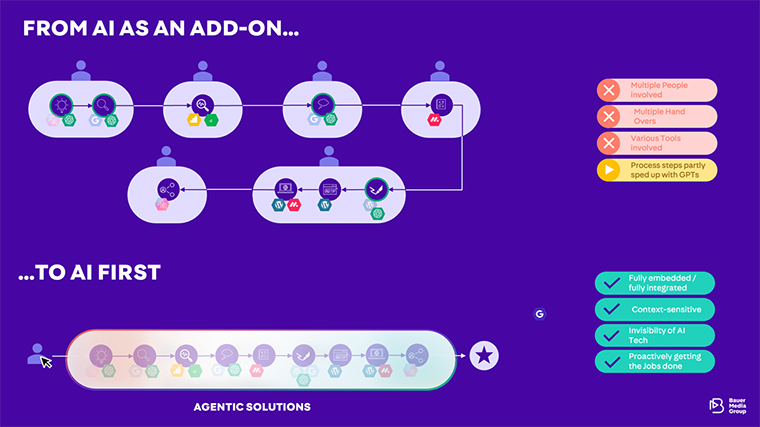
AI-first means workflow-first
One of our strongest learnings was that AI creates the most value when it is embedded into the workflow, not added as a separate tool.
Many organisations start with chat interfaces. That is understandable, but it often means editors still have to leave their workflow, write prompts, copy outputs, and manually move information between systems. It can speed up individual tasks, but the overall process remains fragmented.
With our AI approach and experiments, the ambition was different. We explored agentic workflows that could observe, prepare, and support editorial work across the full content lifecycle. This included trend analysis, content briefings, drafting support, optimisation, publishing support, and lifecycle management.
The goal was never to replace editorial judgment. The goal was to reduce low-value manual work so editors could focus more on creativity, quality, context, and decision-making.
That distinction matters.
AI should not become a shortcut around editorial standards. It should become infrastructure that helps people do better work.
Responsibility by design
Trust was a central principle in the initiative.
AI was not designed to be hidden; editors needed to know when AI was involved, what inputs it used, and where outputs came from. Human-in-the-loop control was not treated as a fallback; it was part of the product design.
The principle was simple: AI can suggest, support and accelerate. But humans remain in control.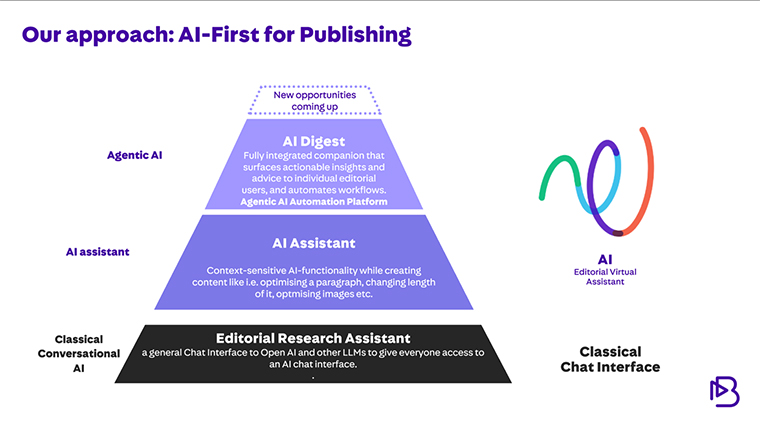
The results showed the potential
The initiative and experiments delivered clear signals of what becomes possible when AI, UX, and publishing workflows are designed together.
Validated use cases included automated trend analysis, AI-supported content briefings, content lifecycle management, and AI-assisted content creation. In our tests and implementations, trend analysis saved significant editorial time, AI-generated briefings reduced preparation work, and structured workflows improved speed and quality across the publishing process.
But the bigger lesson was not only about efficiency; it was organisational. AI will not fix a fragmented publishing organisation. It will expose it.
If editorial, product, technology and commercial teams operate in silos, AI will scale the silos. If workflows are unclear, AI will amplify the confusion. If content is not structured, AI has little foundation to build on.
That is why liquid publishing is not just a technology topic. It is an operating model topic.
The future publisher is a system builder
The next era of publishing will not be defined by who publishes the most content. It will be defined by who best structures knowledge, who creates the most relevant experiences, and who aligns editorial quality, product experience, and commercial logic into a single coherent system.
Related Articles
-

Marketers should outsource tasks, not thinking
25 October 2026 -

AI’s effect on super user math
15 September 2026 -

At Mediacorp’s CNA, loyalty means giving audiences a reason to ...
20 August 2026 -

Tribun Network turns print “dots” into AI-powered insight
20 August 2026 -

Nation Media Group focuses editorial strategy on stories that m...
4 August 2026 -

Briefly News empowers journalists with AI tool suite Nova
4 August 2026 -

Grupo RBS builds social-first video operation to expand audienc...
20 July 2026 -

AI adoption in newsrooms should move from experiment to strateg...
12 July 2026
Upcoming Events
-

Subscriber Acquisition Master Class
10-17 November 2026
-

Media Advertising Summit
New York, United States
07-10 December 2026
-

AI-Native News Product Master Class
18-25 February 2027
-

Media Subscriptions Summit
Oslo, Norway
08-12 March 2027
-

World Congress of News Media
New York, United States
25-30 April 2027
-

Branded Content & Partnerships Master Class
20-27 May 2027
-

Subscriber Retention Master Class
17-24 June 2027
-

Conferencia Latinoamericana
15-16 July 2027
-

South Asia News Media Festival
New Delhi, India
19-22 July 2027
-

Asia/Pacific News Media Summit
19-20 August 2027
-

CEO Roundtable at Kilkenny
Kilkenny, Ireland
24-26 August 2027
-

Media Innovation Week
Amsterdam, The Netherlands
27 September - 01 October 2027








