

Bergens Tidende created the world’s simplest election guide
Ideas Blog | 01 July 2026


Digital election guides can easily feel like homework. That is what one young woman told us when asked how she used such guides before the Norwegian elections.
Another, a young man, said he often started answering the questions in these guides on his way home from work, but it took him too long. He planned to finish later but rarely did.
Both these users illustrate an important point: Even motivated users drop off when the process feels heavy and time-consuming.
What if the problem isn’t that young people don’t care about politics but that our formats and language make it too demanding to participate? Consequently, we asked ourselves: Can we build the world’s simplest election guide?
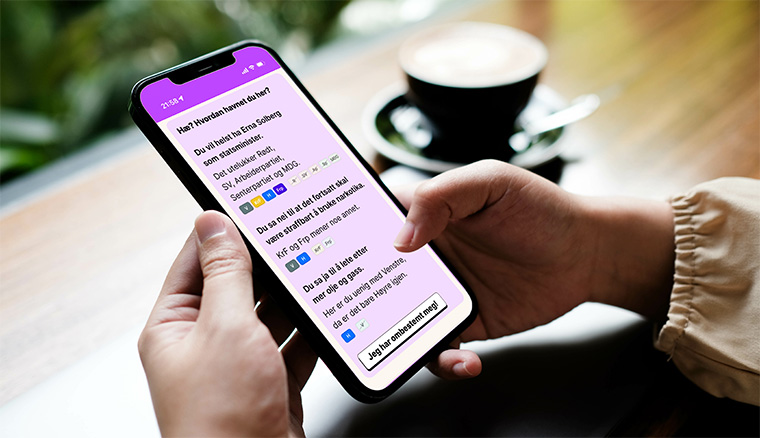
After all, these election guides have been a feature of every major Norwegian media outlet ahead of elections for well over two decades. But despite changing the questions and colours, they have all been built exactly the same way.
Until we launched ours.
Our goal was to tell users, within seconds, which political party they aligned with ahead of Norway’s 2025 parliamentary election. We wanted to remove complex language, unclear differences between parties and questions that went on and on.
Behind the scenes
Four political journalists reviewed all parties’ manifestos to identify clear political differences. Then came the hardest part: Cutting and simplifying. The result was a guide that covered topics like parental leave, drug policy, after-school programmes, the European Union and climate change — in a format that provided answers in seconds.
Just as importantly, it explained how each choice matched a specific party, helping users understand the differences in Norwegian politics.
Traditional election guides add points to the parties the user agrees with on 10, 15, or 20 questions, then presents the parties with the most points. Our approach was different: we built several tree structures, eliminating parties until one remained.
Outwardly, it was the world’s simplest election guide. Behind the scenes, it was built on weeks of work by some of Norway’s most experienced political journalists.
Simplicity wasn’t just about content — it also shaped the design. While we based it on BT’s visual identity, we studied design preferences for younger audiences and adjusted everything from font sizes and spacing to animations, ensuring the experience felt quick and intuitive.
Before launch, we invited readers to test and give feedback. Their input led to several improvements — meaning users themselves helped shape the final product. We believe this strengthened both trust and engagement.
The votes are in
The result exceeded our expectations. The guide reached around 160,000 users at Bergens Tidende and achieved a significantly higher click-through rate than competing guides. It became one of the most popular election concepts in BT’s history. Many users completed it multiple times and shared it with others.
Perhaps most importantly, it sparked interest in politics. As one user put it: “I took it several times — and it just made me want more.”
And they could get more. A simple feature — “Help! Give me more questions!”— allowed users who wanted to dive deeper to spend more time with the guide.
The world’s simplest election guide shows that simplification is not the same as oversimplification. If there’s one thing we learned from this project, it’s that simplifying is perhaps the hardest thing we journalists do. It requires expertise, linguistic precision, and the ability to understand users’ needs — regardless of their age, interest, or prior knowledge.
Low voter participation is a democratic challenge. By lowering the threshold for participation — without compromising journalistic quality — we believe we created an election guide that is truly inclusive for everyone.
Related Articles
-

At Mediacorp’s CNA, loyalty means giving audiences a reason to ...
20 August 2026 -

Tribun Network turns print “dots” into AI-powered insight
20 August 2026 -

Indian Express builds a video-first future around trusted journ...
20 July 2026 -

Grupo RBS builds social-first video operation to expand audienc...
20 July 2026 -

Inside Denník N’s successful subscription strategy
15 July 2026 -

10 years later, user needs must be twinned with content formats...
1 July 2026 -

Why are audiences going to AI answer engines for news?
30 June 2026 -

Rheinische Post programme turns print loyalty into digital conf...
11 June 2026
Upcoming Events
-

Subscriber Acquisition Master Class
10-17 November 2026
-

Media Advertising Summit
New York, United States
07-10 December 2026
-

AI-Native News Product Master Class
18-25 February 2027
-

Media Subscriptions Summit
Oslo, Norway
08-12 March 2027
-

World Congress of News Media
New York, United States
25-30 April 2027
-

Branded Content & Partnerships Master Class
20-27 May 2027
-

Subscriber Retention Master Class
17-24 June 2027
-

Conferencia Latinoamericana
15-16 July 2027
-

South Asia News Media Festival
New Delhi, India
19-22 July 2027
-

Asia/Pacific News Media Summit
19-20 August 2027
-

CEO Roundtable at Kilkenny
Kilkenny, Ireland
24-26 August 2027
-

Media Innovation Week
Amsterdam, The Netherlands
27 September - 01 October 2027








