

DRIVE shows how publishers can use vision, mission, values to map success
Ideas Blog | 10 September 2026


It’s much easier to decide which route to take if you know where you’re going.
What’s true for travel is also true for companies. Vision and mission statements, North Stars, values, and claims are often thoughtfully crafted – but too often they don’t affect daily decisions in the newsroom, marketing, and advertising teams.
From anecdote to analysis
A recent analysis at DRIVE, the digital revenue initiative connecting 30 regional publishers from Germany, Austria, and Switzerland, aimed to determine whether actively using these instruments makes a difference in performance KPIs.
Anecdotal evidence and best practices from publishers, including Lensing and Aftenposten, have led to the conclusion that when goals are clear and well-communicated, they lead to better performance in media time and conversions.
Publishing houses where vision and goals genuinely shape daily work gain media time and new subscribers considerably faster. A shared strategy pays off, but only if it is actively and purposefully brought to life.
As a first step, DRIVE mapped which of these instruments each of the 30 publishers uses and what they promise.
Everyone wants to be the anchor of the region
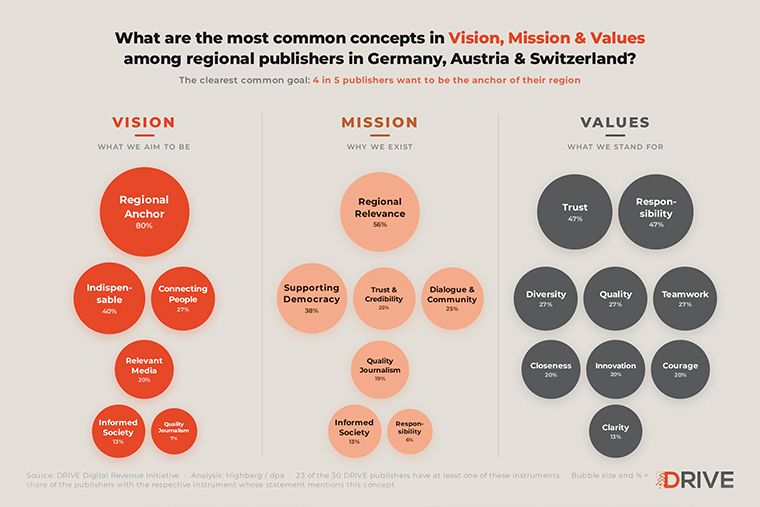
The analysis showed strong parallels in the promises made by regional publishers. Being recognised as the major news source for the region was most important to almost every publisher, and being indispensable was another major goal.
Supporting democracy and dialogue with the community ran through the mission statements, while trust and responsibility topped the list of stated values.
DRIVE asked the publishers for a self-assessment on how well those goals are known throughout the company and how much they influence daily decisions. On a scale from 1 (not present/not known) to 5 (known everywhere, shapes everyday decisions), the companies rated themselves at an average of 2.8. Even though 23 publishers have clear statements on what they aim to achieve and what they stand for, only one rated itself a 5.
An operationalised vision predicts growth
We then correlated these scores with the KPIs that matter most on the road to digital subscription success: media time (how much time readers spend with a publisher’s digital products), conversions (newly started digital subscriptions), the habit score (how many days a month subscribers actually come back, DRIVE’s key retention metric), and the total number of active subscriptions.
To make publishers of different sizes comparable, media time, number of conversions, and number of active subscribers were set in relation to the population of each publisher’s region.
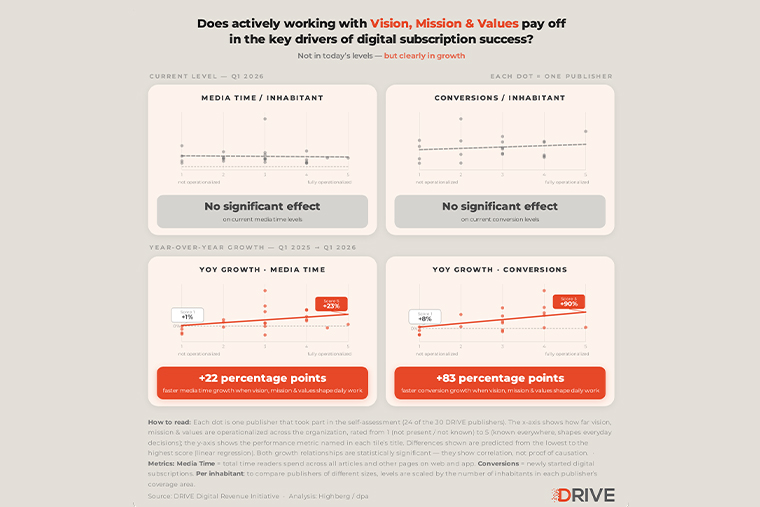
Current levels of media time and conversions show no measurable connection to how intensively vision, mission, and values are operationalised in daily business. Growth is a different matter. Publishers who use these instruments to strongly shape daily work grew their media time 22 percentage points faster year-on-year than publishers who give them hardly any role.
For conversions, the gap is even wider: 83 percentage points. Both growth effects hold up to statistical significance testing. A lived vision says little about where a publisher stands today. But it says a lot about where it is heading.
On the habit score, the data showed no reliable effects. A likely reason is that publishers still focus more on media time and conversions than on retention. For the number of active subscriptions, there is a positive correlation with the self-assessment and a negative correlation with its growth (neither is statistically significant, though).
One possibility is that publishers where vision, mission, and values have a stronger impact on daily work tend to have higher market penetration and slower growth in more mature markets.
Making strategy part of the daily routine
Although most publishers have formulated visions, missions, and values, the average self-assessment score is only 2.8, so DRIVE concluded there’s a gap between the goals they aim for and reality. Publishing houses should use their goals and strategies to structure decision-making processes and to get their teams on board — meaning not only the editorial team, but also marketing, sales, and communications.
What does it look like when vision, mission, and values actually shape daily work? The publishers ahead of the pack translate their statements into everyday routines. They communicate them relentlessly: One publisher anchors its values in a company compass that every employee encounters in the intranet and from the first day of onboarding, following the principle that you cannot communicate too much.
Editorial frameworks such as user needs models are documented as part of the mission, so every piece of content ties back to the promise made to readers. Another checks in its daily news conferences whether the output actually fulfils the mission. And the goals move into planning: Several publishers break their North Star down into objectives and key results for each team, so the strategy shows up in daily work instead of hanging on a wall.
The promise also works outward. One-third of DRIVE publishers have condensed their mission into a public claim, and some have built brand campaigns around it. That becomes more important as search and social media lose weight as traffic sources: the clearer a publisher’s identity, the more readers come directly.
Employees who are aware of their purpose and the role they play in building a successful company are more likely to be motivated and focused. Resources are less likely to be wasted on less impactful projects when everyone asks themselves one easy question before making a decision: “Does this help us achieve our goal?”
The destination is set. What separates the fast movers is that everyone in the newsroom and in every other department of the publishing house knows the way.
Banner art: Adobe Stock by NongAsimo.
Related Articles
-

Bundling is a pricing decision, rebundling is an organisational...
18 October 2026 -

7 themes from Madrid show publishers trading traffic for relati...
28 September 2026 -

AI’s effect on super user math
15 September 2026 -

What I told 40 CEOs (and won’t gatekeep from you)
30 August 2026 -

Economist launches subscription tier targeting younger audience...
20 July 2026 -

Grupo RBS builds social-first video operation to expand audienc...
20 July 2026 -

Inside Denník N’s successful subscription strategy
15 July 2026 -

Bonnier News Local, Gota Media strike gold with their Core Mode...
21 June 2026
Upcoming Events
-

Subscriber Acquisition Master Class
10-17 November 2026
-

Media Advertising Summit
New York, United States
07-10 December 2026
-

AI-Native News Product Master Class
18-25 February 2027
-

Media Subscriptions Summit
Oslo, Norway
08-12 March 2027
-

World Congress of News Media
New York, United States
25-30 April 2027
-

Branded Content & Partnerships Master Class
20-27 May 2027
-

Subscriber Retention Master Class
17-24 June 2027
-

Conferencia Latinoamericana
15-16 July 2027
-

South Asia News Media Festival
New Delhi, India
19-22 July 2027
-

Asia/Pacific News Media Summit
19-20 August 2027
-

CEO Roundtable at Kilkenny
Kilkenny, Ireland
24-26 August 2027
-

Media Innovation Week
Amsterdam, The Netherlands
27 September - 01 October 2027








