

The Quint’s documentary on walkability told the daily struggle of millions of Indians
Ideas Blog | 14 June 2026

In India’s fast-growing cities, mobility conversations are dominated by vehicles — highways, flyovers, metros, congestion. But what about the most fundamental mode of transport: walking?
This question became the starting point of our documentary, Why Indian Cities Aren’t Walkable — a project that set out to examine an issue that affects every urban resident, yet remains underreported and under-prioritised.
Identifying the gap
The idea for the documentary emerged organically from audience feedback. Following a previous video on public transport, a recurring theme in the comments stood out: the poor condition of footpaths. Viewers weren’t just complaining about traffic; they were pointing to something more basic — the absence of safe pedestrian infrastructure, which is also crucial for last-mile connectivity to access public transport.
We saw an opportunity to investigate a systemic issue hiding in plain sight.
Geographically representative and inclusive coverage
Walkability is not a hyperlocal issue; it varies across cities, geographies, and lived experiences. While the documentary is anchored by a single reporter, we expanded its scope by collaborating with urbanists across cities — including Mumbai, Bengaluru, and Kolkata — to capture a more representative and layered narrative without losing coherence.
These collaborations also moved the story beyond visible infrastructure failures — broken pavements, encroachments, unsafe crossings — to include deeper concerns around accessibility, gendered safety, and urban design.
Blending data, expert insights, and human impact
While the documentary integrates data insights and expert analysis by an urban designer, it also foregrounds the human cost of poor planning — a case study of a pedestrian fatality — to transform abstract data into a lived reality.
Combining data with human stories helped position walkability not just as an infrastructure issue, but as a public health, safety, and equity concern.
The documentary was developed over several months, involving extensive research, scripting, on-ground shoots, coordination with contributors, and iterative editing.
Experimenting with narrative form
A key creative decision was to make the reporting process itself part of the narrative.
Instead of a conventional explainer, the documentary places the reporter within the story — navigating broken footpaths, questioning systems, and even simulating the experience of walking through hazardous streets.
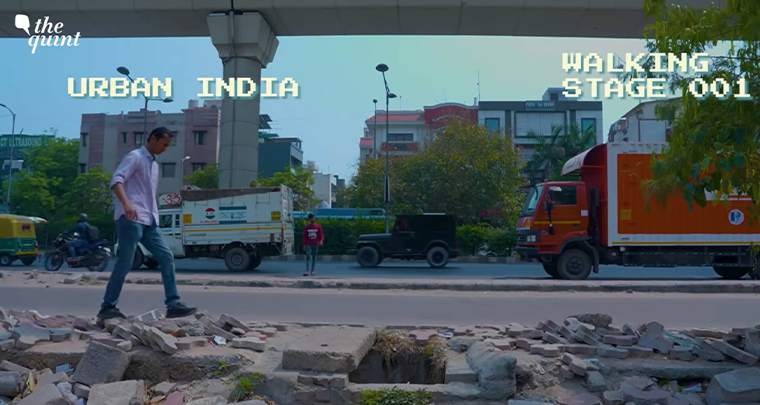
This approach aimed to collapse the distance between the viewer and the issue, making it less observational and more experiential.
Driving engagement, distribution, and promotion
Given the subject’s relatability, we anticipated strong organic traction — but we also designed a structured promotion strategy to maximise reach.
Ahead of the release, the documentary was seeded across platforms through Instagram reels, carousels, polls, and newsletters to build anticipation. Post-launch, it was amplified through The Quint’s distribution ecosystem — including YouTube, Instagram, Facebook, X, LinkedIn, WhatsApp communities, and Substack.
This multi-platform strategy ensured that the documentary reached audiences with varying consumption habits.
Measuring impact
In the six months since publication, the documentary has garnered over 900,000 views on YouTube, alongside 30,000+ likes and over 2,400 comments.
More importantly, the engagement signals indicate sustained viewer interest. Despite being a 16-minute video, the average view duration stands at 4 minutes 30 seconds — reflecting the effectiveness of its engaging narrative structure in retaining audiences. To discuss the issue with viewers and enhance engagement, the reporter also initiated a conversation in the comments section.
Our documentary sought to highlight the systemic failure that normalised poor pedestrian safety in urban India. For us, the project reinforces a key editorial takeaway: some of the most impactful stories are not hidden — they are simply overlooked.
Related Articles
-

Local news publishers need to tap into journalists’ trusted exp...
4 October 2026 -

Inside 20 Minuten’s quest to create a vertical video format
30 September 2026 -

Onmanorama reinvents history for Gen Z with AI-created video se...
16 September 2026 -

FAZ’s video investment pays off on new platforms
27 August 2026 -

At Mediacorp’s CNA, loyalty means giving audiences a reason to ...
20 August 2026 -

Grupo RBS builds social-first video operation to expand audienc...
20 July 2026 -

AI forced Washington Post to rethink paid acquisition, start wi...
12 July 2026 -

With The B‑Side, Boston Globe scored an A+ with young audiences
10 June 2026
Upcoming Events
-

Subscriber Acquisition Master Class
10-17 November 2026
-

Media Advertising Summit
New York, United States
07-10 December 2026
-

AI-Native News Product Master Class
18-25 February 2027
-

Media Subscriptions Summit
Oslo, Norway
08-12 March 2027
-

World Congress of News Media
New York, United States
25-30 April 2027
-

Branded Content & Partnerships Master Class
20-27 May 2027
-

Subscriber Retention Master Class
17-24 June 2027
-

Conferencia Latinoamericana
15-16 July 2027
-

South Asia News Media Festival
New Delhi, India
19-22 July 2027
-

Asia/Pacific News Media Summit
19-20 August 2027
-

CEO Roundtable at Kilkenny
Kilkenny, Ireland
24-26 August 2027
-

Media Innovation Week
Amsterdam, The Netherlands
27 September - 01 October 2027








