

FAZ’s video investment pays off on new platforms
Newsroom Innovation Initiative Blog | 27 August 2026

As news consumption continued shifting toward digital, visual, and platform‑driven formats, Frankfurter Allgemeine Zeitung (FAZ) knew it was time to pivot.
During this week’s Webinar, presented by the INMA Newsroom Innovation Initiative, INMA members learned how this led the company to make one of its most significant modern-day investments. Andreas Brand, FAZ’s head of video, detailed how the organisation has accelerated its video journalism, expanded its podcasting footprint, and strengthened its social media presence.
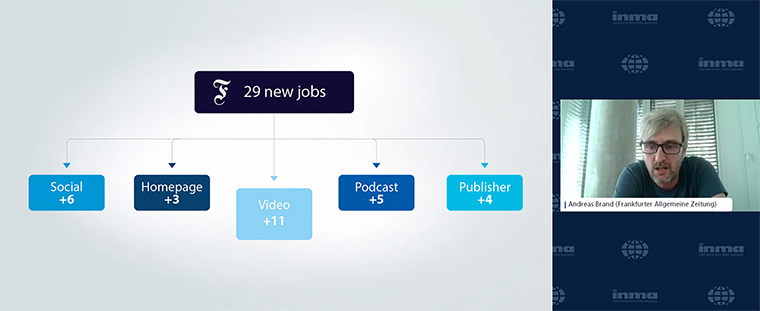
On April 23 — which happened to be Brand’s birthday — FAZ’s editors were called into the organisation’s largest conference room. Rumours were already circulating about what was afoot, but instead of job cuts, FAZ revealed it would be adding 29 new positions focused on digital growth. Of those, 22 were video-specific.
“We didn’t expect that,” Brand recalled. “It was kind of my birthday present.
“And it’s good because it says they’re investing in a field where many media companies are shrinking in this moment and not investing.”
Remaining relevant
The decision rested on a central question posed by publisher Carsten Knop: How can FAZ remain relevant enough to continue securing interviews with Germany’s chancellor and senior ministers when political figures increasingly turn to influencer podcasts, Instagram creators, and other high‑reach digital channels?
“We need relevance and more reach,” Brand said. “The central question is not only what we publish and how good we are. The central question will be how we remain part of the conversation online, or in our society.”
FAZ had already made progress on digital subscriptions; its F+ offering has become the organisation’s “hardest currency,” and its Web site has become “more and more important than the newspaper.”
But Brand said strong writing alone no longer reaches enough people. Audiences across all age groups now listen to podcasts, watch videos, and swipe through Instagram and TikTok.
“It’s not only the young people,” he said. “It’s all over society.”
To meet audiences where they are, FAZ invested in six new social media roles, five new podcast roles, and 11 new video roles. That forms the foundation for FAZ’s new video strategy, Brand said.
He explained the department operates like a puzzle, with multiple pieces that must fit together to serve different platforms and audience behaviours:
- One key piece is FAZ’s long‑form explainer format, Was kostet die Welt?, which runs 20 to 30 minutes.
- Another is FAZ’s TikTok channel.
- A third is the use of agency footage — Reuters, AFP, and others — adapted for FAZ.net.
That third piece, Brand said, is currently the organisation’s biggest weakness: “We have something foreign on our Web sites, and that’s what we want to change. It’s not our brand.”

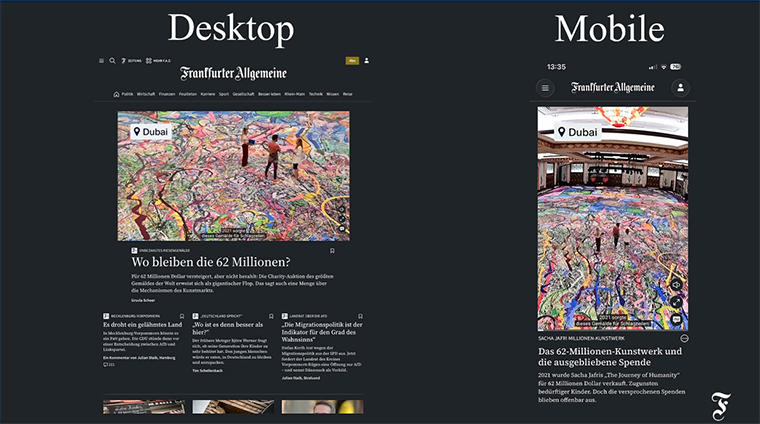
To fix that, FAZ is hiring three people to produce autoplay videos for its homepage. The goal is to strengthen FAZ.net, the organisation’s most important channel for subscriptions and revenue. By producing its own short videos, which range from 10‑second loops to two‑minute explainers or journalist commentary, FAZ can bring stories to life and encourage readers to stay longer.
Those videos, Brand explained, will not replace articles but “open the door to them.”
Because FAZ’s audience is overwhelmingly mobile, every video will be produced in both vertical and horizontal versions, with mobile as the priority. The aim is to create an “Instagram feeling” on FAZ.net, where autoplay videos appear naturally as readers scroll, Brand said.
Inside a video success story
One of FAZ’s best learning experiences came from Was kostet die Welt?, the explainer series produced for funk, a youth‑oriented digital platform run by Germany’s public broadcasters ARD and ZDF. Funk asked FAZ whether it could explain economics to a young audience.
“Economics, yes, that’s what we can do,” Brand said. “But the YouTube game and young audience, well, that’s not our natural strength.”
FAZ decided to take the challenge.
The team developed a host‑driven, weekly explainer series and spent nearly a year learning how to produce it. They underwent intensive workshops on visual storytelling, scriptwriting, thumbnail creation, and host performance. Newspaper editors contributed research and reporting, but had to learn how to write video treatments and scripts.
“Writing a script for a video is something different,” Brand said. “You have to learn it.”
The turning point came when one episode — about the sports streaming service DAZN and its pricing strategy — became a viral hit, surpassing one million views. Instead of celebrating, the team studied why it worked and realised that focusing on business models, emotional resonance, and story‑driven narratives created stronger engagement.
That led to developing a checklist for selecting topics: They must appeal to young people, be tellable as a compelling story, evoke emotion, and teach economic concepts “over the back door.”
The results were dramatic. Season one averaged 27,000 views per episode; season three averaged half a million. Brand said the success helped convince FAZ’s leadership that video was worth investing in.
Building a new identity
FAZ now plans to transfer those learnings into a new explainer series produced under its own brand. YouTube will be the primary platform because it supports longer videos, offers advertising potential, and allows for paid channels or merchandising in the future.
The challenge, Brand said, is finding a niche not already saturated on YouTube, while ensuring the format feels distinctly FAZ. Brand said the goal is scalability: if the first format succeeds, FAZ wants to create a second, third, and fourth.
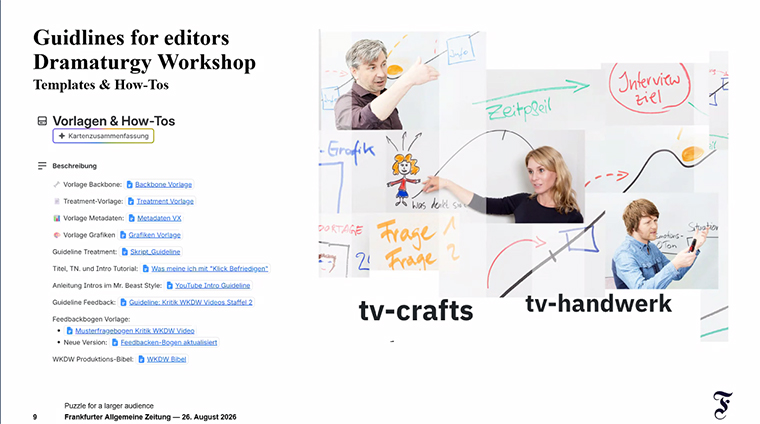
Part of FAZ’s strategy includes turning select editors into content creators. Today, self‑marketing on TikTok and Instagram is critical for journalists, but FAZ currently has few journalists active on these platforms. The company has started running workshops where journalists experiment with smartphone filming, scriptwriting, editing, and responding to audience feedback.
“We want to support [the journalists] with ongoing technical and editorial support,” Brand said, adding that it also gives the creator a bit of independence from their regular roles.
“Hopefully they will have fun with this. The aim is not to turn every journalist into an influencer, but to make expertise visible where people already are.”
Related Articles
-

At Mediacorp’s CNA, loyalty means giving audiences a reason to ...
20 August 2026 -

Tribun Network turns print “dots” into AI-powered insight
20 August 2026 -

Nation Media Group focuses editorial strategy on stories that m...
4 August 2026 -

Indian Express builds a video-first future around trusted journ...
20 July 2026 -

Grupo RBS builds social-first video operation to expand audienc...
20 July 2026 -

Inside Denník N’s successful subscription strategy
15 July 2026 -

AI adoption in newsrooms should move from experiment to strateg...
12 July 2026 -

Why are audiences going to AI answer engines for news?
30 June 2026
Upcoming Events
-

Subscriber Acquisition Master Class
10-17 November 2026
-

Media Advertising Summit
New York, United States
07-10 December 2026
-

AI-Native News Product Master Class
18-25 February 2027
-

Media Subscriptions Summit
Oslo, Norway
08-12 March 2027
-

World Congress of News Media
New York, United States
25-30 April 2027
-

Branded Content & Partnerships Master Class
20-27 May 2027
-

Subscriber Retention Master Class
17-24 June 2027
-

Conferencia Latinoamericana
15-16 July 2027
-

South Asia News Media Festival
New Delhi, India
19-22 July 2027
-

Asia/Pacific News Media Summit
19-20 August 2027
-

CEO Roundtable at Kilkenny
Kilkenny, Ireland
24-26 August 2027
-

Media Innovation Week
Amsterdam, The Netherlands
27 September - 01 October 2027








