

Inside 20 Minuten’s quest to create a vertical video format
Young Audiences Initiative Blog | 30 September 2026

When Switzerland’s 20 Minuten decided to stop printing its newspaper at the end of 2025 and transform fully into a digital‑only news platform, it prompted an evaluation of where audiences were coming from and what they were looking for.
During this week’s INMA Young Audiences Initiative Webinar, Basil Honegger, head of video news at 20 Minuten, shared insights with Kerstin Hasse, lead of the INMA Young Audiences Initiative, and noted that the data had become impossible to ignore.
Young audiences were not reading newspapers or visiting news apps; they were consuming news (and everything else) through vertical video on social platforms.

That revelation became the catalyst for the company to create vertical video shorts inside its app.
The writing on the wall was spelt out in the 2024 Reuters Digital News Report: 65% of young people globally have never regularly read a newspaper, but 73% of 18‑ to 24‑year‑olds watch weekly short‑form news videos.
“This was 2024,” he noted. “We’re two years later now, and for sure this number hasn’t decreased.”
For 20 Minuten, the situation was urgent. The company had just ended its print edition and was repositioning itself as a fully digital news brand. Yet its video product — which was still built around horizontal, 16:9 formats — wasn’t engaging users.
“They weren’t consuming our app, our Web sites, our papers, whatever — but they consume on social media, and they consume news completely differently than we used to,” Honegger said.
Swipe, don’t scroll
The turning point came when the team looked closely at how Swiss audiences were actually encountering news.
In Switzerland, Instagram and TikTok had become the dominant platforms for news consumption among young people. The habit was fully formed: swipe, watch, swipe again.
Vertical video wasn’t just a format; it was a behaviour.
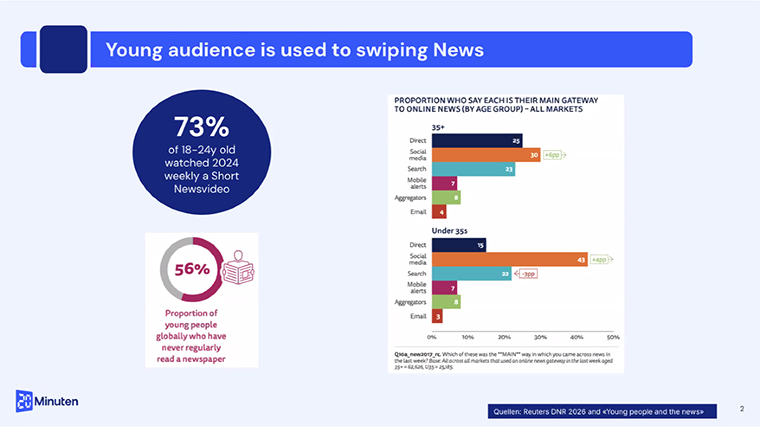
And that behaviour was shaping expectations. “People are used to swiping,” Honegger said. “They learned their habits on social media. They learned what a good video experience looks like.”
If 20 Minuten wanted to remain relevant, it had to meet users where they already were. That meant transforming its app into an experience that felt as intuitive and frictionless as TikTok or Instagram Reels.
Making the business case
The editorial motivation was only half the story; such a move also made business sense.
In Switzerland, every third Swiss franc spent on advertising already goes to Big Tech platforms. Video advertising budgets for YouTube, TikTok, and Instagram were rising sharply. Meanwhile, ad spend on print and display was declining.
“With the decreasing interest in linear television, advertisers still want video advertising. They have to find new channels,” Honegger said.
Building a high‑quality vertical video environment inside its own app would mean 20 Minuten could offer advertisers a brand‑safe alternative to social platforms — while promising verified journalism and strong reach.
And although the opportunity was clear, the challenge was enormous.
A one‑year sprint
The project began in mid‑2025 with full support from the board of directors: “We had the backup from the board of directors from the beginning,” he said. That support allowed the team to explore what was working in other markets and adapt those lessons to Swiss audiences.
The product team and editorial team worked “hand‑in‑hand,” Honegger said, from the very beginning. The goal was to build a vertical video shorts feed inside the app that could rival the experience users already had on TikTok and Instagram.
The teams didn’t waste any time. Honegger shared a timeline that was incredibly fast:
- Summer 2025: Product team begins exploring video CMS options and workflows.
- Autumn 2025: Editorial team begins forming a dedicated shorts team.
- November 2025: First hires join the video team.
- January 2026: First test runs inside the app with 2% of users.
- May 2026: Full rollout to 100% of users on iOS and Android.
“We tested every month,” Honegger said. “Every app sprint we had a new version of the experience.”
Designed to exceed expectations
The team made several key decisions that shaped the final product:
- Full‑screen vertical video. Horizontal video was abandoned. The news feed is entirely vertical, optimised for mobile.
- Fast, dense storytelling. Shorts use split screens, captions, sound design, and visual effects to deliver stories quickly and emulate the social media experience.
- Social‑native interactions. Likes, comments, shares, and double‑speed playback were added, further meeting the expectations of young users. A Gen Z peer group of 20 staff members from across the company provided continuous feedback on the project.
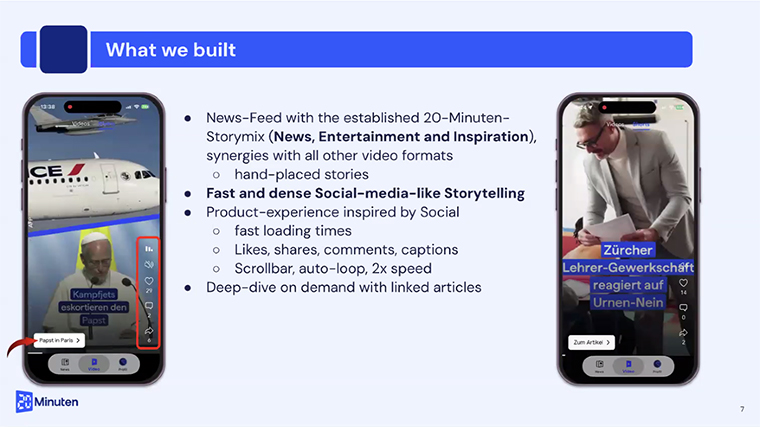
- Seamless transitions between video and text. Every video includes a button that leads directly to a related article. If users tap “back,” they return to the video feed, not the homepage. This keeps the experience fluid and prevents users from feeling “kicked out” of the feed.
- Skippable ads. This was a major editorial decision. Non‑skippable pre‑roll ads are more profitable, but the team didn’t want to compromise user experience. “We wanted the user to have a really good experience,” Honegger said. “That’s why everything is skippable.”
What the teams learned
By summer 2026, the vertical video feed had become a core part of user behaviour. “Shorts already equal standard video views in our app,” Honegger reported.
Some of the other key takeaways included:
- Soft news performs best, mirroring social platforms, while hard news requires more creative storytelling to succeed.
- Quality beats quantity, so the team reduced output to focus on strong ideas.
- Editorial culture is shifting, with reporters now thinking visually and often producing video teasers alongside articles.
- Shorts can be repurposed for TikTok, Instagram, and YouTube, creating cross‑platform efficiency.
The biggest takeaway is that vertical video is not a trend; it’s a habit.
“We do see a lot of further potential, and we want to build some more,” Honegger said, adding that “the habit of consuming news as vertical videos is established and gets more and more important.
“Users are looking for that, and we should give them what they’re used to,” he said, emphasising the need to present news in the format they like to consume it. “And we should also improve that all the time.”
Related Articles
-

At Mediacorp’s CNA, loyalty means giving audiences a reason to ...
20 August 2026 -

Tribun Network turns print “dots” into AI-powered insight
20 August 2026 -

Nation Media Group focuses editorial strategy on stories that m...
4 August 2026 -

Indian Express builds a video-first future around trusted journ...
20 July 2026 -

Economist launches subscription tier targeting younger audience...
20 July 2026 -

Grupo RBS builds social-first video operation to expand audienc...
20 July 2026 -

Inside Denník N’s successful subscription strategy
15 July 2026 -

AI adoption in newsrooms should move from experiment to strateg...
12 July 2026
Upcoming Events
-

Subscriber Acquisition Master Class
10-17 November 2026
-

Media Advertising Summit
New York, United States
07-10 December 2026
-

AI-Native News Product Master Class
18-25 February 2027
-

Media Subscriptions Summit
Oslo, Norway
08-12 March 2027
-

World Congress of News Media
New York, United States
25-30 April 2027
-

Branded Content & Partnerships Master Class
20-27 May 2027
-

Subscriber Retention Master Class
17-24 June 2027
-

Conferencia Latinoamericana
15-16 July 2027
-

South Asia News Media Festival
New Delhi, India
19-22 July 2027
-

Asia/Pacific News Media Summit
19-20 August 2027
-

CEO Roundtable at Kilkenny
Kilkenny, Ireland
24-26 August 2027
-

Media Innovation Week
Amsterdam, The Netherlands
27 September - 01 October 2027








