

United Daily News Group’s Publish X leverages AI to scale editorial judgment
Ideas Blog | 29 June 2026



Newsrooms don’t fail because they lack content; they fail when judgment cannot keep up.
In the age of AI, production has been optimised, accelerated, and automated; editorial decision-making has not. It remains fragmented, experience-bound, and increasingly difficult to sustain as senior expertise thins across organisations. This is not a Taiwan-specific issue, but a structural challenge facing newsrooms worldwide.
At United Daily News Group, we set out to solve this problem — not by automating decisions but by operationalising them.
Providing judgment at scale
Publish X is not a content tool. It is a decision infrastructure embedded at the newsroom’s central desk — where editorial priorities are set, resources are allocated, and accountability resides.
At its core is the democratisation of editorial expertise. Traditionally, judgment has been concentrated in the experience of senior editors — valuable, but difficult to transfer and nearly impossible to scale. Publish X transforms this model by converting decades of editorial experience into structured, shared decision logic.
Through iterative interviews and real-world validation, tacit knowledge was translated into multi-layered frameworks. Editorial processes — from reporting experience, judgment, and prediction to outcomes — were mapped into eight activation flows and 41 reporting scenarios, enabling structured, actionable story planning.
What was once individual intuition becomes an organisational capability — accessible, testable, and continuously refined.
This shift redistributes expertise across the newsroom. Editorial judgment becomes a shared resource embedded in daily workflows. In fast-moving stories, editors-in-chief and cross-functional teams can rapidly align on angles, coordinate coverage, and execute without duplication or blind spots.
Collaboration becomes a system-supported process.
Three tiers, one mission
The framework operates across three layers: human judgment remains the final authority; structured logic provides alignment; and AI acts strictly as a support layer.
In Publish X, AI does not make decisions — and is not allowed to. Every decision remains human-owned, with mandatory approval embedded at critical points. Journalists engage with AI critically, evaluating outputs in terms of context, ethics, privacy, and bias.
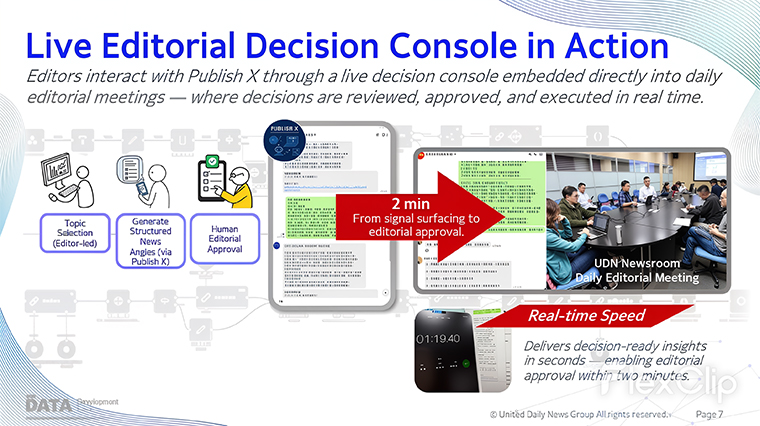
One of the most striking shifts is in the timing of decisions. Publish X can generate a structured story plan within two minutes. This does not replace human decision-making; it advances it. Senior editors are brought into the decision process earlier, with more time to assess blind spots, challenge assumptions, and expand coverage perspectives.
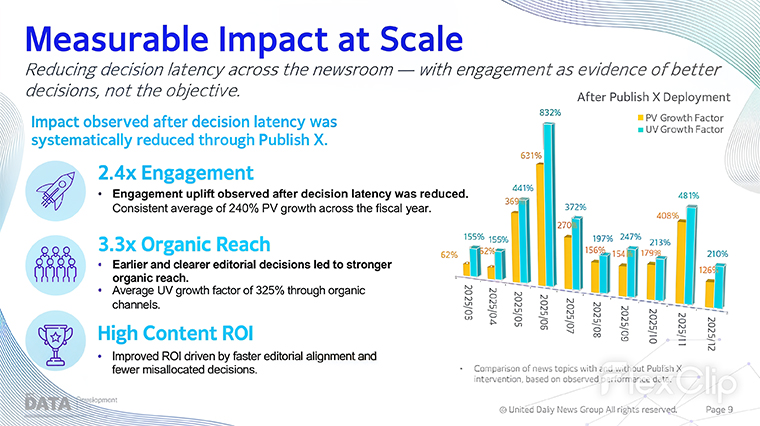
The impact has been both operational and cultural. Teams align faster, while judgment becomes institutionalised across editorial, data, and engineering teams. This has translated into sustained growth in reach, engagement, and content performance — driven by better, more consistent decisions.
The challenge facing journalism is not whether AI can produce more; it has already proven it can. The real question is whether news organisations can preserve the quality and accountability of the decisions behind that output.
Publish X offers one answer: scale judgment, without surrendering it.
In this system, AI expands what is visible, but not what is decided. The future of journalism will not be defined by how much we automate but by what we choose to keep human.
Related Articles
-

Marketers should outsource tasks, not thinking
25 October 2026 -

AI’s effect on super user math
15 September 2026 -

At Mediacorp’s CNA, loyalty means giving audiences a reason to ...
20 August 2026 -

Tribun Network turns print “dots” into AI-powered insight
20 August 2026 -

Nation Media Group focuses editorial strategy on stories that m...
4 August 2026 -

Briefly News empowers journalists with AI tool suite Nova
4 August 2026 -

Infobae embeds AI into newsroom while keeping journalists in co...
21 July 2026 -

Indian Express builds a video-first future around trusted journ...
20 July 2026
Upcoming Events
-

Subscriber Acquisition Master Class
10-17 November 2026
-

Media Advertising Summit
New York, United States
07-10 December 2026
-

AI-Native News Product Master Class
18-25 February 2027
-

Media Subscriptions Summit
Oslo, Norway
08-12 March 2027
-

World Congress of News Media
New York, United States
25-30 April 2027
-

Branded Content & Partnerships Master Class
20-27 May 2027
-

Subscriber Retention Master Class
17-24 June 2027
-

Conferencia Latinoamericana
15-16 July 2027
-

South Asia News Media Festival
New Delhi, India
19-22 July 2027
-

Asia/Pacific News Media Summit
19-20 August 2027
-

CEO Roundtable at Kilkenny
Kilkenny, Ireland
24-26 August 2027
-

Media Innovation Week
Amsterdam, The Netherlands
27 September - 01 October 2027








