

Infobae embeds AI into newsroom while keeping journalists in control
Conference Blog | 21 July 2026

Artificial Intelligence is not replacing journalists at Infobae — it is giving them more time to practice journalism. That was the central message delivered by Fernanda Kobelinsky, editor at Infobae Argentina, during the recent INMA Latin American Media Conference.
Drawing on 16 years of experience at what she described as the world’s most-read Spanish-language news outlet, Kobelinsky explained how the continental news organisation has moved beyond AI experimentation and embedded AI into everyday newsroom workflows through its proprietary platform, Scribnews.
“The idea is to talk about AI not from a laboratory but from what is actually happening to us at Infobae,” Kobelinsky said.
Infobae operates a newsroom of more than 400 journalists across six countries — Argentina, Colombia, Spain, Peru, Mexico, and El Salvador. Despite functioning as a global media company, each newsroom maintains its own editorial identity.
“If we are in Mexico, we speak to Mexicans or foreigners living in Mexico, and the same applies to all of our other newsrooms,” she said.
AI represents journalism’s biggest transformation
For Kobelinsky, the arrival of AI marks the most profound transformation she has experienced during her journalism career — even greater than the emergence of the internet or social media.
Unlike previous technological revolutions that primarily changed content distribution, AI performs intellectual tasks that were once considered uniquely human.
“Previously, we were the only ones who wrote. Now AI can write, summarise, create headlines, optimise for SEO, search, and synthesise information. That is a turning point for journalists and media organizations,” she said. “It is also every journalist’s biggest ghost because it is everywhere.”
She acknowledged that many journalists initially respond to AI with fear, assuming that if machines can write, their jobs are no longer necessary. According to Kobelinsky, that reaction is misguided.
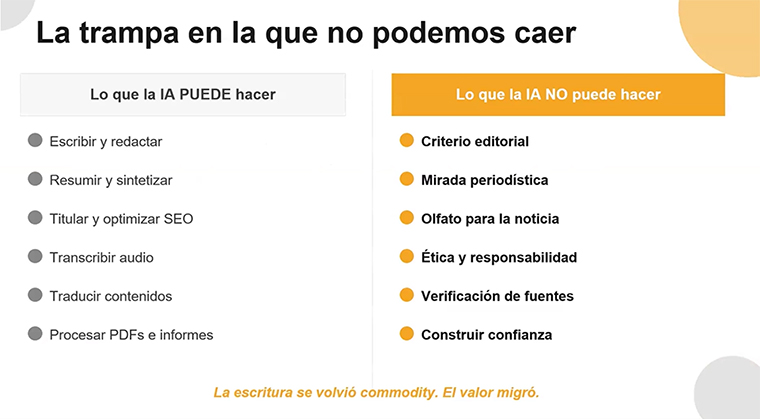
She summarised AI’s current capabilities by distinguishing between what the technology can — and cannot — do.
AI can:
-
Write and draft articles.
-
Summarise and synthesise information.
-
Generate headlines and optimise stories for SEO.
-
Transcribe audio.
-
Translate content.
-
Process PDFs and reports.
However, AI still cannot replace core journalistic skills such as:
-
Editorial judgment.
-
News instinct.
-
Ethical responsibility.
-
Source verification.
-
Building audience trust.
“Writing has become a commodity,” Kobelinsky said. “The value has migrated.”
Competing with algorithms, not only other media
Many media organisations are still debating whether to adopt AI, while audiences have already embraced it, Kobelinsky said.
“The competition is no longer only between media companies,” she said. “It is between media and algorithms, between media and newsletters, and between media and AI that summarises our own content without readers ever clicking on our stories.”
That reality led Infobae to ask a different question, she said: Instead of asking whether to adopt AI, the company focused on how to integrate it without sacrificing the elements that define its journalism — its brand value, credibility, and editorial responsibility.
Why Infobae built its own AI platform
Infobae has long considered itself an early adopter of technology. By 2023, while many organisations were still trying to understand ChatGPT, the company had already begun developing its own generative AI model.
The decision not to rely on generic AI platforms stemmed from concerns that they produce homogenised content and lack editorial memory.
“They flatten information,” Kobelinsky explained. “They don’t know Infobae’s DNA, what we would publish and what we wouldn’t,” she said.
Generic models also fail to understand the linguistic and cultural differences among Infobae’s international newsrooms.
Writing about judicial matters in Colombia differs significantly from writing about the same topic in Spain, she noted. Even verb tenses vary between Argentina and other Spanish-speaking countries.
As a result, Infobae chose to develop a proprietary AI platform trained specifically on the editorial style of each country where it operates and integrated directly into real newsroom workflows.
Scribnews: AI designed by journalists
The result was Scribnews, an internally developed AI editorial platform launched in 2023.
Integrated into the company’s CMS, Scribnews was never intended to replace journalists but rather to support them.

The platform incorporates the journalistic style, grammar, and editorial standards of every Infobae newsroom. Its development began in Miami through collaboration between the technology team and journalists themselves, who defined what the tool should accomplish.
Today, Kobelinsky said, Scribnews has become the operating system used across all Infobae newsrooms.
The platform also serves as a laboratory for cultural transformation inside the organization. New features are continuously added in response to newsroom needs, making the system as indispensable as email or other essential workplace applications.
Rather than relying on a single large language model, Scribnews integrates multiple AI providers — including Anthropic, Gemini, OpenAI, and Perplexity.
The platform automatically selects the model best suited for each task and evolves as AI technologies improve.
One of its most distinctive features is that journalists never need to engineer prompts.
“The platform already knows Infobae’s style,” Kobelinsky explained. “It knows which newsroom the journalist belongs to and which section they are writing for.”
Built directly into newsroom workflows
Scribnews offers customisable shortcuts that allow journalists to:
-
Chat with AI assistants.
-
Generate stories from reference material.
-
Export content.
-
Convert audio into text.
-
Rewrite articles.
-
Edit drafts.
-
Generate headlines.
The platform also includes specialised editorial assistants tailored for beats such as courts, economics, crime, and sports, each adapted to the editorial standards of the corresponding country.
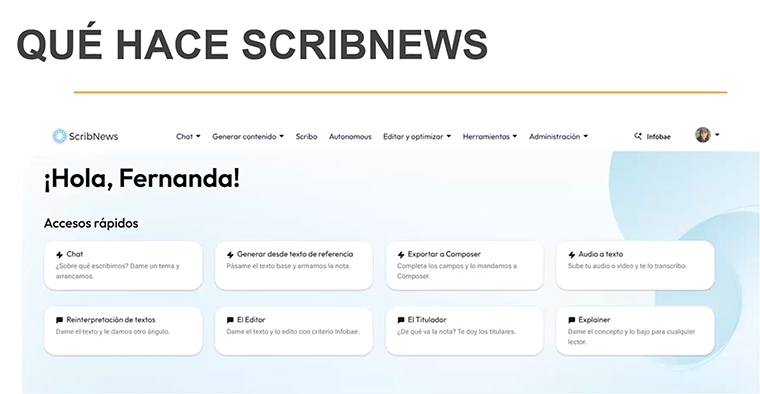
All of these functions operate within the same interface, allowing journalists to remain inside their normal workflow.
Beyond drafting, Scribnews performs SEO optimisation, recommends related stories to improve recirculation, generates photo captions, and automates repetitive editorial tasks that become especially valuable during breaking news situations.
One of the most time-saving features is AI-powered archive image search. Rather than browsing manually, journalists can search using highly specific descriptions.
For example, Kobelinsky said the platform can retrieve an image of “Lionel Messi raising his left fist while wearing Argentina’s dark blue national team jersey, not the light blue striped one.”
Such precision is possible because every archived image includes extensive metadata.
Three levels of AI assistance
Kobelinsky described Scribnews as operating on three distinct levels.
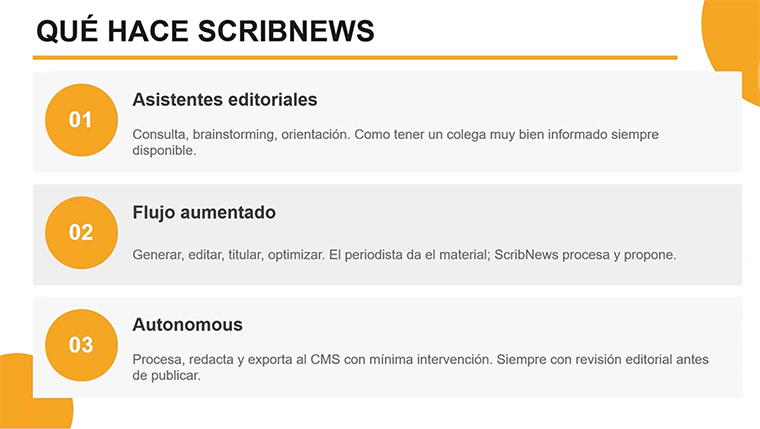
The first consists of editorial assistants that function that resemble an informed colleague available for consultation and brainstorming, one that is always ready to help and does not get tired.
The second level supports augmented workflows by generating, editing, optimising, and proposing content while journalists remain in control.
The third level introduces greater autonomy, allowing the system to propose story angles, process information, draft articles, and export them directly into the CMS with minimal human intervention.
Editorial review, however, always remains mandatory before publication.
Because Scribnews is integrated into the CMS, journalists move information between tools with a single click instead of copying and pasting across multiple applications.
AI also powers audiovisual storytelling
The platform extends beyond text production. Its audiovisual capabilities support everything from scriptwriting and visual design to image generation and video production.
Kobelinsky highlighted a small AI-produced documentary created for an Argentine national holiday celebration as an example.

However, Infobae deliberately limits AI-generated visuals. The company avoids using AI to recreate current events or breaking news.
“When there are protests in the streets, we send our reporters and cameras — not AI,” she said.
Instead, AI-generated videos are mainly used for historical content, science, and health stories where visualization would otherwise be difficult to produce.
According to Kobelinsky, these videos perform particularly well on social media.
Giving journalists more time to report
After several years of implementation, Infobae has measured significant gains in newsroom efficiency.
The greatest improvements have come in routine stories, freeing journalists to spend more time interviewing sources, investigating, developing fresh angles, and covering additional stories.
“The time we previously spent transcribing is now used to verify, investigate more deeply, and write the part that only the journalist who was actually there can write,” Kobelinsky said.
That shift has helped many journalists realise AI does not replace editorial judgment — it amplifies it. “The tools give us more time to do journalism,” she said.
Ideally, she added, reporters should spend their days in the field gathering stories while AI helps accelerate publication once they return to the newsroom.
The journalist’s role is evolving into one that curates information, works across multiple formats, produces complex infographics quickly, and manages increasingly sophisticated editorial workflows.
“The value is no longer measured by how many words a journalist can write or how fast,” Kobelinsky concluded. “It lies in the quality of judgment applied to every editorial decision. Journalists who understand this will realize their jobs are not at risk.”
AI has also allowed journalists who previously spent much of their time on administrative tasks to return to what attracted them to journalism in the first place, such as conducting in-depth interviews, she said. When reporters return from field assignments, Scribnews helps organise audio recordings, notes, and other reporting materials so nothing is overlooked before publication.
Kobelinsky concluded with a reminder that encapsulated Infobae’s philosophy toward artificial intelligence: “AI frees time, but it does not replace editorial judgment. AI does not decide what gets published — that responsibility belongs to journalists. We cannot delegate that credibility.”
For that transformation to succeed, she emphasised, news organisations need leaders who actively encourage adoption.
“When leaders understand they must accompany journalists through this process, cultural transformation begins to happen,” she said. “And the fear that AI will replace journalists disappears — at least for those who learn to use it well.”
Related Articles
-

Marketers should outsource tasks, not thinking
25 October 2026 -

AI’s effect on super user math
15 September 2026 -

At Mediacorp’s CNA, loyalty means giving audiences a reason to ...
20 August 2026 -

Tribun Network turns print “dots” into AI-powered insight
20 August 2026 -

Nation Media Group focuses editorial strategy on stories that m...
4 August 2026 -

Briefly News empowers journalists with AI tool suite Nova
4 August 2026 -

Indian Express builds a video-first future around trusted journ...
20 July 2026 -

Grupo RBS builds social-first video operation to expand audienc...
20 July 2026
Upcoming Events
-

Subscriber Acquisition Master Class
10-17 November 2026
-

Media Advertising Summit
New York, United States
07-10 December 2026
-

AI-Native News Product Master Class
18-25 February 2027
-

Media Subscriptions Summit
Oslo, Norway
08-12 March 2027
-

World Congress of News Media
New York, United States
25-30 April 2027
-

Branded Content & Partnerships Master Class
20-27 May 2027
-

Subscriber Retention Master Class
17-24 June 2027
-

Conferencia Latinoamericana
15-16 July 2027
-

South Asia News Media Festival
New Delhi, India
19-22 July 2027
-

Asia/Pacific News Media Summit
19-20 August 2027
-

CEO Roundtable at Kilkenny
Kilkenny, Ireland
24-26 August 2027
-

Media Innovation Week
Amsterdam, The Netherlands
27 September - 01 October 2027








