

Wall Street Journal AI tool cuts through the noise to find the news
Ideas Blog | 10 May 2026

Editor’s note: This initiative won the INMA Global Media Awards “Best in Show” award last week in Berlin.
Nobody has time to listen to all of it.
Candidates sit for hours with Joe Rogan, Marc Maron, or Theo Von. Wellness influencers tout antidepressants between dance videos. Conservative hosts do battle with the administration they helped elect. Clips circulate on YouTube, TikTok, X, and Instagram until a single conversation has fanned out into hundreds of segments over days or weeks.
The podcast ecosystem is sprawling, and episodes are long. Politics, wellness, comedy, sports — all of it weaves together. A host might float an idea for weeks before it becomes part of a campaign’s message. A fringe argument can move from a wellness show to a political podcast to a candidate’s stump speech without most newsrooms noticing.
Searching the pods
We built Orca to keep up. This internal newsroom tool uses AI to track podcast feeds, download new episodes, transcribe them, and make them searchable. It summarises, identifies speakers, extracts topics, and alerts reporters to conversations that might matter to them.
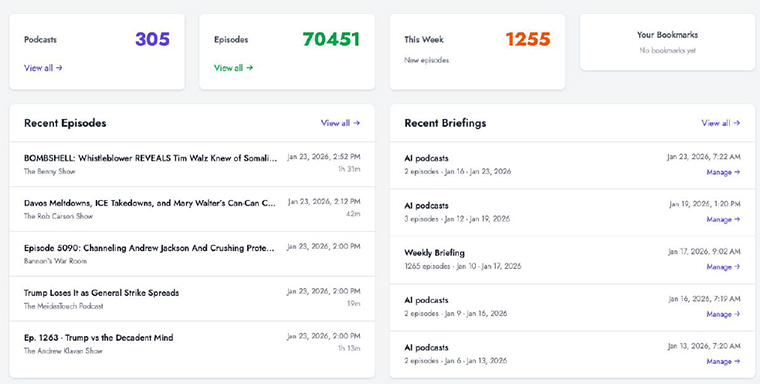
A reporter can search across episodes, ask questions about a topic, or set up briefings around the things they care about. Instead of spending the morning scrubbing through audio, they can start with the few segments most likely to be relevant.
The point isn’t to replace judgment. It’s to give reporters a chance to filter an information ecosystem that has become far too large to monitor by hand.
Orca in action
We used Orca to write the definitive account of how Epstein consumed the MAGA movement last summer. The tool found 3,123 episodes across 124 shows mentioned Epstein, with chatter jumping more than eightfold in the three weeks after the DOJ said there was no client list — even after Trump told the movement to drop it.
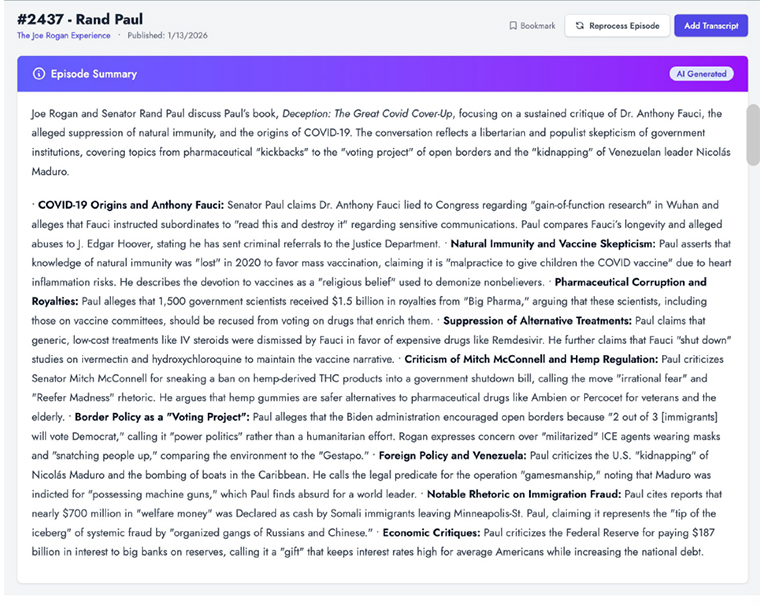
Reporters tracked the moment Joe Rogan drew “a line in the sand,” when Alex Jones turned on the administration, and how the MAGA coalition frayed. Orca later helped reporters pull key throughlines out of the broader Epstein coverage — including podcasters airing unfounded claims about cannibalism and child sacrifice straight into upbeat ad reads.
Orca anchored reporting on how antidepressants went from stigmatised medication to “#lexaprogirly” lifestyle accessory, finding the podcast appearances where influencers — some paid by telehealth companies to promote SSRIs on social media — admitted to emotional numbness, brain fog, and sexual dysfunction they hadn’t disclosed to followers.
And it surfaced U.S. FBI Director Kash Patel’s podcast appearances — including telling Joe Rogan the job was “effin’ wild” and his 2023 criticism of his predecessor for taking the FBI jet on an Adirondacks vacation.

Mapping the narrative
Orca keeps reporters close to the underlying material. The transcript links back to the audio. If a summary points to something interesting, the reporter can check the quote, listen for context and decide what it means.
This is what the good version of AI in a newsroom looks like: clear objective. Large corpus. Unstructured information. Humans verify. A machine can tell us that a theme is appearing across dozens of shows. It cannot decide whether that theme is meaningful, exaggerated, misleading, or worth putting in front of readers.
Podcasting is looser than television, more intimate than social media, and harder to track than either. Orca helps us listen at the scale the moment requires.
Related Articles
-

Marketers should outsource tasks, not thinking
25 October 2026 -

AI’s effect on super user math
15 September 2026 -

At Mediacorp’s CNA, loyalty means giving audiences a reason to ...
20 August 2026 -

Tribun Network turns print “dots” into AI-powered insight
20 August 2026 -

Nation Media Group focuses editorial strategy on stories that m...
4 August 2026 -

Briefly News empowers journalists with AI tool suite Nova
4 August 2026 -

Indian Express builds a video-first future around trusted journ...
20 July 2026 -

Grupo RBS builds social-first video operation to expand audienc...
20 July 2026
Upcoming Events
-

Subscriber Acquisition Master Class
10-17 November 2026
-

Media Advertising Summit
New York, United States
07-10 December 2026
-

AI-Native News Product Master Class
18-25 February 2027
-

Media Subscriptions Summit
Oslo, Norway
08-12 March 2027
-

World Congress of News Media
New York, United States
25-30 April 2027
-

Branded Content & Partnerships Master Class
20-27 May 2027
-

Subscriber Retention Master Class
17-24 June 2027
-

Conferencia Latinoamericana
15-16 July 2027
-

South Asia News Media Festival
New Delhi, India
19-22 July 2027
-

Asia/Pacific News Media Summit
19-20 August 2027
-

CEO Roundtable at Kilkenny
Kilkenny, Ireland
24-26 August 2027
-

Media Innovation Week
Amsterdam, The Netherlands
27 September - 01 October 2027








