

What The New York Times AI copyright case means for the news industry
Product & Tech Initiative Blog | 07 October 2026

The legal case that likely will define the future of news media copyright in the age of AI is reaching a critical point.
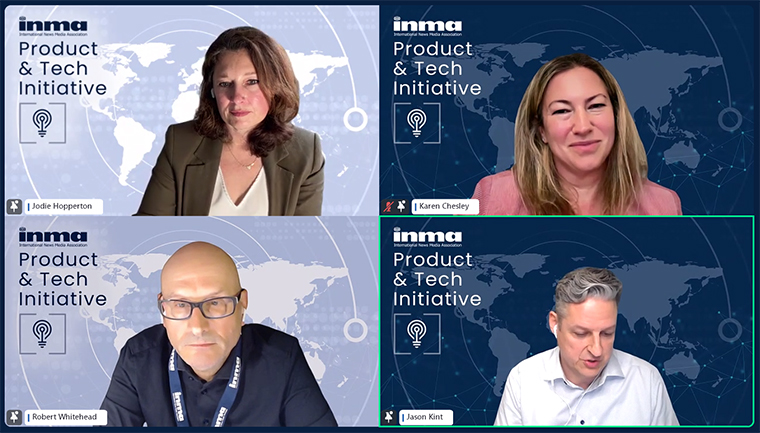
During this week’s Webinar, INMA’s Jodie Hopperton and Robert Whitehead joined New York Times Assistant General Counsel Karen Chesley and Digital Content Next CEO Jason Kint to examine recent court rulings and unpack what lies ahead.
Hopperton, lead of INMA Product & Tech Initiative, opened with a recap of how generative AI evolved and why the media industry now finds itself in a legal showdown. She explained that early large language models were built by scraping “vast amounts of information off the Web” — largely without publishers’ knowledge or permission — and then became the foundation for training AI systems.
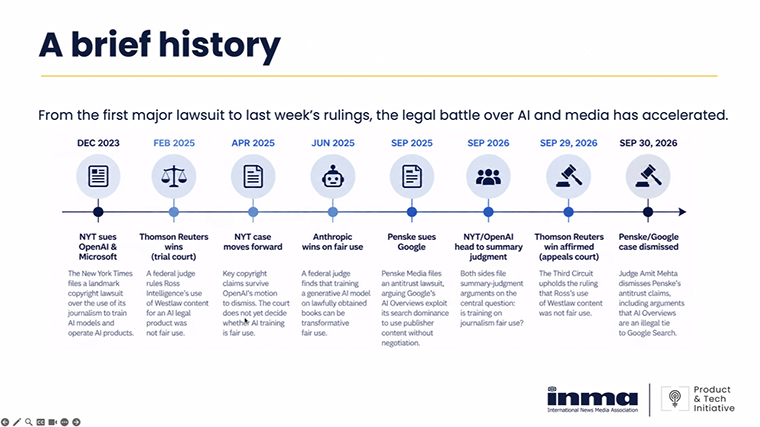
She shared a timeline of escalating legal battles, beginning with the New York Times’ landmark lawsuit in December 2023. These cases — especially The New York Times v. OpenAI and Microsoft — will determine whether AI companies can legally use journalism without permission or payment, Hopperton said.
Before diving into that case, Hopperton and Whitehead, who heads the INMA Digital Platform Initiative, examined two key recent rulings.
In Thomson Reuters v. Ross Intelligence, a judge ruled on September 30 that Ross’ use of Reuters content to train a legal search tool was not fair use. The product was commercial, not transformative, and directly competed with Reuters — a clear case of market harm.
“It’s a baby case in the arena of New York Times versus Microsoft and OpenAI,” Whitehead said, but an important one nonetheless.
In Penske Media v. Google, however, the antitrust case was dismissed because news publishers couldn’t prove Google Search and AI Overviews were two separate products illegally tied together.
“The judge was very sympathetic to the publisher case but basically said the publishers had not proved that they were two separate products,” Whitehead said. While it didn’t end with a win, he noted the case “was very good at exposing the damage that AI overviews had done.”
The “Super Bowl” of AI copyright
As Chesley and Kint joined the conversation, the topic turned to the Times’ litigation with Microsoft and OpenAI, with Whitehead calling it “the Super Bowl” of AI copyright, given the impact its outcome will have on the future of news.
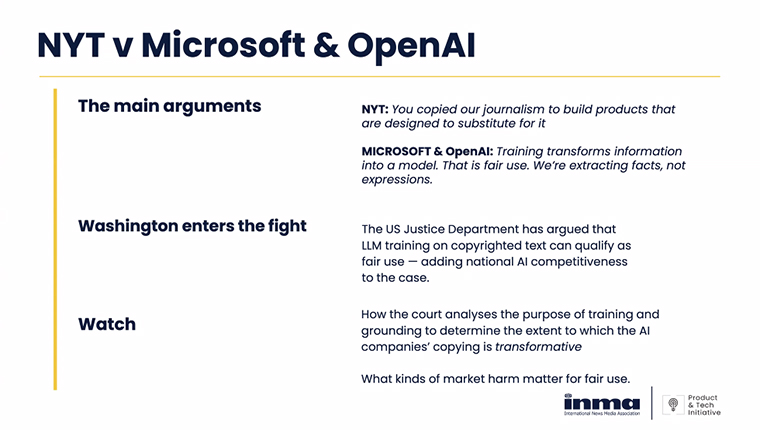
Chesley offered an overview of the case and said both Microsoft and OpenAI insist training and Web grounding are fair use: “Although both defendants make those arguments, we argue that there’s actually five different kinds of copying that the court has to address.”
She walked INMA members through those five areas:
- Wrongful acquisition or scraping the Web site. “We block people from doing that. We have terms of service that say ‘don’t do that.’ We know they did it anyway.” Some of the documents unsealed in their motion include people talking about finding a hack to get past the paywall and scrape the site, she said.
- Training. Although Microsoft and OpenAI claim training is “fair use,” The Times believes the opposite is true: “Our central argument is that they trained on news content because they wanted to produce news content. This isn’t a situation where they were building large language models to do spell check. They were doing it for a very specific purpose, which was to create these all-knowing chatbots that could deliver news.”
- Retrieval-augmented generation or RAG. This when the AI copies publisher content in real time to answer user questions. The Times argues this is direct copying for a commercial purpose that competes with its core business. “We think that … counts for copyright infringement and is not justifiable as fair use because it is truly copied very directly in real time for the purpose of delivering news — and that is our business.”
- Outputs. “We gave the court 58 examples of outputs that we think, as a matter of law, are substantially similar to our articles,” Chesley said, explaining they picked specific articles as examples. “You can’t ask the court to look at thousands or tens of thousands of articles, but you can ask him to make a ruling that this select group counts.” That, she said, can then create a precedent that outputs can also infringe on copyright.
- “Horse trading” of publisher data. The fifth issue surfaced during discovery, when Chesley said they found “the defendants were bargaining with one another for data sets and our data, like publisher content that is in these data sets.” In their internal documents, they called it “horse trading.” Because some of the information has been redacted, Chesley said she didn’t know what “things of value” the two companies were exchanging with one another for the content.
To put the enormity of this case in perspective, Chesley shared that the discovery in this case has been the most extensive of her career, with more than 100 depositions taken and about 1 million documents generated.
“American-style discovery is a blessing and a curse. It is extremely expensive,” she said, noting this suit is probably “in the ballpark” of US$20 million.
“But it is also a search for truth,” she emphasised. “I think it is probably unparalleled in the world.”
Leading the charge
Although The Times is at the forefront, it’s not alone in its fight. Kint said other news media companies are watching this case closely, knowing it will shape their future.
“A lot of companies are sitting back and watching and are incredibly appreciative that The Times is leading the charge on this,” he said. “I personally believe … they’re uniquely capable as an organisation, including the resource perspective … that most publishers — especially local, smaller, independent publishers — would not have the resources to take on.”
As news companies try planning a future that inevitably includes AI, they want to understand how it works within their ecosystem.
“This is just a fundamental issue of how is this content going to get paid for,” Kint said. “Is an intermediary going to be able to just take all the content and all the work of art and the IP and take all the value for themselves? How are we going to play going forward?
“I think that’s critically important, and this case will shape that for sure.”
The DOJ’s surprise move
One of the most unexpected twists came when the U.S. Department of Justice filed a statement in early September supporting OpenAI and Microsoft. As Kint noted, “It was odd … . It seemed to be something that was kept very tight within the Justice Department.”
Even more surprising: The U.S. Copyright Office was not consulted.
“So the experts weren’t consulted, and it went against prior positions from the administration,” Kint said.
Chesley emphasised the judge is not required to give the DOJ’s statement any weight; The Times has asked him to disregard it entirely.
“We have filed an opposition asking him to give it no weight for a number of reasons, including that it directly contradicts the one government agency that is an expert on copyright law — and the judge can do that,” she said.
Still, the intervention created international confusion. As Whitehead pointed out, some countries interpreted it as U.S. policy — a perception that could be as damaging as an actual ruling.
What comes next
After three years of work on the case, briefing will finally be complete on the summary judgments on November 20. Oral arguments will follow. After that, Judge Sidney Stein will take his time — possibly months — before issuing a ruling.
Several outcomes are possible:
- Full denial, and everything goes to trial.
- Partial rulings, with some issues resolved, others left for a jury.
- Immediate appeal, with key questions being fast‑tracked to higher courts.
Whatever happens, the ripple effects will be global. Other countries are watching this case to shape their own policies. The outcome will influence licensing negotiations, scraping rules, AI product design, and the future of news distribution.
At the heart of all this, Hopperton reminded, is a simple, existential question: Can AI companies use journalism without permission or payment?
“Essentially,” she said, “that’s what this boils down to.”
Related Articles
-

What 11 Bay Area companies agree on about news in the AI era
26 October 2026 -

Marketers should outsource tasks, not thinking
25 October 2026 -

Publishers may leave Meta unless it formally re-issues new term...
18 October 2026 -

What makes an AI choose your news brand?
14 October 2026 -

Licensing won’t save media, but authentication might
13 October 2026 -

AI pushes licensing to become a third revenue stream
12 October 2026 -

Penske, Chegg lose AI summary cases against Google, but fight i...
6 October 2026 -

3 product, tech, and AI lessons from INMA’s CEO Roundtable
1 September 2026
Upcoming Events
-

Subscriber Acquisition Master Class
10-17 November 2026
-

Media Advertising Summit
New York, United States
07-10 December 2026
-

AI-Native News Product Master Class
18-25 February 2027
-

Media Subscriptions Summit
Oslo, Norway
08-12 March 2027
-

World Congress of News Media
New York, United States
25-30 April 2027
-

Branded Content & Partnerships Master Class
20-27 May 2027
-

Subscriber Retention Master Class
17-24 June 2027
-

Conferencia Latinoamericana
15-16 July 2027
-

South Asia News Media Festival
New Delhi, India
19-22 July 2027
-

Asia/Pacific News Media Summit
19-20 August 2027
-

CEO Roundtable at Kilkenny
Kilkenny, Ireland
24-26 August 2027
-

Media Innovation Week
Amsterdam, The Netherlands
27 September - 01 October 2027
YOU MUST BE A MEMBER TO ACCESS THIS CONTENT
Become An INMA Member or Log In Below
INMA members have unparalleled access to ideas and peer connections that make a difference in the success of their companies and their careers.
Click Here to Become a Member NowAlready a Member? Log In
Benefits of Being an INMA Member
-

Strategic Reports
Total access to all INMA reports on just-in-time topics, trends, and case studies
-

Member Directory
The most powerful tool in media: global peer connections at the leading companies
-

Industry Headlines
Daily news industry headlines personally curated by INMA, inclusive of archives
-

Best Practices
Thousands of best practices and case studies to grow audience, revenue, and brand
-

Crowdsourced Ideas
Learn what fellow INMA members are prioritising: most-read, social shares, searches
-

Conference Presentations
Thousands of INMA conference presentations for ideation and benchmarking
-

Webinars
Bring INMA to your computer or phone with exclusive case study-based Webinars
-

Newsletters
Subscribe to 20+ newsletters by latest content, topic, or world region
-

Conference Discounts
Members enjoy up to 50% registration discounts on INMA conferences worldwide