

As AI changes everything, what publishers need to know
Product & Tech Initiative Blog | 27 July 2026

It’s no secret AI has transformed the news media. During a recent INMA Webinar, INMA Product and Tech Initiative Lead Jodie Hopperton took a deep dive into some of those changes and what they mean for publishers.
Hopperton began by highlighting the shift from traditional keyword‑based search toward conversational answer engines. She noted tools such as ChatGPT, Gemini, Claude, and others have become increasingly central to how users seek information: “We can ask a question, we get an answer … and we can ask follow‑up questions,” she said. “It’s just like real conversations.”
Compared to the older method of scanning blue links on a search results page and hoping to find an answer, this “is way more intuitive for us.”
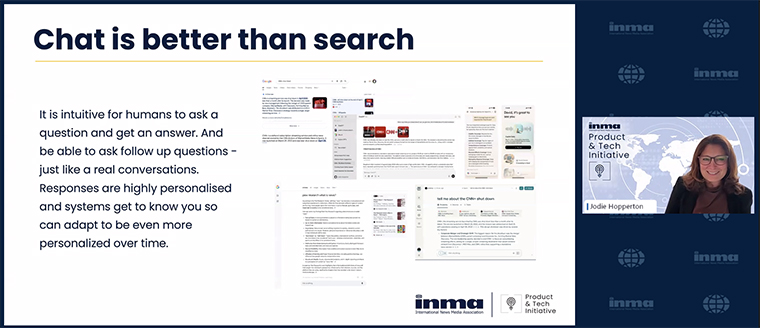
This shift is not limited to search engines. Conversational interfaces are appearing across consumer platforms, including Google Maps, Amazon, and WhatsApp. Users are now prompted to ask questions rather than search as part of an overall move toward natural language interaction, Hopperton said: “Everywhere now we are being prompted not to search but to ask.”
Beyond answering questions, Hopperton noted AI systems are increasingly taking action on behalf of users. She described scenarios in which a user might search for a location and immediately be offered options to book transportation through services like Uber or Waymo.
“AI is enabling you to take action immediately,” she said, calling this a significant behavioural shift that news organisations must anticipate as they consider future distribution and engagement strategies.
Inside AI’s training challenges
To explain the current landscape, Hopperton offered background on how foundational AI models were trained. She noted early systems scraped vast amounts of content from the open Internet — content created by publishers, creators, and consumers — without consent.
“They developed bots which basically ate the Internet,” she explained. “They scraped the open Internet at unprecedented scale. It’s not something that anyone was expecting.”
That has led to disputes over copyright and fair use, with AI companies arguing that scraping constitutes fair use while publishers contend that proprietary content was used without permission.
But another challenge comes from AI being trained on unverified online content: “Spoiler alert, not everything on the Internet is true,” Hopperton said. And because foundational models were trained on messy, contradictory, and sometimes false information, hallucinations are inevitable. “AI systems communicate with massive amount of confidence, but they’re actually predicting plausibility, not truth,” she said.
And, with more than half of the Internet now composed of AI‑generated content, it is increasingly difficult to distinguish human‑verified information from synthetic material. But this could carry a hidden opportunity for news organisations, allowing them to differentiate themselves through trust and verification:
“Maybe trust becomes the differentiator,” she said, suggesting publishers who invest in credibility may gain an advantage in an increasingly chaotic information ecosystem.
Accelerating AI capabilities
The pace of AI development now exceeds traditional benchmarking methods, Hopperton said. Citing research from METR, she explained that AI systems can now complete complex engineering tasks faster than human engineers, making direct comparison increasingly unreliable.
“Engineers have to sleep. AI doesn’t,” she said, underscoring the widening capability gap and the need for news organisations to plan for future developments rather than current use cases alone.
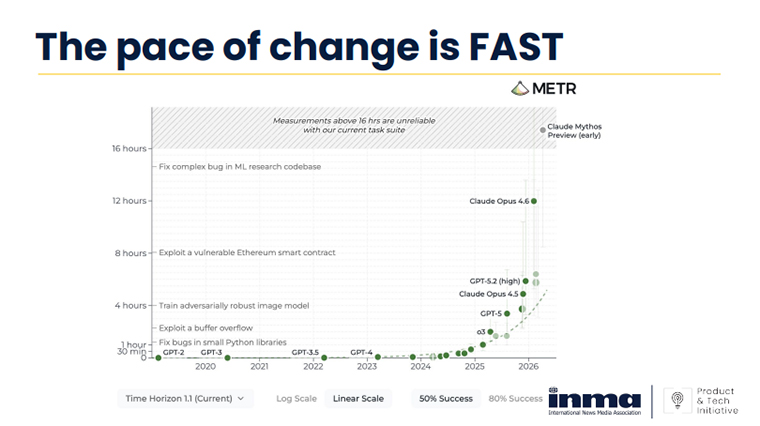
While most consumers use AI for tasks such as summarising documents or generating descriptions, engineers are testing far more advanced capabilities. As a result, many organisations may underestimate the speed at which AI is evolving.
“We’ve got to stay on top of this, see how it’s moving, but we’ve also got to look at where it’s going, not just what it can do now,” she said.
Audio as an emerging opportunity
Audio is another emerging opportunity for publishers. With smart speakers, AirPods, CarPlay, Meta glasses, and other devices already widely adopted, AI‑driven voice interfaces could significantly expand news consumption.
“Audio is deemed to be more trustworthy,” she said, adding that listening creates a sense of familiarity and connection. Audio consumption is “generation agnostic,” appealing to both younger and older audiences, she said.
She encouraged attendees to experiment with AI voice tools; as voice becomes a core AI feature, Hopperton expects audio to play a larger role in news distribution.
Liquid content and distribution challenges
Hopperton revisited the concept of “liquid content,” which describes how audiences increasingly “watch audio, listen to text, and read video.”
AI makes it possible to reformat content instantly, but distribution remains complex due to the number of platforms and the need for format‑specific optimisation, she said.
“There’s more and more places for content to live,” she said, noting different formats perform differently depending on the platform.
Publishers should clarify their strategic objectives — reach, community building, or subscription funnel development — before deciding how broadly to distribute content. Brand consistency, she added, remains essential across formats and platforms.
One major new development is the appearance of media brands inside AI platforms. She pointed to OpenAI’s ChatGPT apps, which allow users to call in specific brands. Zillow was one of the first, but Hopperton focused on The Economist’s recent experiment. Users could request graphs on Trump’s approval ratings, generated directly from Economist data and branded within ChatGPT.
“It’s really shifting from this kind of answer engine to an entire operating system,” she said, noting this could become a powerful distribution channel for news media companies.
While monetisation and subscription integration are not yet available, Hopperton said the development signals a future in which users may seek out specific news brands directly within AI ecosystems.
Agentic AI and autonomous workflows
Finally, Hopperton explored agentic AI — systems capable of performing multi‑step tasks autonomously.
She outlined potential internal applications for news organisations, including personalised newsletters, subscription management, automated local information generation, and multi‑format content production. Hopperton also described user‑facing agents that could summarise local news, translate foreign coverage, or act as virtual assistants.
Two case studies underscored how publishers are already adopting agentic systems:
- HT Digital has restructured operations around AI agents, achieving 70% faster development cycles and generating 95% of its code with AI while shifting human roles toward strategy and innovation.
- Ippen Media has built an AI‑driven operating system for editorial work designed to increase volume, maintain quality, and enable personalisation at scale.
Neither organisation intends to replace newsroom staff but rather to reallocate human effort to higher‑value tasks, Hopperton said.
What to expect next
As companies move deeper into this next era of news consumption, Hopperton said the landscape is shifting faster than most organisations can track. Search is declining, chat interfaces and audio are rising, and new discovery pathways are emerging almost monthly.
In a world where audiences increasingly struggle to tell what’s real, trust becomes a powerful differentiator — not just a value, but a competitive advantage. AI agents will soon act as a primary gateway to information, creating a new layer between publishers and the people they serve.
Understanding how audiences navigate these tools will be essential for staying visible and relevant.
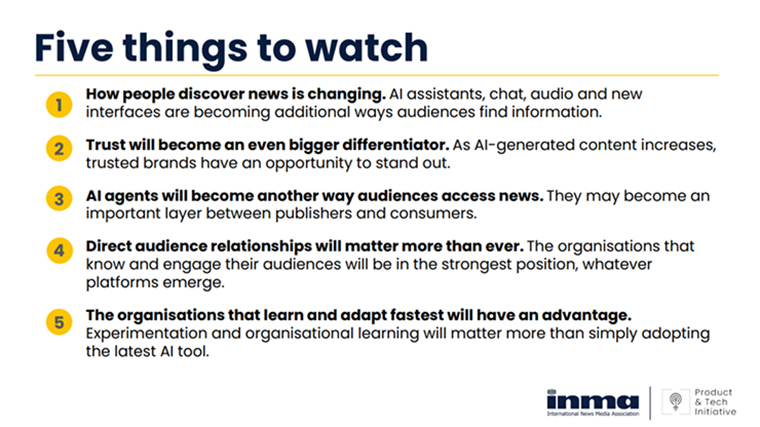
Ultimately, the organisations that thrive will be the ones that nurture strong, direct relationships with their audiences and adapt quickly to change. This isn’t a moment for siloed innovation or isolated experimentation; it’s a whole‑organisation shift that requires curiosity, flexibility, and a willingness to rethink long‑held assumptions.
News media companies that lean into learning, listen closely to their communities, and evolve with intention will be the ones best positioned for whatever comes next.
Banner photo: Adobe stock by Mechastock
Related Articles
-

Marketers should outsource tasks, not thinking
25 October 2026 -

AI’s effect on super user math
15 September 2026 -

At Mediacorp’s CNA, loyalty means giving audiences a reason to ...
20 August 2026 -

Tribun Network turns print “dots” into AI-powered insight
20 August 2026 -

Nation Media Group focuses editorial strategy on stories that m...
4 August 2026 -

Briefly News empowers journalists with AI tool suite Nova
4 August 2026 -

Grupo RBS builds social-first video operation to expand audienc...
20 July 2026 -

Inside Denník N’s successful subscription strategy
15 July 2026
Upcoming Events
-

Subscriber Acquisition Master Class
10-17 November 2026
-

Media Advertising Summit
New York, United States
07-10 December 2026
-

AI-Native News Product Master Class
18-25 February 2027
-

Media Subscriptions Summit
Oslo, Norway
08-12 March 2027
-

World Congress of News Media
New York, United States
25-30 April 2027
-

Branded Content & Partnerships Master Class
20-27 May 2027
-

Subscriber Retention Master Class
17-24 June 2027
-

Conferencia Latinoamericana
15-16 July 2027
-

South Asia News Media Festival
New Delhi, India
19-22 July 2027
-

Asia/Pacific News Media Summit
19-20 August 2027
-

CEO Roundtable at Kilkenny
Kilkenny, Ireland
24-26 August 2027
-

Media Innovation Week
Amsterdam, The Netherlands
27 September - 01 October 2027








