

Reuters Digital News Report 2026 author shares key themes with INMA members
Product & Tech Initiative Blog | 05 July 2026

Each year, the Reuters Digital News Report provides a snapshot of the global news industry, and in 2026, that snapshot depicts an era of dramatic change and transition.
During a recent INMA Webinar, presented by the INMA Product & Tech Initiative, members heard from Jim Egan, author of this year’s report. The senior research associate at Reuters Institute began by noting that this year’s findings are different from previous reports:
“We have seen a lot of movement in the data this year. A lot of the key metrics that we’ve been covering in the previous 14 editions of the report … have moved this year and that’s really quite striking.”
The report surveyed nearly 100,000 people across 48 markets and offers an overview of how news consumption, trust, formats, creators, and payment models are evolving — and what those changes mean for publishers navigating an increasingly platform‑driven world.
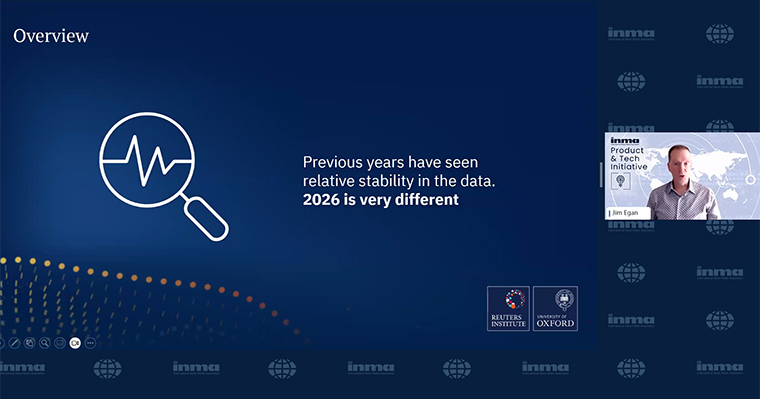
In fact, Egan said this year’s most consequential theme is the “platformisation of the news experience” or a shift away from direct discovery on publisher‑owned Web sites and apps as they turn to third‑party platforms — especially social media and video networks.
But it isn’t the only theme publishers need to pay attention to: The growing role of AI chatbots, the continued erosion of trust in news overall, the rise of creators as complementary news sources, and the widening gap between what audiences say they want from news and how they feel it is currently delivered all provide plenty of reasons for news media leaders to stay up at night.
However, there’s good news in the findings: Audiences still support public service news.
“Even though the audience might be a bit smaller for news overall, there is a core audience which is highly engaged and is showing propensity and willingness to pay,” Egan said.
Where people find the news
One of the most dramatic findings in this year’s report is the global crossover point in news discovery. For the first time, social media and video networks have overtaken both TV news and publisher Web sites and apps as the most widely used source of news around the globe.
Egan described it as “a decisive moment,” adding: “This has been happening for a while, and the reason it’s happening has more to do with the decline of traditional news sources and much less to do with the growth of these third-party platforms.”
The trend is visible across nearly all age groups, but it is most pronounced among younger audiences, who are not just drifting away from TV and news Web sites. Many never formed the habit of using them to begin with: “More than a third of [18–24‑year‑olds] have never regularly watched TV news and a similar proportion says they’ve never been in the habit of using news Web sites and apps.”
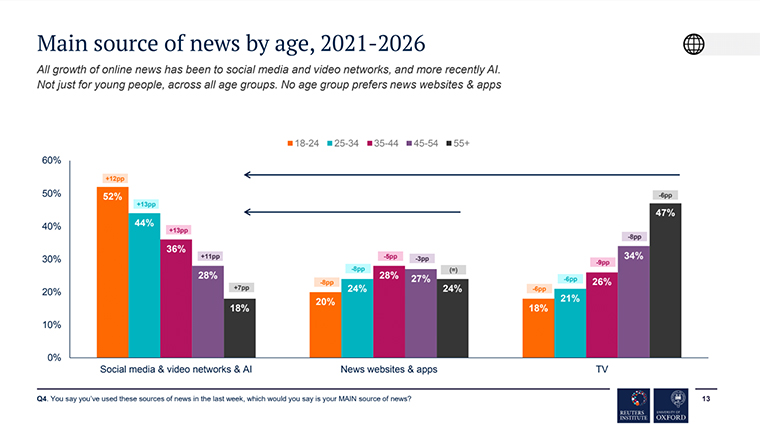
This generational divide is reshaping how news is followed during major global events. In supplementary polling on the war in Iran, younger Americans overwhelmingly preferred social media and video networks, while older audiences leaned heavily toward TV news.
Egan also pointed to the use of standalone AI chatbots — which rose from 7% to 10% globally — though Egan described this as “fast growth but not explosive.” He said the lack of a dominant use case for chatbots in news may be slowing adoption, but their presence is clearly expanding.
Where has the trust gone?
Trust in news fell sharply this year, with 29 of 48 markets showing statistically significant declines. However, the decline is not uniform across all types of news sources. Trust in individual news brands shows more stability than trust in news overall, suggesting audiences still value familiar, established outlets even as they grow more anxious about the broader information environment.
“I like to talk about this as the idea of a trust gap,” Egan said, explaining trust in news on social media and AI chatbots is substantially lower than trust in news overall. As consumption patterns shift toward these platforms, Egan predicts trust in news will decline even farther.
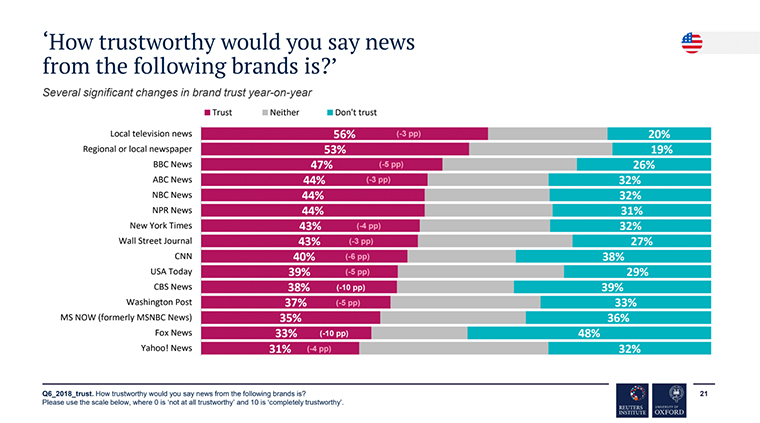
However, trust in news brands is still holding up much better than trust in news overall, with one notable exception: the United States. Amongst American respondents, “Trust in news brands is down.”
In many cases, trust in U.S. news brands is lower than trust in news overall: “I think this is reflective of increasing polarisation and increasing fragmentation and coarsening of the U.S. news and political debate,” he said. “In most other markets, we haven’t seen brand trust change like this.”
Video takes the lead
Video remains a dominant format for news consumption, with TikTok now reaching 20% of global users for news, which Egan said is significant: “It’s evidently growing very, very, very quickly.”
However, usage varies, with a stronger presence in Latin America, sub‑Saharan Africa, and South and Southeast Asia. YouTube’s role is even more significant, with two‑thirds of respondents in Kenya using it for news each week.
As video networks grow, consumption of news video on publisher‑owned sites has fallen sharply — dropping 10 percentage points since 2021 and five points in just the past year.
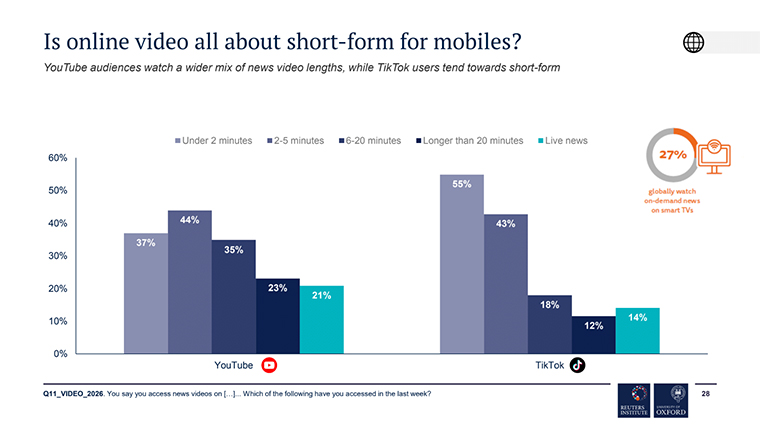
The findings challenged the assumption that online news video is synonymous with short‑form clips, Egan said. While TikTok skews short, YouTube shows a broad distribution of video lengths, including full‑length news videos over 20 minutes, as well as substantial live news consumption.
Younger audiences are embracing long‑form viewing on YouTube, suggesting video’s growth is not simply a matter of shrinking attention spans.
Also of interest is the resurgence of the television set for watching video news: “A quarter of people globally are using the television set as a place for getting on-demand video news,” Egan said.
“So although broadcast TV news is in structural decline, the television set seems to live on as a place people think of and actively go to for at least some of their news. And that could be an interesting news distribution channel and a route to market for some people.”
The growth of news creators
Creators continue to grow as influential players in the news ecosystem, but they are seen more as complementary to traditional news than as disruptive.
About one-third of Americans and nearly half of respondents in Thailand turn to news‑focused creators weekly, with usage highest in heavily platformised markets.
But that doesn’t mean they’re replacing traditional news sources: Only 13% of users say creators meet most or all of their news needs, and just 3% say creators meet all their needs without relying on any traditional sources.
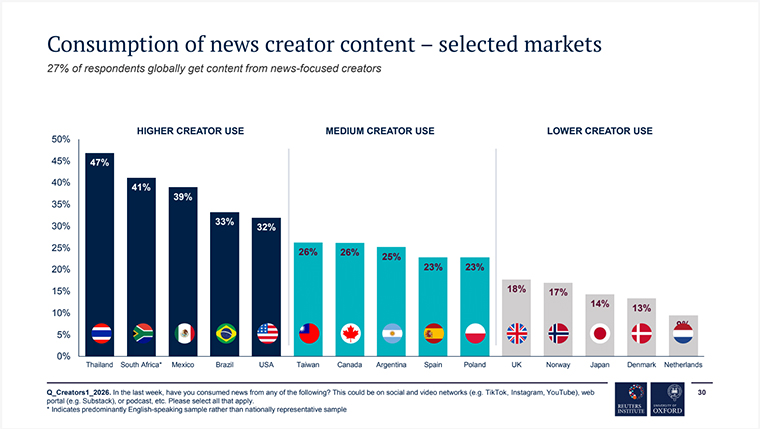
Surprisingly, people who rely on creators “are actually using more rather than less of these traditional news publishers online,” Egan said.
This finding challenges the narrative that creators are luring audiences away from established outlets. Instead, they appear to be expanding overall news consumption, offering relatability, personality, and platform fluency to complement traditional journalism.
Audiences can’t always get what they want
Although the way users consume news is changing, their preferences for news values have not. When asked what kind of news they prefer, the majority still choose news “that doesn’t have a particular point of view” — an answer that remains more than twice as popular as any other option.
The preference for news that shares the audience’s own point of view has actually declined from 24% in 2020 to 20% today.
When asked how well the news media covers major global issues — including Ukraine, inflation, climate change, conflicts in the Middle East, and immigration — audiences expressed dissatisfaction overall. Immigration stands out as the issue most consistently viewed as poorly covered across markets, even in countries where audiences are mostly satisfied with their news coverage.
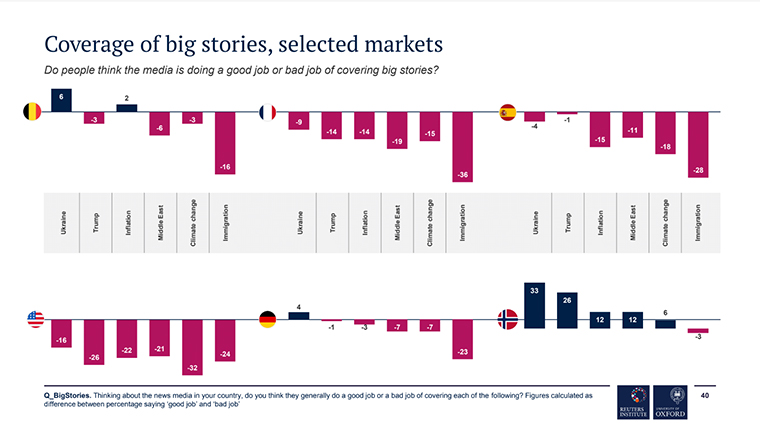
Egan acknowledged this year’s report “isn’t awash with good news” for the news media industry but said he hopes it opens the door to internal reflection and productive strategic conversations.
“That’s really the point of the research. We do it to be useful to the publisher community and to help people figure out how to do the best possible job of serving audiences wherever you are.”
Related Articles
-

Marketers should outsource tasks, not thinking
25 October 2026 -

AI’s effect on super user math
15 September 2026 -

At Mediacorp’s CNA, loyalty means giving audiences a reason to ...
20 August 2026 -

Tribun Network turns print “dots” into AI-powered insight
20 August 2026 -

Nation Media Group focuses editorial strategy on stories that m...
4 August 2026 -

Briefly News empowers journalists with AI tool suite Nova
4 August 2026 -

Indian Express builds a video-first future around trusted journ...
20 July 2026 -

Grupo RBS builds social-first video operation to expand audienc...
20 July 2026
Upcoming Events
-

Subscriber Acquisition Master Class
10-17 November 2026
-

Media Advertising Summit
New York, United States
07-10 December 2026
-

AI-Native News Product Master Class
18-25 February 2027
-

Media Subscriptions Summit
Oslo, Norway
08-12 March 2027
-

World Congress of News Media
New York, United States
25-30 April 2027
-

Branded Content & Partnerships Master Class
20-27 May 2027
-

Subscriber Retention Master Class
17-24 June 2027
-

Conferencia Latinoamericana
15-16 July 2027
-

South Asia News Media Festival
New Delhi, India
19-22 July 2027
-

Asia/Pacific News Media Summit
19-20 August 2027
-

CEO Roundtable at Kilkenny
Kilkenny, Ireland
24-26 August 2027
-

Media Innovation Week
Amsterdam, The Netherlands
27 September - 01 October 2027








