

News media companies create strong foundations for long-term subscription success
Readers First Initiative Blog | 21 June 2026




During this month’s Subscriber Retention Master Class, hosted as part of INMA’s Readers First Initiative, media leaders discussed efforts and considerations to support the foundations of successful subscription strategies in the wake of global conflict and rapidly shifting user behaviour.
Greg Piechota — researcher-in-residence, lead of the Readers First Initiative, and host of the Subscriber Retention Master Class — offered an overview of the current subscription landscape that left plenty of reason for optimism, but his outlook for what’s ahead was less rosy.
Rising energy prices linked to the war in Iran are already pushing inflation upward in many countries. That, he warned, will inevitably hit subscription businesses.
“We know from previous periods of high inflation what happened,” Piechota said. When the war in Ukraine began in the first quarter of 2022, inflation spiked — and churn followed one quarter later: “The peak of inflation was in the third quarter and in the fourth quarter was the peaking churn.”
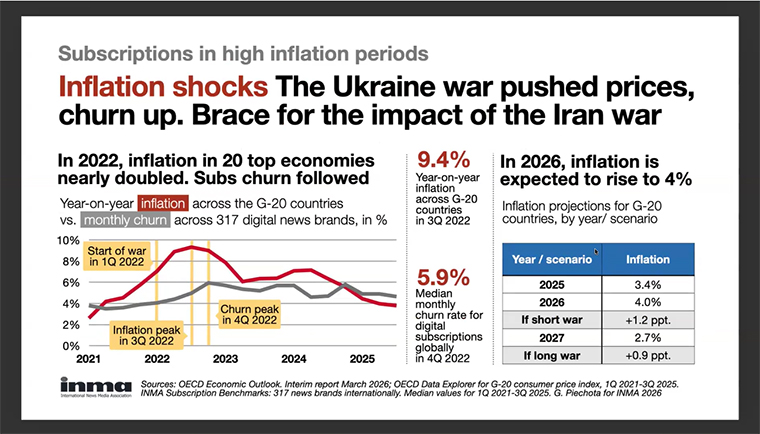
Economists at the OECD and elsewhere expect inflation to worsen if the conflict continues, and Piechota urged INMA members to brace themselves.
“The question is, how do you defend yourself?”
Surprisingly, he said publishers should not avoid raising their prices and cited a Mather Economics study showing that during high‑inflation periods, price elasticity falls. Heavy users — the most valuable subscribers — are more willing to accept price increases without canceling.
“The churn is not really growing much faster,” he said.
Piechota left members with a series of defensive strategies to consider:
- Upgrade monthly subscribers to annual plans. Annual plans reduce churn, though they may be harder to sell in countries where the upfront cost is high.
- Segment by engagement and target price increases accordingly. High‑engagement users are the most resilient to price hikes.
- Consider family plans. Bundling with external products and creating family plans can help boost subscriptions: “Based on the public statements, 40% of new acquisition of The New York Times last year actually came from upgrading their current subscribers to get family plans. So this is a very easy win that you could immediately offer to all your subscribers,” Piechota said.
Other suggestions he offered included redesigning cancellation flows and reevaluating payment methods to use a form that has shown less churn. “Apple Pay is very good for acquisition, but it’s surprisingly bad for retention,” Piechota noted, suggesting publishers look at how to decentivise the use of formats that don’t support retention.
Creating long-term value at Grupo RBS
Instead of treating the initial transaction as the primary value event, Grupo RBS in Brazil views acquisition as the starting point of a much longer process designed to create engagement, habit formation, and ultimately retention.
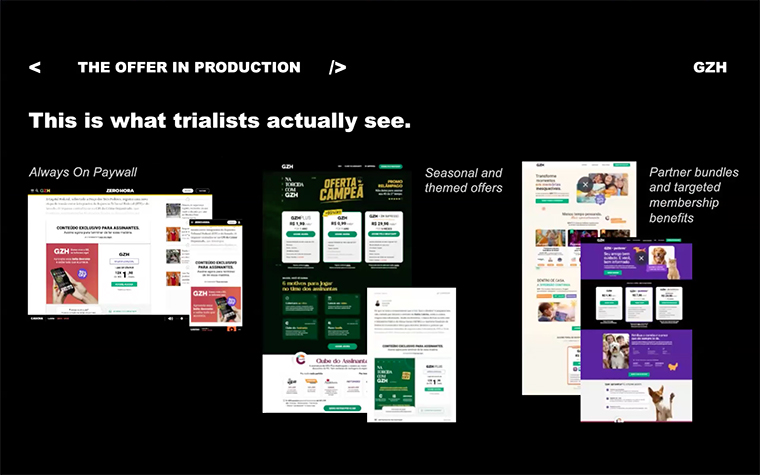
The company’s subscriber growth model is built around four stages: attract, convert, engage, and retain. Each stage feeds the next while continuously generating new customer data that improves future decision-making.
"The key insight here is simple,” Alan Streck, senior executive manager at B2C, said. “Acquisition and retention are not separate initiatives. They are integrated parts of the same growth system.”
The approach required Grupo RBS to accept certain tradeoffs. Average revenue per user initially starts lower because of the introductory pricing, and churn can increase as acquisition volumes rise.
However, the company designed its operating model with those realities in mind.
“The math worked because we built the engine,” Streck said.
That engine is built on four interconnected layers: signals, predictions, decisions, and actions.
Behavioural signals generated by subscribers feed predictive models. Those models drive decisions, which are then executed through CRM campaigns, product experiences, and customer service interventions.
Every action generates new behavioural data, creating a continuous feedback loop that improves the system over time.
“This architecture is what transformed an operation model into a true growth system,” Streck said.
User segmentation at Iltalehti
Perttu Kauppinen, editor-in-chief of Iltalehti, published by Alma Media in Finland, described how the newsroom used six months of subscriber reading data and AI-generated sentiment tagging to identify five distinct reader segments, and then reorganised its daily editorial decisions around them.
The result was not a marketing campaign or a pricing change, but a clearer understanding of “why our different readers pay for our subscription and what kind of content best serves the tastes of the different readers.”
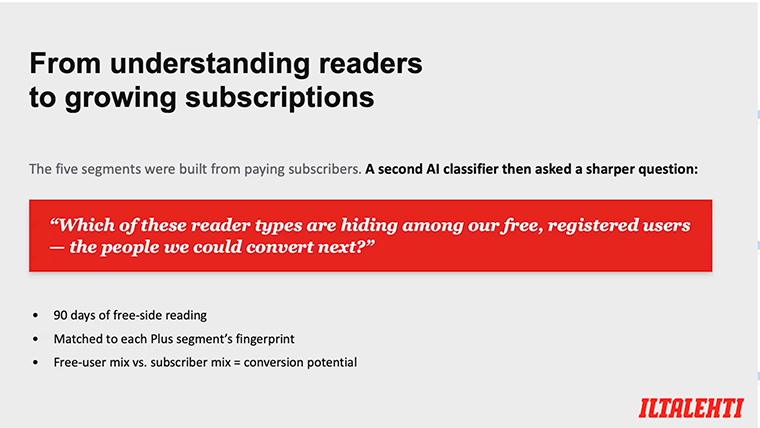
The subscription base grew steadily enough that consumer revenue increased despite the decline in print. But as the subscriber base grew, so did the challenge. That is when the newsroom started asking “who our subscribers actually are and how we could improve the product. That is how we found our reader segments,” Kauppinen said.
The idea behind the segmentation project was to group subscribers based on what they actually read. The team took six months of reading data and used it as the foundation. Each article in the system carried a topic tag or keyword.
On top of that, an AI model detected the general sentiment or tone of each article, “which can be positive or negative or neutral or critical, compassionate, uplifting, and so on.” An AI algorithm was then used to group the readers with similar appetites, and the process was repeated “over and over again until we were down to five stable and robust subscriber segments.”
“AI and segmentation helps us to turn anonymous crowd into people,” Kauppinen said. “Reading behaviour, actual reading behaviour and the sentiments, they reveal different recognisable reader types, and we don’t have to guess anything. We don’t have to make any surveys. We just know.”
The paid media funnel
Jonathan Gupta-Buckley, founder of The Twenty One, shared six levers that news media organisations should evaluate. One lever focused on the paid media funnel.
Impatience is a culprit here. Gupta-Buckley said he’s often told by clients that paid media doesn’t work, or acquisition costs are too high, and they’ve stopped paid media.
“What we typically find when we look under the hood is that 85-90% of ad dollars is being spent to tell people to buy now,” Gupta-Buckley said. “You have to first understand likes, dislikes, habits, and interests before you can move (to subscription).”
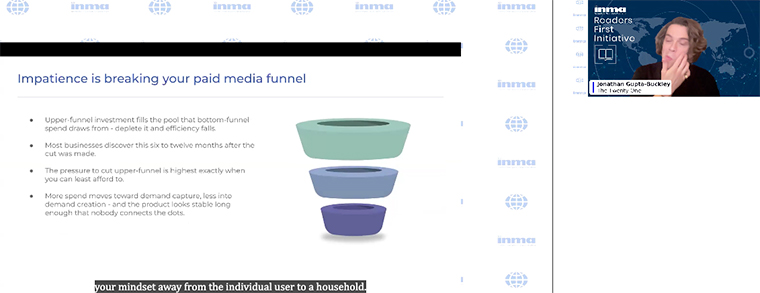
There are a finite number of people in the bottom of the funnel ready to buy now. Upper-funnel investment fills the pool for that bottom funnel. Many organisations cut upper-funnel spending when it is most needed.
If paid media investment is weighted towards the bottom of the funnel, that’s why acquisition costs are through the roof.
“The aim of the game from a paid media standpoint should be, at a minimum, 60% of your budget around the middle and top funnel,” he said. “As a brand today, do you have an awareness problem or a consideration problem? You’ll have one of them. The aim of the game is very much around driving frequency.”
This entails amplifying evergreen content as much as possible. Identify that content — ideally 20 to 30 pieces, Gupta-Buckley said — and allow the algorithm to optimise for best performance. Also ensure the audience isn’t being hammered with price.
Related Articles
-

Marketers should outsource tasks, not thinking
25 October 2026 -

Bundling is a pricing decision, rebundling is an organisational...
18 October 2026 -

AI’s effect on super user math
15 September 2026 -

At Mediacorp’s CNA, loyalty means giving audiences a reason to ...
20 August 2026 -

Tribun Network turns print “dots” into AI-powered insight
20 August 2026 -

Nation Media Group focuses editorial strategy on stories that m...
4 August 2026 -

Briefly News empowers journalists with AI tool suite Nova
4 August 2026 -

Economist launches subscription tier targeting younger audience...
20 July 2026
Upcoming Events
-

Subscriber Acquisition Master Class
10-17 November 2026
-

Media Advertising Summit
New York, United States
07-10 December 2026
-

AI-Native News Product Master Class
18-25 February 2027
-

Media Subscriptions Summit
Oslo, Norway
08-12 March 2027
-

World Congress of News Media
New York, United States
25-30 April 2027
-

Branded Content & Partnerships Master Class
20-27 May 2027
-

Subscriber Retention Master Class
17-24 June 2027
-

Conferencia Latinoamericana
15-16 July 2027
-

South Asia News Media Festival
New Delhi, India
19-22 July 2027
-

Asia/Pacific News Media Summit
19-20 August 2027
-

CEO Roundtable at Kilkenny
Kilkenny, Ireland
24-26 August 2027
-

Media Innovation Week
Amsterdam, The Netherlands
27 September - 01 October 2027








