

As AI commoditises content, publishers bet on brand
World Congress Blog | 11 May 2026

As AI floods the Internet with content, platforms weaken direct audience relationships, and trust in institutions continues to erode, media executives gathered in Berlin this week around a surprisingly old-fashioned idea: Brand matters again.
Not as a marketing campaign.
Not as a logo.
But as the defining strategic asset of a news organisation.
Across five days at the INMA World Congress of News Media in Berlin, speakers repeatedly returned to the same theme: In a world where content is becoming abundant and synthetic, trusted brands may become the scarcest and most valuable thing publishers own.
That theme was articulated most directly by INMA CEO and Executive Director Earl J. Wilkinson: “The only thing that is yours is who you are.”
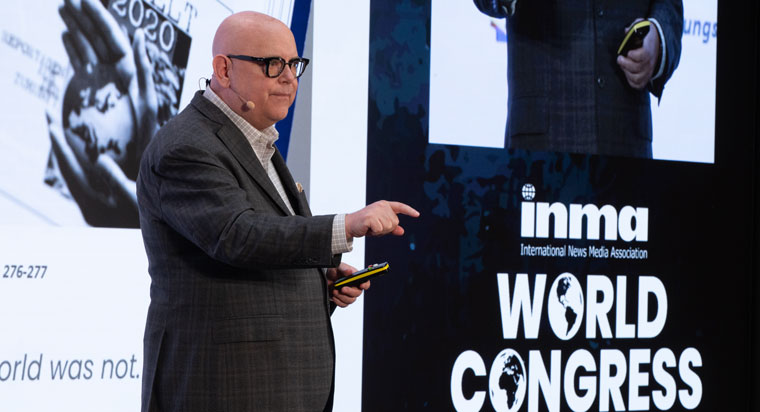
For Wilkinson, the shift is structural. Publishers can no longer assume their competitive advantage will come from scale, distribution, speed, or even quality journalism alone. AI systems can generate enormous volumes of content. Platforms increasingly mediate audience relationships. Search traffic is weakening. Attention is fragmenting.
What remains defensible, he said, is identity.
“Brand is no longer marketing,” Wilkinson said. “It’s an operating system.”
From marketing to strategy
The news industry still too often treats brand as a communications exercise when it should instead shape editorial choices, product design, audience strategy, subscriptions, hiring, and community engagement, Wilkinson said.
The publishers winning today, he said, tend to share several characteristics:
-
Distinctive positioning.
-
Emotional connection with audiences.
-
Strong audience rituals and habits.
-
Human recognisability.
-
Consistency across the organisation.
-
The courage to stand for something specific.
“Winning brands today have an emotional connection,” Wilkinson said. “Do they make you smarter? Do they make you calmer? Do they make you better informed?”
Many news publishers still make the critical mistake of trying to appeal to everyone, he said: “Most news brands to this day are designed not to offend. I think the winning brands choose to lose some readers in order to keep others more deeply.”
That idea surfaced repeatedly throughout the week, especially in discussions around younger audiences, newsletters, creators, local journalism, and specialist products.
AI is making trusted brands more valuable
Ironically, the rise of AI became one of the strongest reasons speakers gave for investing more heavily in brand.
Claudius Senst, chief operating officer of Axel Springer, framed the challenge around the disappearance of scarcity itself.
“What happens to media? What happens to journalism and to the definition of this when scarcity of content is gone?” Senst asked delegates.
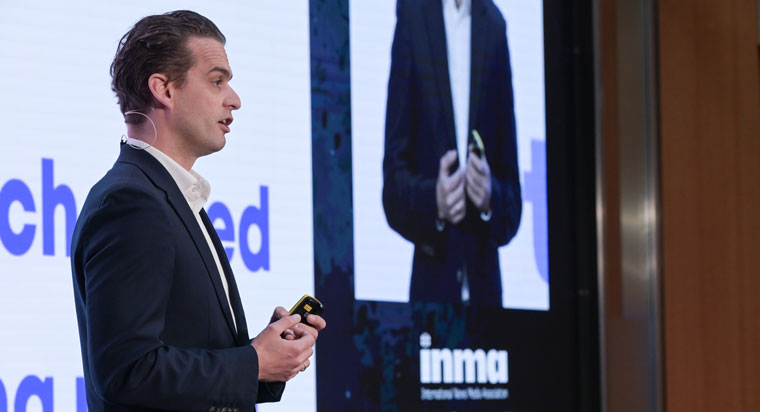
If AI systems can summarise, rewrite, and aggregate information instantly, news publishers cannot compete through generic output alone. They must compete through authority, voice, expertise, and audience relationship.
Wilkinson described this as the industry’s “last real advantage.”
“I believe that verified human journalism will become a premium category in the news world,” he said.
In a presentation on journalism’s democratic responsibility, Julia Becker, chair of the supervisory board of Funke Mediengruppe, warned that AI-generated videos, fabricated images, and fake quotations are making it increasingly difficult for audiences to distinguish reality from manipulation.
“We produce something far more fragile — and far more valuable: Trust,” Becker said. “Trust is not created through cost-cutting. It is created through conviction.”
Andy Thomson, executive director of business operations at Sky News, described restructuring workflows around premium, multi-platform video journalism that can move across television, YouTube, TikTok, podcasts, and streaming environments while maintaining a consistent editorial identity.
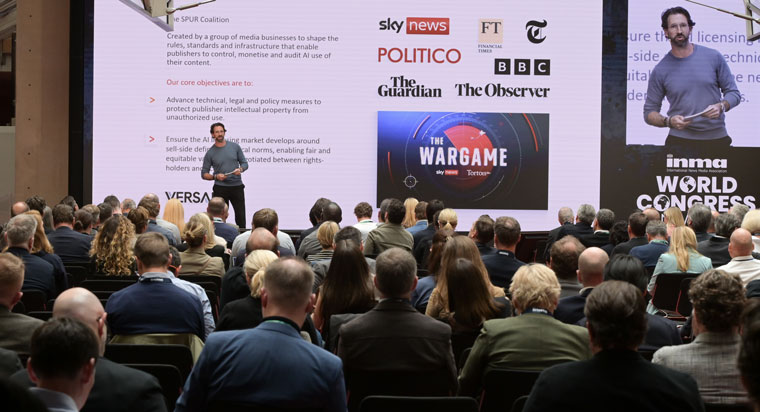
Collaboration and trusted journalism will become even more important as AI-generated misinformation increases, Thomson said.
Younger audiences trust people before institutions
The World Congress’ young audiences seminar reinforced how dramatically brand-building itself is changing.
Kerstin Hasse, INMA Young Audiences Initiative lead, said younger consumers increasingly discover journalism through personalities, creators, newsletters, video formats, and social recommendation systems rather than institutional homepages.
“Authenticity creates trust,” Hasse said.
That authenticity, she said, is not about imitating influencer culture. It is about transparency, visible humanity, and helping audiences understand how journalism is produced.
Using an example from Der Spiegel, Hasse described how reporters produced social content explaining how an investigation was reported and how editorial decisions were made.
“That is a very, very good example of showing and building trust,” she said.
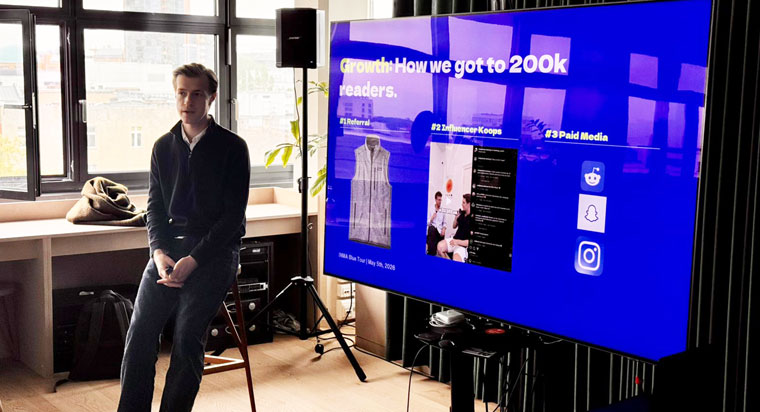
Berlin-based startup morningcrunch showed a similar shift during a study tour stop. The company has built a fast-growing audience around a concise, conversational business and finance newsletter designed to feel useful and approachable rather than institutional.
Throughout the seminars, speakers emphasised that younger audiences increasingly expect to know who is behind journalism and how it is made. Trust is formed through transparency and repeated interaction, not simply institutional reputation.
Specialist journalism strengthens brand identity
The study tours across Berlin showed how many publishers are restructuring around clearer brand identities and more defined audience relationships.
At Table.Media, executives described building specialist products around political, business, and policy expertise rather than pursuing mass-market scale. Company executives repeatedly emphasised “deep journalism,” authority, and usefulness as its differentiators.
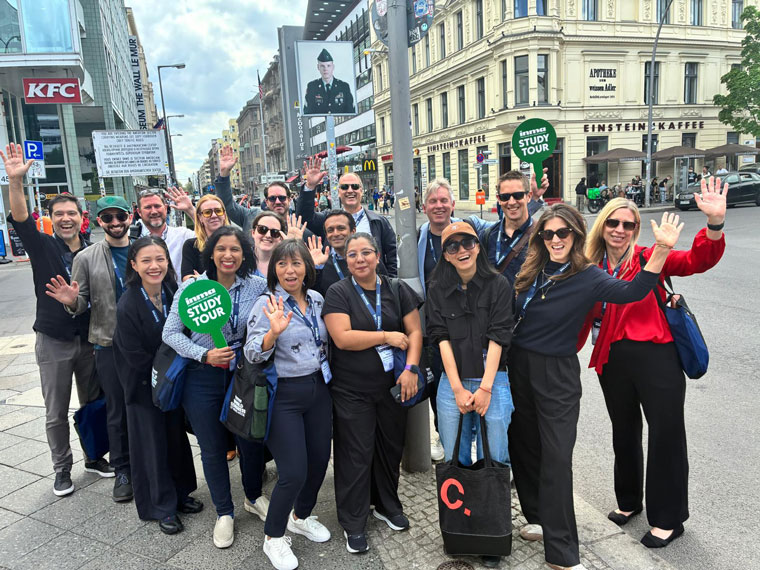
At Tagesspiegel, editors discussed the challenge of evolving from a historically Berlin-focused newspaper into a national brand without losing local identity and authority.
“We are focused on Berlin, but we are also a nationwide newspaper,” Editor-in-Chief Christian Tretbar said.
Regional publishers also described trust itself as a competitive advantage.
One study tour discussion about sports newsletters explained that audiences trusted local coverage because reporters were embedded in communities, physically close to clubs and sources, and able to provide deeper interpretation than national outlets.
At Germany’s RND network, executives described how local trust could be scaled through shared infrastructure and collaboration while preserving strong regional identities.
Elsewhere, publishers discussed shifting their language away from “subscribers” toward “communities.”
That may sound semantic, but speakers said it reflects a broader transformation: Successful media brands are no longer simply content providers. They are relationship builders.
Trust is also becoming a monetisation strategy
Several speakers throughout the week connected brand trust directly to revenue.
During a conference session on advertising and audience value, Pippa Leary, managing director and publisher of free news and lifestyle at News Corp Australia, said publishers’ direct audience relationships and first-party data have become some of their strongest commercial advantages.
“First-party data is your moat,” she said.
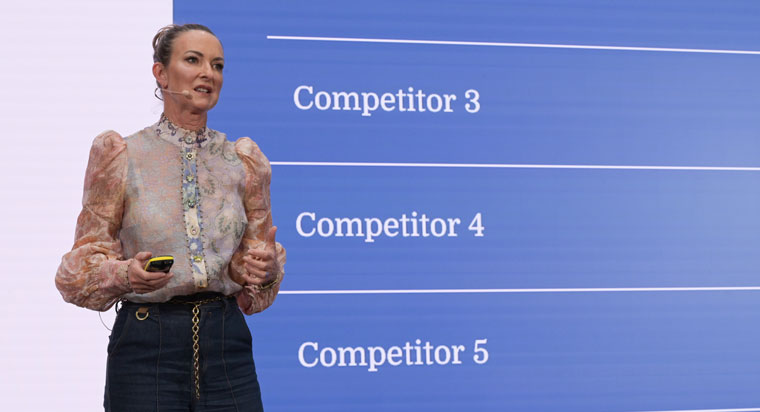
Leary described how News Corp Australia uses audience relationships and behavioural insights to provide advertisers with trusted, highly targeted environments that platforms increasingly struggle to replicate.
Other speakers said publishers are not really selling advertising inventory at all. They are selling trusted relationships, contextual environments, and audience attention shaped by brand credibility.
In one conference presentation on transformation and community-building, a German publisher described turning a live journalism festival into a broader platform business that includes Webinars, master classes, travel experiences, and content products.
The new moat
One seminar discussion explored how publisher brands increasingly exist not only in consumers’ minds but also inside AI systems themselves. One speaker described brands as existing “in the brain and in data,” adding: “News discovers, AI recombines.”
That means publishers must now think about how large language models interpret, describe, summarise, and represent their brands.
Jimmy Wales, founder of Wikipedia, added another layer to the discussion by noting that neutrality alone is not enough to define a modern publisher identity.
“Neutrality is not a brand,” Wales said. “It is for us, but that’s because we’re Wikipedia.”

For years, publishers invested heavily in traffic scale, SEO, social distribution, and content volume. But the Berlin conversations suggested many executives now believe those advantages are weakening simultaneously.
Platforms can change.
Traffic can collapse.
AI can summarise.
Algorithms can reroute audiences overnight.
Strong brands, however, are harder to displace.
Wilkinson summarised the shift directly: “The competitive edge has moved from product to cost to relationship.”
That relationship — built through trust, identity, expertise, transparency, community, and repeated audience experience — increasingly looks like the foundation on which future media businesses will compete.
The message from Berlin was not nostalgic. Executives were not calling for a return to traditional branding campaigns.
They were describing a future in which the publishers most likely to survive may be the ones audiences recognise, remember, trust, and deliberately seek out by name.
All photos by Robert Downs Photography.
Related Articles
-

Marketers should outsource tasks, not thinking
25 October 2026 -

WSJ executive councils show how publishers build communities th...
19 October 2026 -

AI’s effect on super user math
15 September 2026 -

At Mediacorp’s CNA, loyalty means giving audiences a reason to ...
20 August 2026 -

Tribun Network turns print “dots” into AI-powered insight
20 August 2026 -

Nation Media Group focuses editorial strategy on stories that m...
4 August 2026 -

Briefly News empowers journalists with AI tool suite Nova
4 August 2026 -

Indian Express builds a video-first future around trusted journ...
20 July 2026
Upcoming Events
-

Subscriber Acquisition Master Class
10-17 November 2026
-

Media Advertising Summit
New York, United States
07-10 December 2026
-

AI-Native News Product Master Class
18-25 February 2027
-

Media Subscriptions Summit
Oslo, Norway
08-12 March 2027
-

World Congress of News Media
New York, United States
25-30 April 2027
-

Branded Content & Partnerships Master Class
20-27 May 2027
-

Subscriber Retention Master Class
17-24 June 2027
-

Conferencia Latinoamericana
15-16 July 2027
-

South Asia News Media Festival
New Delhi, India
19-22 July 2027
-

Asia/Pacific News Media Summit
19-20 August 2027
-

CEO Roundtable at Kilkenny
Kilkenny, Ireland
24-26 August 2027
-

Media Innovation Week
Amsterdam, The Netherlands
27 September - 01 October 2027








