

Berlin study tours reveal a media industry rebuilding itself in real time
World Congress Blog | 07 May 2026

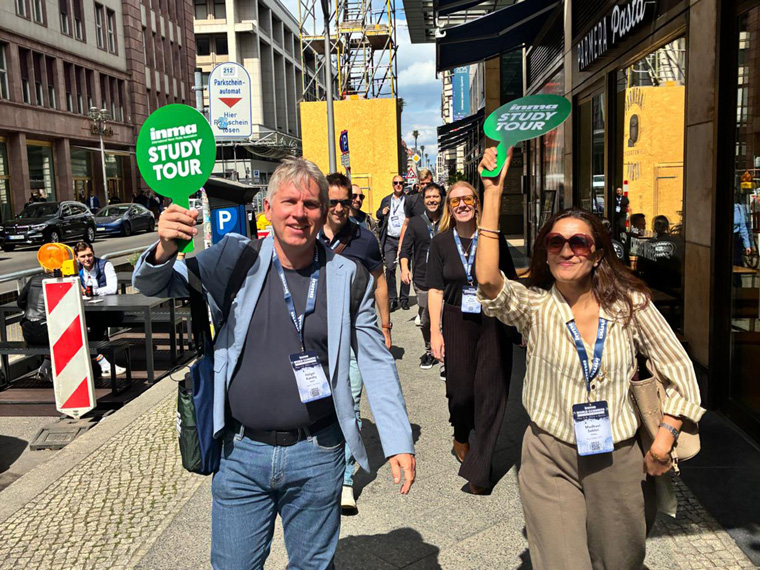
The opening study tours of the INMA World Congress of News Media in Berlin this week offered more than behind-the-scenes access to 17 German and European media companies. Together, the visits revealed a broader picture of how one of Europe’s most influential media ecosystems is reinventing itself amid platform disruption, AI, and shifting audience habits.
Over two days, 94 media executives split into three groups to visit publishers, startups, nonprofit newsrooms, networks, and specialist information companies across Berlin and Germany. Stops included Axel Springer, Tagesspiegel, The Pioneer, RND — RedaktionsNetzwerk Deutschland, Table.Media, DPA, Der Spiegel, Funke Mediengruppe, Süddeutsche Zeitung, Correctiv, Ippen Digital, Bauer Media Group, morningcrunch, Die Zeit, NZZ, taz, and FAZ (Frankfurter Allgemeine Zeitung).
Despite the diversity of organisations — from century-old legacy publishers to venture-backed startups — many were converging on similar conclusions about the future of media.
Among the clearest themes: News publishers are trying to reduce dependence on platforms by building direct audience relationships; regional news organisations are scaling through collaboration and shared infrastructure; and AI is accelerating organisational redesign far beyond newsroom automation.

For many delegates, Berlin emerged not simply as a host city for World Congress but as a laboratory for media reinvention.
“People kind of want to understand where it’s going, how others are doing with it,” INMA Readers First Initiative Lead Greg Piechota, who led one of the tours, said as the week began. “Germany is a super attractive place.”
Local journalism scales through networks
One of the strongest recurring themes across the tours was that local journalism alone may no longer scale economically — but local journalism connected through networks can.
At RND – RedaktionsNetzwerk Deutschland and its parent company Madsack Media Group, executives described a model in which dozens of regional news organisations share infrastructure, technology, editorial resources, data systems, and product development while maintaining strong local identities.
RND executives repeatedly returned to the idea that “relevance starts locally” but argued that collaboration enables local journalism to achieve national scale.
The network now works with 139 newspaper brands and more than 4,000 journalists, allowing local reporting, investigations, newsletters, products, and audience insights to spread across regions.
That same tension between local identity and national ambition surfaced repeatedly elsewhere.
At Tagesspiegel, editors described the challenge of evolving from a historically Berlin-focused newspaper into a national digital news player while retaining the authority and intimacy that came from its local roots.
At Ippen Digital and Funke Mediengruppe, delegates heard how regional publishers are increasingly centralising technology, AI systems, and product development while leaving editorial teams distributed closer to audiences.
The model stood in contrast to older assumptions that scale requires editorial homogenisation.
Instead, many German publishers argued scale now comes from shared systems behind the scenes, not identical journalism.
Direct audience relationships become strategic priority
Another dominant theme was the industry-wide effort to reduce dependence on Google, search, and social referral traffic by strengthening direct audience relationships.
Across nearly every stop, newsletters, podcasts, apps, memberships, events, and specialist products were treated not as side projects, but as core business infrastructure.
At RND, executives described newsletters as products in their own right rather than marketing tools. The company has scaled its newsletter network to roughly one million subscriptions across regional brands, with leaders emphasising habit-building and loyalty over traffic spikes.
At morningcrunch, delegates saw a younger, startup-driven version of the same strategy: concise, high-frequency newsletters and podcasts designed to fit seamlessly into the daily routines of younger professionals.
At The Pioneer and Table.Media, publishers showed how premium political and business intelligence products can generate high-value subscription businesses through niche audiences rather than mass scale.
Executives described increasingly affluent and time-poor audiences who want sharp, curated information products delivered directly to them rather than broad destination homepages.
The Pioneer’s media-and-events model — including high-level networking experiences hosted aboard its ship on Berlin’s River Spree — illustrated how some publishers are blending journalism, community, access, and live experiences into a single premium membership proposition.
Meanwhile, publishers including Die Zeit, FAZ (Frankfurter Allgemeine Zeitung), NZZ, and Süddeutsche Zeitung continued to emphasise premium journalism, subscriber relationships, and brand trust as competitive advantages in an increasingly fragmented information environment.
AI becomes organisational challenge, not just newsroom tool
Artificial Intelligence surfaced at nearly every stop, but the tours suggested that many publishers are now treating AI less as a novelty and more as an operational reality requiring structural change.
At Bauer Media Group, executives described AI and platform disruption as fundamentally reshaping media distribution and audience relationships. Leaders argued publishers must rethink workflows, infrastructure, and product strategies rather than focus only on isolated AI tools.
At RND and Funke, AI discussions centred heavily on shared prompting systems, scalable workflows, data infrastructure, and centralised experimentation that could be distributed across multiple newsrooms.
At Axel Springer, delegates saw how one of Europe’s largest publishers is reorganising itself around premium digital journalism, video, technology, and experimentation through brands including Bild, Welt, Politico Germany, and Business Insider Germany.
At DPA, Germany’s national news agency, conversations focused on how AI and shared data systems could support publishers collectively rather than simply disrupt them individually.
Even younger companies such as morningcrunch discussed AI primarily in terms of workflow efficiency and personalisation rather than newsroom replacement.
The common thread was pragmatic adaptation.
Few companies framed AI as optional. Instead, most described it as something already embedded into editorial, product, and operational decision-making.
Trust, experimentation, and reinvention
If there was a defining mood across the tours, it was experimentation.
At Correctiv and taz, delegates saw nonprofit and mission-driven journalism models focused heavily on trust, transparency, and public-interest reporting.
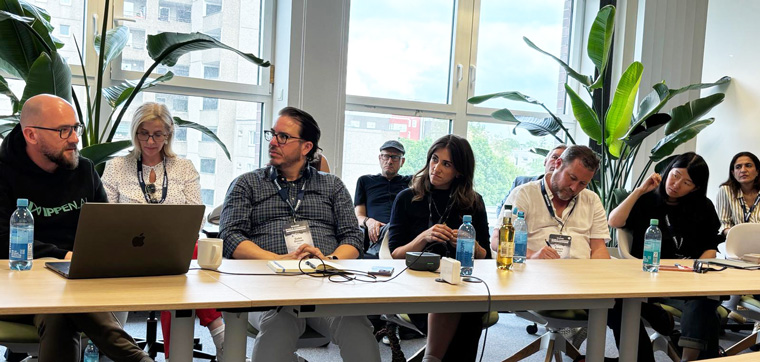
At legacy organisations including Der Spiegel, FAZ, Die Zeit, and Süddeutsche Zeitung, the challenge was how to preserve institutional authority while adapting to radically different audience behaviours.
At startups such as morningcrunch and Table.Media, the emphasis shifted toward speed, niche products, audience utility, and format experimentation.
Yet despite their differences, many companies appeared to be moving toward similar conclusions:
-
Journalism alone is no longer enough.
-
Direct audience relationships matter more than ever.
-
Sustainable media businesses increasingly depend on combining journalism with strong products, technology, community, and data capabilities.
For delegates at the opening of the Berlin World Congress week, the study tours ultimately offered something larger than individual case studies.
They revealed an industry attempting to redesign itself in real time.
Related Articles
-

Marketers should outsource tasks, not thinking
25 October 2026 -

WSJ executive councils show how publishers build communities th...
19 October 2026 -

AI’s effect on super user math
15 September 2026 -

At Mediacorp’s CNA, loyalty means giving audiences a reason to ...
20 August 2026 -

Tribun Network turns print “dots” into AI-powered insight
20 August 2026 -

Nation Media Group focuses editorial strategy on stories that m...
4 August 2026 -

Briefly News empowers journalists with AI tool suite Nova
4 August 2026 -

Indian Express builds a video-first future around trusted journ...
20 July 2026
Upcoming Events
-

Subscriber Acquisition Master Class
10-17 November 2026
-

Media Advertising Summit
New York, United States
07-10 December 2026
-

AI-Native News Product Master Class
18-25 February 2027
-

Media Subscriptions Summit
Oslo, Norway
08-12 March 2027
-

World Congress of News Media
New York, United States
25-30 April 2027
-

Branded Content & Partnerships Master Class
20-27 May 2027
-

Subscriber Retention Master Class
17-24 June 2027
-

Conferencia Latinoamericana
15-16 July 2027
-

South Asia News Media Festival
New Delhi, India
19-22 July 2027
-

Asia/Pacific News Media Summit
19-20 August 2027
-

CEO Roundtable at Kilkenny
Kilkenny, Ireland
24-26 August 2027
-

Media Innovation Week
Amsterdam, The Netherlands
27 September - 01 October 2027








