

Guardian editor-in-chief calls AI disruption “absolutely seismic” for news media
World Congress Blog | 10 May 2026

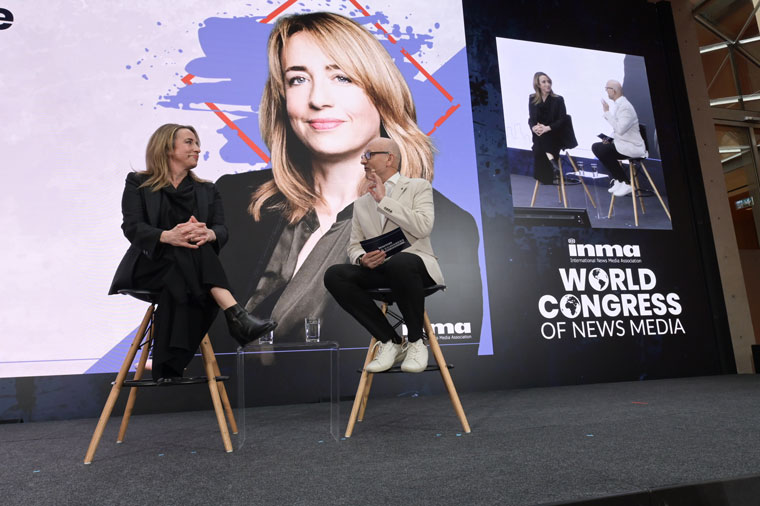
News organisations must embrace experimentation with AI while doubling down on the distinctly human value of journalism: original reporting, editorial independence, and direct audience trust, Katharine Viner, the editor-in-chief of The Guardian, told delegates at the INMA World Congress of News Media in Berlin
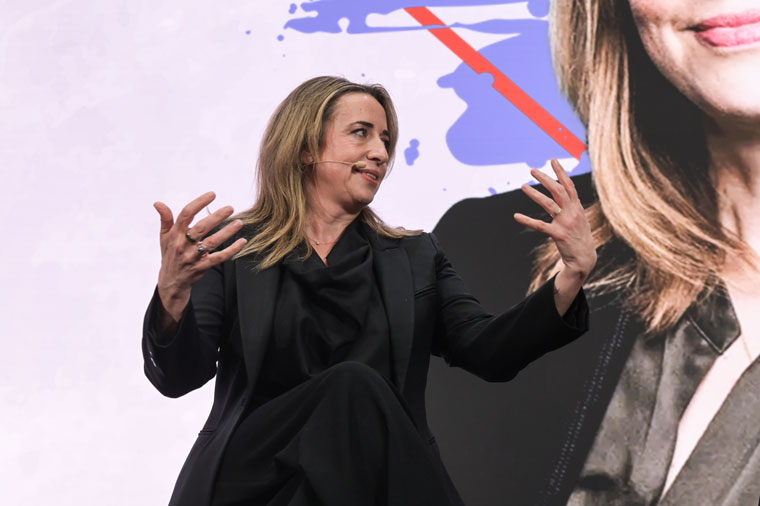
In a wide-ranging interview on stage, Viner outlined how The Guardian is navigating technological disruption, global expansion, and changing audience habits through a contributor-supported model that she described as both commercially sustainable and politically significant.
“We’re in a transition period and a period of experimentation,” Viner said of AI. “Anyone who says it’s definitely going to be this or definitely going to be that — nobody knows.”
Still, journalism organisations should neither ignore AI nor surrender editorial judgement to it, she said.
AI can strengthen journalism — but not replace it
Viner described AI as particularly useful for investigative and data-driven reporting, citing a recent collaboration with University College London in which The Guardian used AI tools to analyse 100 years of Hansard parliamentary records to track changes in immigration rhetoric in Britain.
The analysis found that anti-immigration rhetoric in the past five years had become “more aggressive” than at any point in the previous century, she said.
“We would not have been able to do that computing without AI,” Viner said. “That is exciting. That’s exciting. That’s a fresh way of looking at the world.”
At the same time, she stressed there are core journalistic functions AI cannot replicate.
“On-the-ground reporting, talking to people where it’s the fourth or fifth question that really reveals something interesting, holding power to account — that is not in the AI business model,” Viner said.
She also warned against careless AI implementation in publishing.
“We are seeing some organisations using it in an extremely sloppy way with sort of gobbledygook headlines, churning out endless stuff,” she said. “I just don’t think that’s respectful to the audience, and they’ll soon get fed up with it.”
Inside The Guardian, Viner said the company is approaching AI as a newsroom-wide learning process, with training and experimentation designed to bring staff along together rather than imposing change from the top down.
Editorial independence remains central
Much of the discussion focused on The Guardian’s ownership structure and how it shapes decision-making during a period of industry upheaval.
Viner explained that the Scott Trust, established in 1936, exists solely to preserve The Guardian’s editorial and commercial independence “in perpetuity.”
“The only job of the Scott Trust is to make sure The Guardian keeps going and keeps being itself,” she said.
That structure, she argued, gives the newsroom freedom from billionaire owners, political influence, and external commercial pressure.
“To have the freedom to make the decision of what is right for The Guardian — not for anybody else, not for outside commercial interest, not for outside political interest — I think is really powerful,” Viner said.
At the same time, she rejected the idea that editorial and business operations can remain separate in modern media organisations: “The business is the journalism. The journalism is the business,” she said.
A global strategy built around audience support
The Guardian’s audience and revenue base have become increasingly international, with two-thirds of its audience now outside the United Kingdom and 60% of digital revenue generated internationally, Viner said.
The United States has become a particularly important growth market, with The Guardian now employing 200 staff there.
“What our American readers tell us is that we’ve brought something different to American reporting,” she said.
Viner attributed the company’s growth to three factors:
-
Global reporting and perspective.
-
Independent ownership.
-
Free access to journalism without a paywall.
“I think there’s something radical about it,” she said of the open-access model.
When Viner became editor-in-chief in 2015, The Guardian had no digital reader revenue and faced severe financial pressure. Rather than introducing a paywall, the company developed its now-famous contributor model asking readers to voluntarily support journalism.
The first campaign focused on the risk of losing The Guardian. Later messaging shifted toward inviting audiences to become part of a successful mission.
“That positive message worked much better,” Viner said.
She described the model not simply as a commercial strategy but as a democratic one.
“Lots of readers wrote to us saying, ‘I am giving you money so that people who can’t afford to can read for free,’” she said. “I think it’s a political act.”
Journalism faces an “absolutely seismic” moment
Viner characterised the current media environment as one of profound instability driven by both technological and political change.
“This one goes up to 11” she said when asked to rate the scale of disruption facing journalism on a scale of one to 10.
She contrasted today’s AI revolution with the early optimism surrounding the open Web: “The World Wide Web was all about creativity and connection and openness. This doesn’t feel like that at all.”
She linked technological upheaval with democratic backsliding around the world, noting that more people now live under autocracies than democracies.
“I think those two big things playing in together mean this is an absolutely seismic time for change,” she said.
All photos by Robert Downs Photography.
Related Articles
-

Marketers should outsource tasks, not thinking
25 October 2026 -

AI’s effect on super user math
15 September 2026 -

At Mediacorp’s CNA, loyalty means giving audiences a reason to ...
20 August 2026 -

Tribun Network turns print “dots” into AI-powered insight
20 August 2026 -

Nation Media Group focuses editorial strategy on stories that m...
4 August 2026 -

Briefly News empowers journalists with AI tool suite Nova
4 August 2026 -

Indian Express builds a video-first future around trusted journ...
20 July 2026 -

Grupo RBS builds social-first video operation to expand audienc...
20 July 2026
Upcoming Events
-

Subscriber Acquisition Master Class
10-17 November 2026
-

Media Advertising Summit
New York, United States
07-10 December 2026
-

AI-Native News Product Master Class
18-25 February 2027
-

Media Subscriptions Summit
Oslo, Norway
08-12 March 2027
-

World Congress of News Media
New York, United States
25-30 April 2027
-

Branded Content & Partnerships Master Class
20-27 May 2027
-

Subscriber Retention Master Class
17-24 June 2027
-

Conferencia Latinoamericana
15-16 July 2027
-

South Asia News Media Festival
New Delhi, India
19-22 July 2027
-

Asia/Pacific News Media Summit
19-20 August 2027
-

CEO Roundtable at Kilkenny
Kilkenny, Ireland
24-26 August 2027
-

Media Innovation Week
Amsterdam, The Netherlands
27 September - 01 October 2027








