

INMA survey shows news executives growing less optimistic as AI reshapes strategy
World Congress Blog | 06 May 2026

News media executives attending the INMA World Congress of News Media expressed a noticeably more cautious outlook for the year ahead, even as subscriptions, video, and AI-related initiatives remain central growth priorities.
In a brief opening session Wednesday at the World Congress in Berlin, conference co-moderators Jodie Hopperton, INMA’s Product & Tech Initiative lead, and Robert Whitehead, INMA’s Digital Platform Initiative lead, shared findings from a pre-conference survey of 54 INMA corporate members.
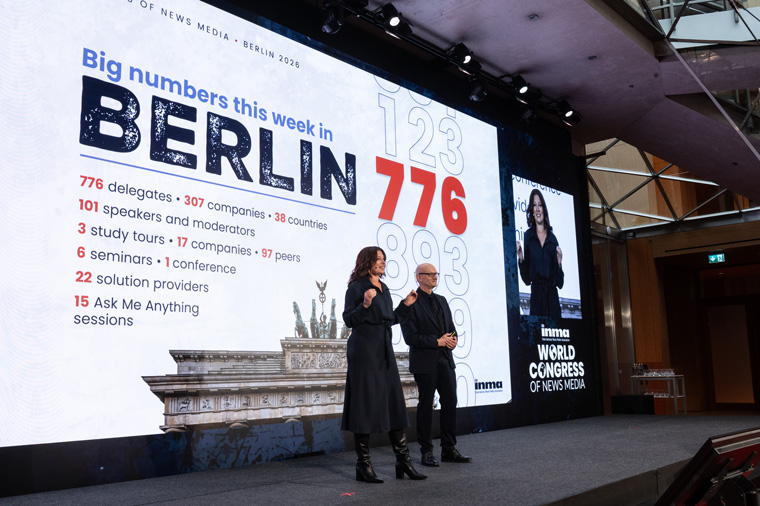
The discussion framed the conference around an industry grappling with rapid technological change, organisational transformation, and the growing impact of AI across the entire media business.
“We’ve actually realised how big this moment is,” Whitehead said. “That’s why people are concerned with business prospects changing, and that’s because the enormity of what we’re looking at is coming into view.”
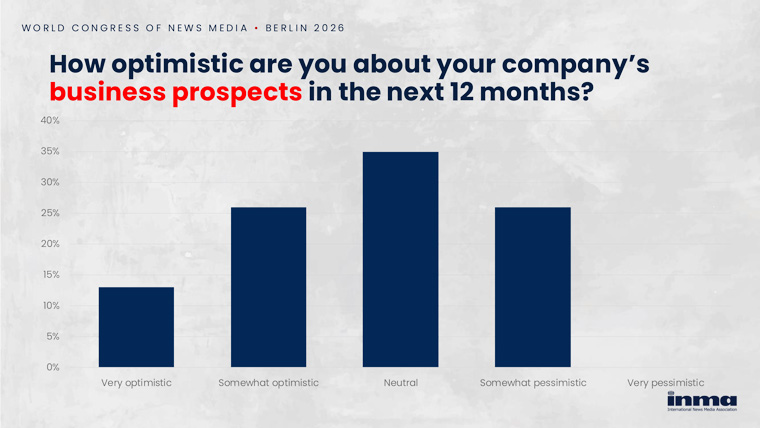
Survey results presented on stage showed only a small share of executives describing themselves as “very optimistic” about their company’s business prospects over the next 12 months, while the largest group selected “neutral.”
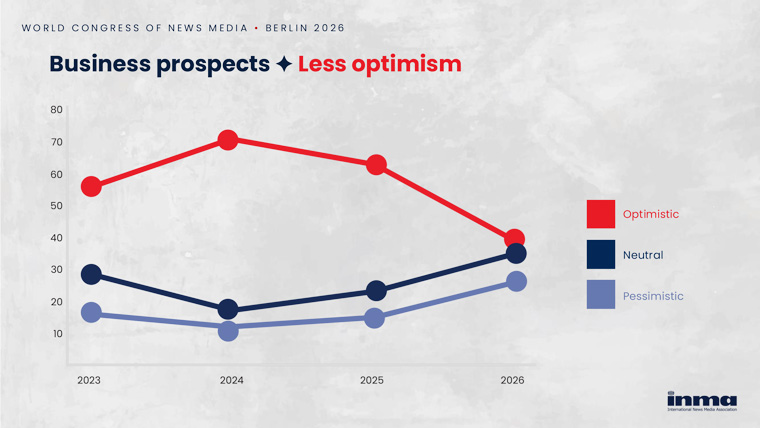
The survey suggested industry confidence has declined steadily since 2024, with neutral and pessimistic responses rising in parallel.
Even amid that caution, executives identified clear areas of opportunity.
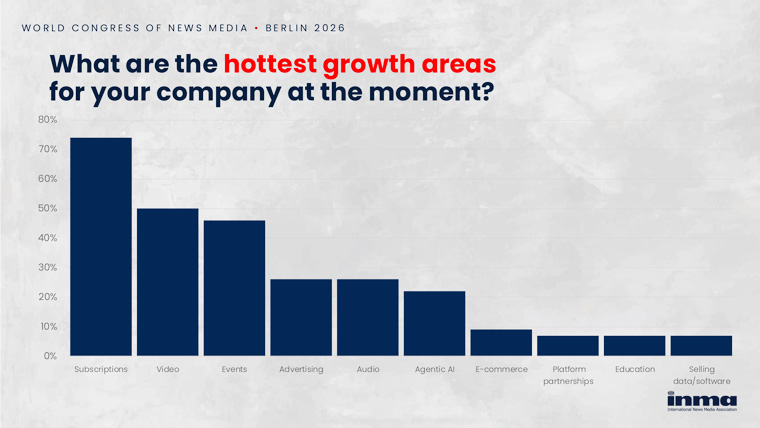
Subscriptions remained by far the strongest perceived growth area among surveyed companies, followed by video and events. Advertising and audio also ranked prominently, while “agentic AI” emerged as a new strategic focus area.
The prominence of AI-related revenue discussions marked a significant shift for the news industry, Whitehead said: “It did take this industry 80 months to get it up there,” he said, referring to AI monetisation and implementation. “Understanding and implementing AI consumer revenue and, interestingly, advertising revenue and understanding a path forward on that is right at the top.”
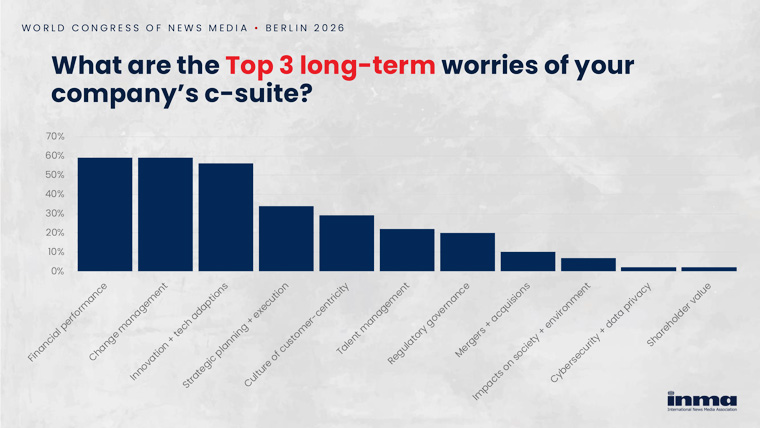
The moderators also highlighted longer-term concerns weighing on media leaders, particularly around organisational readiness for transformation: “Change management, innovation and tech adoption,” Whitehead said, were among the issues “keeping the C-suite awake at night.”
News publishers increasingly understand what they need to do strategically but are struggling with the pace of execution, Whitehead said: “We know what we need to do, but how do we move fast enough? How do we get the right technology in place? How do we get everyone moving in the right direction, and how do we bring in the right skill sets and change those skill sets?”
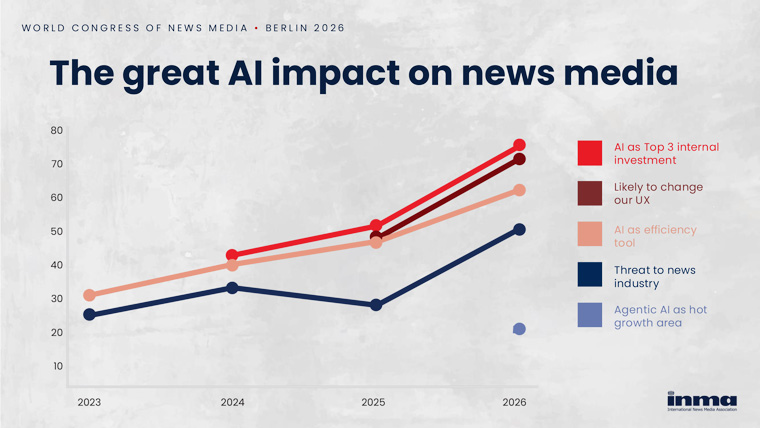
The survey reinforced one of the conference’s central themes: AI is no longer confined to experimentation inside editorial departments.
“AI has finally moved out of the newsroom into the entire corporate entity,” Whitehead said. “It’s invaded all of our strategic thinking, and not a minute too soon.”
The survey discussion served as a scene-setting moment for the World Congress, which drew a sell-out crowd of 776 delegates from 307 companies across 38 countries to Berlin this week.
The findings also aligned closely with several themes highlighted throughout the conference programme, including AI-driven transformation, brand trust, subscription growth, advertising reinvention, and the rise of semi-autonomous “agentic AI” systems.
All photos by Robert Downs Photography.
Related Articles
-

Readers’ agents are becoming customers, and most publishers can...
28 October 2026 -

Why publishers are blocking bots by default to starve the black...
28 October 2026 -

What makes an AI choose your news brand?
14 October 2026 -

Licensing won’t save media, but authentication might
13 October 2026 -

INMA report: AI’s dependence on journalism gives publishers new...
30 September 2026 -

When the agent — not the app — becomes the interface
30 September 2026 -

AI is now media’s operating environment
28 September 2026 -

INMA spends 5 days in Madrid learning what actually works
20 September 2026
Upcoming Events
-

Subscriber Acquisition Master Class
10-17 November 2026
-

Media Advertising Summit
New York, United States
07-10 December 2026
-

AI-Native News Product Master Class
18-25 February 2027
-

Media Subscriptions Summit
Oslo, Norway
08-12 March 2027
-

World Congress of News Media
New York, United States
25-30 April 2027
-

Branded Content & Partnerships Master Class
20-27 May 2027
-

Subscriber Retention Master Class
17-24 June 2027
-

Conferencia Latinoamericana
15-16 July 2027
-

South Asia News Media Festival
New Delhi, India
19-22 July 2027
-

Asia/Pacific News Media Summit
19-20 August 2027
-

CEO Roundtable at Kilkenny
Kilkenny, Ireland
24-26 August 2027
-

Media Innovation Week
Amsterdam, The Netherlands
27 September - 01 October 2027








