

When the agent — not the app — becomes the interface
Product & Tech Initiative Blog | 30 September 2026

The argument that personal context may be the next great moat for news companies, as I wrote about here, begs the question: Why would I want five personal agentic systems?
The greatest benefit comes from giving one system enough context to understand me really well. Consumers probably won’t call it an “agent.” It will simply be the thing they use to get things done: Tell me what I need to know this morning, find somewhere for dinner, which shoes should I buy, what happened in the markets, book my train, plan our holiday, explain this story.
The interface becomes less about navigating destinations and more about expressing intent.
Which is why I’m increasingly questioning the long-term role of Web sites and apps. I don’t think either disappears altogether — just like print hasn’t disappeared — but they could dwindle in importance as the primary interface between companies and consumers.
Yesterday, I used 10 apps to do 10 things. Today, I am seeing that dwindle. Tomorrow, I may well tell one AI what I want and it decides which information, services, and tools it needs to fulfil that intention. That creates an extraordinarily powerful position for whoever owns the interface and a difficult question for everyone else: If you don’t own the interface, how do you show up inside someone else’s?
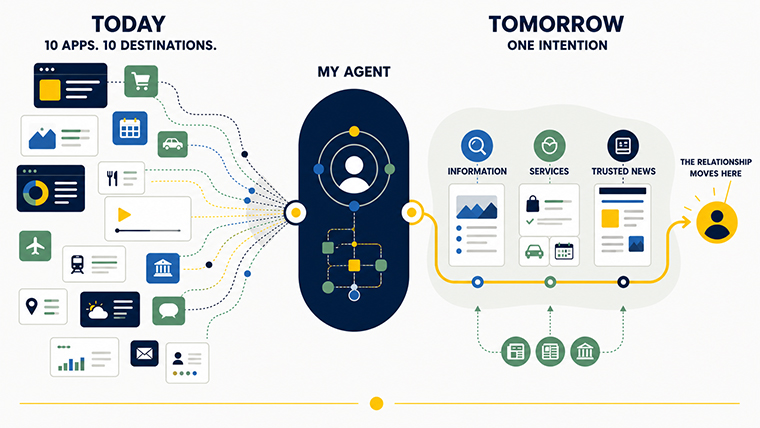
For media, this is profound. For 25 years, digital strategy has largely revolved around destinations and a funnel distribution model: build the homepage, build the app, optimise for Google, build social audiences, send newsletters, bring people back.
But what happens if the consumer increasingly doesn’t come back? They ask their AI instead.
The AI knows what they care about, what they already know, which sources they trust, and perhaps which subscriptions they pay for. It assembles the experience around them. The publisher moves from being the destination to becoming one of the services available to the intelligence layer.
There is an obvious danger here: invisibility. But there’s also an opportunity. An AI that understands me could potentially extract more value from my media subscriptions than today’s generic homepage.
If it knows I subscribe to the Financial Times, for example, it can bring FT journalism into my experience when relevant. It can tell me the information comes from the FT, access things a non-subscriber can’t, and potentially take me deeper when I want it to.
That starts to look like a very different media product.
Which is why I think news organisations need to spend less time asking whether AI will replace their Web sites and more time asking: What does an agent-native media product look like?
Because the bigger challenge isn’t preserving the interface. It’s preserving the relationship when somebody else owns it.
If you’d like to subscribe to my bi-weekly newsletter, INMA members can do so here.
Banner photo: Adobe stock image by Ikramint Studio.
Related Articles
-

Readers’ agents are becoming customers, and most publishers can...
28 October 2026 -

Why publishers are blocking bots by default to starve the black...
28 October 2026 -

What makes an AI choose your news brand?
14 October 2026 -

Licensing won’t save media, but authentication might
13 October 2026 -

INMA report: AI’s dependence on journalism gives publishers new...
30 September 2026 -

AI is now media’s operating environment
28 September 2026 -

INMA spends 5 days in Madrid learning what actually works
20 September 2026 -

South Asia’s publishers have the trust but not yet the revenue ...
26 July 2026
Upcoming Events
-

Subscriber Acquisition Master Class
10-17 November 2026
-

Media Advertising Summit
New York, United States
07-10 December 2026
-

AI-Native News Product Master Class
18-25 February 2027
-

Media Subscriptions Summit
Oslo, Norway
08-12 March 2027
-

World Congress of News Media
New York, United States
25-30 April 2027
-

Branded Content & Partnerships Master Class
20-27 May 2027
-

Subscriber Retention Master Class
17-24 June 2027
-

Conferencia Latinoamericana
15-16 July 2027
-

South Asia News Media Festival
New Delhi, India
19-22 July 2027
-

Asia/Pacific News Media Summit
19-20 August 2027
-

CEO Roundtable at Kilkenny
Kilkenny, Ireland
24-26 August 2027
-

Media Innovation Week
Amsterdam, The Netherlands
27 September - 01 October 2027








