

Local journalism emerges as a safeguard against AI disruption and platform fragmentation
World Congress Blog | 14 May 2026

Discussions about local journalism at the INMA World Congress of News Media last week reflected a growing belief among publishers that community-based reporting may become one of the industry’s strongest safeguards against AI disruption, platform fragmentation, and declining direct audience relationships.
Across study tours, conference sessions, and seminars, executives from Tagesspiegel, Madsack, Ippen, Bonnier News, and other publishers repeatedly returned to the same idea: As AI systems commoditise information and platform traffic becomes less reliable, local journalism’s value increasingly lies in trust, proximity, civic connection, and direct relationships with communities.
Rather than competing with global platforms on scale, many publishers described strategies built around local identity, community engagement, membership, and service journalism — areas they believe are harder for AI systems and platform intermediaries to replicate.
Local journalism positioned as a human advantage
At the conference’s “Local is the future” session, organisers described local journalism as “the beating heart of communities” and emphasised its role in democratic life and public trust.

The conversation unfolded against a broader conference backdrop dominated by discussions about AI agents, search disruption, platform dependency, and changing audience behaviour.
Throughout the week, local publishers increasingly framed their journalism not simply as content production, but as a form of civic infrastructure rooted in physical communities and firsthand reporting.
Markus Knall, editor-in-chief of Ippen, directly addressed that tension during the local news panel, where executives debated the future role of journalists in an AI-driven media environment.
“The key question in every newsroom these days worldwide is: What is the future role of human journalists?” Knall said.
Knall described Ippen as one of Germany’s largest local media networks, operating more than 70 journalism Web sites with thousands of journalists contributing to regional reporting and shared infrastructure.
Even as Ippen aggressively experiments with AI systems, multi-agent workflows, and automation tools, executives repeatedly stressed that local journalism still depends on direct human reporting and local presence.
During the Ippen study tour, one executive noted that large language models cannot replace firsthand conversations or local reporting.
The broader argument surfaced repeatedly throughout the week: AI may increasingly generate and distribute information, but local publishers still maintain advantages around trust, proximity, accountability, and community knowledge.
Community trust becomes more valuable during crises
That thinking was illustrated most clearly by Hannah Suppa, editor-in-chief of Leipziger Volkszeitung at Madsack Media Group.
During the local news panel, Suppa described how her newsroom responded after a man drove a car through a pedestrian zone in Leipzig earlier in the week, killing two people and injuring others. She said reporters were on the scene within minutes as misinformation spread across social media.
“As local journalists, we accompany people with their grief and shock,” Suppa said. “We guide them through the situation.”
Suppa said the moment reinforced why local journalism still matters in an environment flooded with fragmented information and online speculation.
The following day, Leipziger Volkszeitung hosted hundreds of readers at a public discussion about the tragedy and the role of local journalism.
Suppa described local journalism not as distant reporting, but as embedded participation within communities: “We are one of them because we live there too.”
She also described how Madsack combines local reporting with national infrastructure through the RedaktionsNetzwerk Deutschland partnership model.
“Because we are convinced that in the ongoing transformation of the media landscape, collaboration is our greatest strength,” Suppa said.
The examples extended beyond daily reporting. Suppa described local debates, public forums, and reader roundtables as increasingly important parts of local journalism’s civic role.
That emphasis on physical presence and community participation became a recurring theme throughout the week.
Publishers shift from scale to direct relationships
Many executives described local journalism as one of the few areas where publishers still control direct audience relationships rather than depending entirely on platforms.
At Tagesspiegel, executives explained how the Berlin publisher is attempting to expand nationally while preserving its identity as a deeply rooted metropolitan newsroom.
The company described itself as a “capital-city newsroom” serving both Berlin readers and national decision-makers through professional briefings, newsletters, and specialised reporting products.
Executives repeatedly framed the challenge not as maximising scale, but as deepening audience relationships around highly engaged communities and specialist coverage areas.
Germany’s regional structure also surfaced as an advantage in several discussions.
INMA Readers First Initiative Lead Greg Piechota noted during the study tours that Germany’s media landscape differs from highly centralised markets because influence is spread across multiple regional centres rather than concentrated in a single national hub.
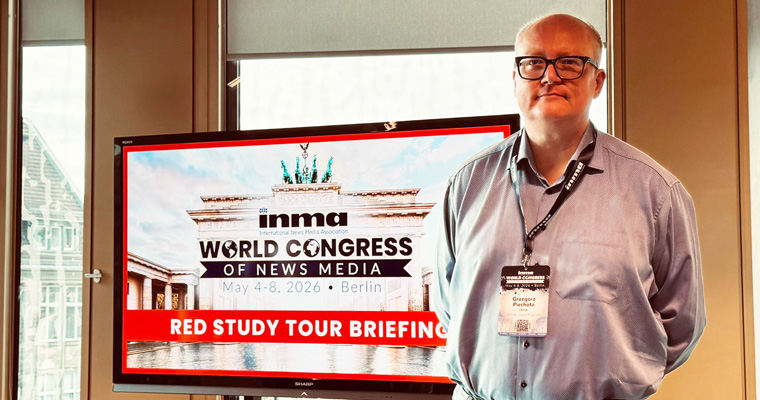
Executives said this structure creates opportunities for local publishers to build strong audience loyalty and differentiated regional identities.
That same thinking also appeared in discussions about advertising and subscriptions, where publishers increasingly described first-party audience relationships as their most valuable strategic asset.
AI pushes local publishers toward utility and service
While many discussions focused on AI risks, publishers also described how artificial intelligence could strengthen local journalism if used to deepen audience relationships rather than replace reporting.
Katja Fleischmann of DPA’s Drive initiative described experiments with AI-powered service journalism, personalised alerts, and community-focused recommendation systems: “We are changing from gatekeepers to companions,” she said. “We are shifting from broadcasting to responding.”
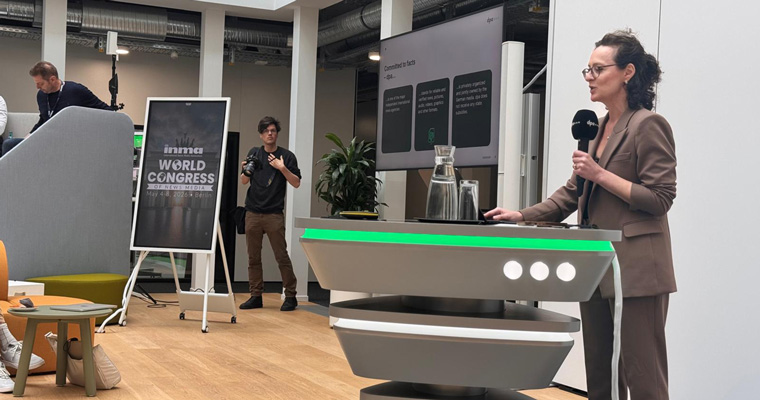
The Drive Local initiative was presented as an example of local publishers pooling resources, research, and infrastructure to explore AI-driven audience products together.
Several executives described this collaborative approach as increasingly necessary because smaller local publishers often lack the resources to independently fund large-scale AI experimentation.
That collaborative logic also shaped discussions at Bonnier News.
Shared infrastructure becomes a survival strategy
During the Subscription Growth Seminar, Bonnier News executives described how the Swedish publisher has spent the past decade consolidating local media companies while building shared technology and subscription infrastructure across dozens of brands.
The company now operates across roughly 70 brands while using common data systems and subscription platforms to improve retention and reduce operational costs.
The goal was not simply to sell discounted bundles, but to deepen engagement across local and national journalism products, executives said.

“We had a strong belief that there was a real potential to get our readers and subscribers to engage with more of our titles, not only one,” said Dilem Güler, director of business development and digital transformation at Bonnier News.
Executives described local journalism as the foundation of that ecosystem rather than a secondary business line. Shared infrastructure, they argued, allows publishers to preserve strong local brands while creating enough scale to survive economically in a fragmented media market.
Local journalism seen as difficult to replicate
By the end of the World Congress, executives repeatedly returned to the same conclusion: in a media environment increasingly shaped by AI-generated information, fragmented distribution, and weakening platform traffic, local journalism may become more valuable precisely because it remains rooted in physical communities, direct relationships, and firsthand reporting.
AI systems may increasingly summarise information, personalise feeds, and automate production workflows. But throughout the week in Berlin, publishers repeatedly described local journalism as something harder to commoditise: trusted human reporting embedded within communities that journalists themselves are part of.
All photos by Robert Downs Photography.
Related Articles
-

Marketers should outsource tasks, not thinking
25 October 2026 -

WSJ executive councils show how publishers build communities th...
19 October 2026 -

AI’s effect on super user math
15 September 2026 -

At Mediacorp’s CNA, loyalty means giving audiences a reason to ...
20 August 2026 -

Tribun Network turns print “dots” into AI-powered insight
20 August 2026 -

Nation Media Group focuses editorial strategy on stories that m...
4 August 2026 -

Briefly News empowers journalists with AI tool suite Nova
4 August 2026 -

Indian Express builds a video-first future around trusted journ...
20 July 2026
Upcoming Events
-

Subscriber Acquisition Master Class
10-17 November 2026
-

Media Advertising Summit
New York, United States
07-10 December 2026
-

AI-Native News Product Master Class
18-25 February 2027
-

Media Subscriptions Summit
Oslo, Norway
08-12 March 2027
-

World Congress of News Media
New York, United States
25-30 April 2027
-

Branded Content & Partnerships Master Class
20-27 May 2027
-

Subscriber Retention Master Class
17-24 June 2027
-

Conferencia Latinoamericana
15-16 July 2027
-

South Asia News Media Festival
New Delhi, India
19-22 July 2027
-

Asia/Pacific News Media Summit
19-20 August 2027
-

CEO Roundtable at Kilkenny
Kilkenny, Ireland
24-26 August 2027
-

Media Innovation Week
Amsterdam, The Netherlands
27 September - 01 October 2027








