

Wikipedia founder Jimmy Wales warns AI will test trust systems, not replace them
World Congress Blog | 06 May 2026

As AI reshapes how audiences discover and consume information, Wikipedia Founder Jimmy Wales told news executives gathered in Berlin for the INMA World Congress of News Media that trust is not a slogan — it is a system that must be deliberately built, defended, and evolved.
Drawing on 25 years of building Wikipedia, Wales framed the platform as a proof point that large-scale, open collaboration can work — but only with rigorous structures for verification, neutrality, and transparency.
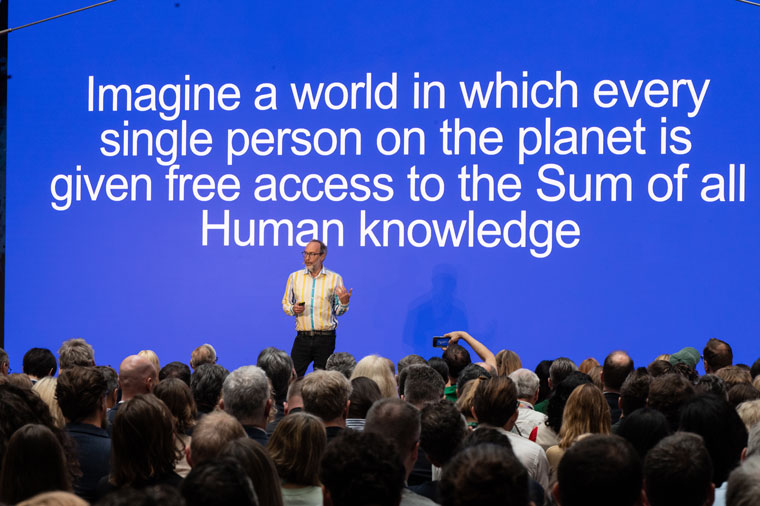
“Imagine a world in which every single person on the planet is given free access to the sum of all human knowledge,” Wales said, repeating Wikipedia’s founding vision.
That vision has scaled to more than 2 billion unique devices monthly, 64 million articles, and more than 300 languages — but its success, he argued, rests on one core principle: trust.
Trust is engineered, not assumed
From its earliest days, Wikipedia faced scepticism. “The whole idea of an encyclopedia written by volunteers is already a little surprising,” Wales said.
To overcome that, Wales said the platform built systems — not messaging — to ensure credibility. These include verifiability through sources, transparent corrections, and a strict commitment to neutrality.
For news organisations, the implication is clear: Trust must be operationalised.
Wales said he can tell when opinions are polarised and said even subtle editorial choices can erode confidence. Using coverage of electric cars as an example, he said he could often identify whether a headline came from The Guardian or The Telegraph based on tone alone.
“I could probably sort [headlines] for you and be 90% accurate,” he said — a pattern he argued “reduces my trust in both papers.”
AI’s limits — and risks — are already visible
While acknowledging the “amazing breakthrough” of large language models, Wales was blunt about their current shortcomings — particularly for journalism and knowledge creation.
“Large language models are really incredible,” he said — but they still “hallucinate quite a lo ” because they are based on plausibility, not fact.
He illustrated this with examples of AI-generated references that appeared credible but were entirely fabricated, including non-existent books with plausible ISBN numbers: “The errors are plausible. You might not think to dig in.”
This creates a new layer of risk for both platforms and publishers: misinformation that looks authoritative.
Wales also dismissed the idea that AI can currently replace journalistic or encyclopedic work.
“It’s one thing to generate some plausible-looking text,” he said. “That’s not quite the same thing as really doing it, doing it well, doing it right.”
AI as a tool, not a publisher
Despite these limitations, Wales sees meaningful opportunities for AI — particularly as a support tool rather than a content generator.
He pointed to use cases such as:
-
Improving search by identifying relevant articles and passages.
-
Auditing content against sources to detect gaps or unsupported claims.
-
Analysing large document sets to surface insights for editors.
In one example, Wales described using AI to review sources at scale, allowing editors to identify patterns — a task that would otherwise take hours.
“You don’t trust this … but you’ve got a tool now to help you,” he said, drawing parallels to investigative journalism.
However, Wikipedia’s community remains firmly opposed to publishing AI-generated text directly to users due to reliability concerns.
Neutrality remains a competitive advantage
At a time of political polarisation, Wales reinforced neutrality as a differentiator — not just for Wikipedia, but for journalism.
The platform’s approach is to present “all of the reasonable sides fairly” without taking a position. This does not mean false balance, he clarified, but rather contextualising viewpoints with credible sourcing.
“Neutrality isn’t some saying, the moon is made of rocks, some say cheese, who knows?” he said.
Instead, it requires judgement, source diversity, and a willingness to interrogate criticism.
“The better approach… is to take a look,” he said when facing accusations of bias. “What can we do better?”
The AI distribution shift is already hitting traffic
Beyond content creation, Wales highlighted a more immediate challenge for publishers: AI is changing how audiences access information.
Wikipedia has already seen an estimated 8% year-on-year decline in human traffic, alongside a drop in contributors. At the same time, AI systems are consuming content at scale — often without delivering traffic back.
“Visitors who would normally read 30 Wikipedia pages in a month are suddenly loading 3,000,” he said, describing how agentic AI systems fetch information at scale on behalf of users — often without those pages ever being seen by a human.
This creates both infrastructure costs and a strategic dilemma for content creators.
The takeaway
Wales’ message to news leaders was not to resist AI, but to focus on what machines cannot replicate: trusted, verified, human knowledge.
“Knowledge is human,” he said, describing Wikipedia’s current campaign.
For publishers, the lesson is clear: in an AI-driven ecosystem flooded with plausible but unreliable information, trust systems — not content volume — will define long-term relevance.
All photos by Robert Downs Photography.
Related Articles
-

Readers’ agents are becoming customers, and most publishers can...
28 October 2026 -

Why publishers are blocking bots by default to starve the black...
28 October 2026 -

What makes an AI choose your news brand?
14 October 2026 -

Licensing won’t save media, but authentication might
13 October 2026 -

INMA report: AI’s dependence on journalism gives publishers new...
30 September 2026 -

When the agent — not the app — becomes the interface
30 September 2026 -

AI is now media’s operating environment
28 September 2026 -

INMA spends 5 days in Madrid learning what actually works
20 September 2026
Upcoming Events
-

Subscriber Acquisition Master Class
10-17 November 2026
-

Media Advertising Summit
New York, United States
07-10 December 2026
-

AI-Native News Product Master Class
18-25 February 2027
-

Media Subscriptions Summit
Oslo, Norway
08-12 March 2027
-

World Congress of News Media
New York, United States
25-30 April 2027
-

Branded Content & Partnerships Master Class
20-27 May 2027
-

Subscriber Retention Master Class
17-24 June 2027
-

Conferencia Latinoamericana
15-16 July 2027
-

South Asia News Media Festival
New Delhi, India
19-22 July 2027
-

Asia/Pacific News Media Summit
19-20 August 2027
-

CEO Roundtable at Kilkenny
Kilkenny, Ireland
24-26 August 2027
-

Media Innovation Week
Amsterdam, The Netherlands
27 September - 01 October 2027








